How SaaS Companies Reduce Churn Through Better UX
Author
Vignesh
Published On

Open with a short, high-impact real-world problem: fast-growing SaaS startups spending heavily on acquisition but losing a similar percentage of MRR each month making growth marginal or negative. Briefly quantify the pain (typical churn ranges, revenue impact) and state the thesis: purposeful UX design and rigorous UX audits are the fastest, most scalable levers to reduce churn, increase LTV, and improve CAC payback. Promise a practical, stage-by-stage UX retention framework, real examples, and measurable outcomes readers can apply immediately. Target keywords: SaaS churn reduction, UX design for SaaS, SaaS retention strategies.
Why Are SaaS Companies Losing Customers Faster Than They Acquire Them?
The SaaS growth model is deceptively fragile. At a 5% monthly churn rate, a company loses more than half its customer base every year even while adding new users. At 8–10% monthly churn, growth is mathematically impossible without unsustainable acquisition spend.
The painful reality: most SaaS churn is predictable, patterned, and preventable.
A 2023 report by ProfitWell found that over 60% of SaaS churn is driven not by pricing or competition, but by product experience failures users who never found value, never formed a habit, or never understood what they were supposed to do next.
This is where UX becomes your most powerful retention lever.
When users struggle to navigate your product, can't find a key feature, or don't experience a meaningful win within their first session, they quietly disengage. No cancellation email. No complaint ticket. Just gone.
The companies winning at retention aren't necessarily building better features. They're building better experiences.
What Is SaaS Churn and Why Does It Matter?
SaaS churn is the rate at which customers stop using or paying for your product over a given period. It's typically measured as:
Customer Churn Rate: Percentage of customers lost in a period
Revenue Churn Rate: Percentage of MRR lost in a period
Net Revenue Churn: Revenue lost minus expansion revenue from existing customers
Why does it matter? Because churn doesn't just stall growth it destroys it.
Consider two companies both growing at 10% MRR monthly:
Company A has 2% monthly churn → Net growth: ~8%
Company B has 7% monthly churn → Net growth: ~3%
Over 24 months, Company A builds nearly 3x the ARR of Company B from the same growth rate. The only difference is retention.
For SaaS companies targeting VC growth or sustainable profitability, reducing churn even by 1–2% compound monthly is worth more than doubling the sales team.
The UX connection is direct: The better a user's experience from onboarding through daily use the longer they stay, the more they expand, and the more likely they are to refer others.
Common UX Problems That Cause SaaS Users to Churn
Most SaaS churn isn't caused by a single catastrophic failure. It's the accumulation of small friction points that erode user confidence and commitment over time.
Confusing or Incomplete Onboarding
First impressions are permanent. Users who don't experience value within their first session often called the "aha moment" rarely come back. Onboarding flows that dump users into empty dashboards, offer no guidance, or front-load configuration tasks create immediate dropout.
Feature Overload Without Context
SaaS teams build features their users want. Then they show them all at once. When users can't identify which feature solves their immediate problem, they default to a simpler competitor. The problem isn't too many features it's poor information architecture and progressive disclosure failure.
Unclear Value Progression
Users need to see they're making progress. If the product doesn't communicate wins completed tasks, goals achieved, milestones reached users feel static. They don't feel like the product is working for them.
Broken or Ignored Mobile Experience
B2B SaaS teams often deprioritize mobile, assuming users only engage on desktop. But product check-ins, notifications, approvals, and casual use happen on mobile. A broken mobile experience signals low product maturity and increases abandon rates.
Poor Error Handling and Feedback Loops
When something breaks or appears to break users with no clear error message or recovery path assume the product is unreliable. Frustration compounds fast when users feel like they're fighting the interface.
Weak Activation Moments
Activation is the moment a user completes a key action that predicts long-term retention. Many SaaS products haven't defined this moment clearly, and therefore haven't designed the experience around it. Without intentional activation design, users wander and leave.
How Better UX Helps SaaS Companies Reduce Churn
UX isn't about aesthetics. For SaaS companies, UX is a revenue architecture decision.
Here's how strategic UX directly reduces churn:
Faster Time-to-Value: When onboarding is designed around a user's goal not the product's feature list users reach their "aha moment" faster. The faster they experience value, the stronger their commitment to continue.
Habit Formation: Well-designed UX creates consistent interaction patterns that build product habits. Users who use a product habitually churn at a fraction of the rate of irregular users.
Reduced Support Load: Clearer UX means fewer support tickets, less frustration, and fewer users abandoning the product mid-task. Every confusion point your UX eliminates is a retained customer.
Expansion Triggers: Strategic UX surfaces advanced features at the right moment when users are ready for them, not overwhelmed by them. This drives natural expansion revenue and increases plan upgrades.
Emotional Trust: Polished, consistent design builds subconscious trust. Users who trust the product's reliability, responsiveness, and clarity are significantly less likely to evaluate competitors.
The compounding effect is measurable: improving UX across the user lifecycle doesn't just reduce churn it increases referrals, accelerates expansion, and reduces CAC over time.
A UX Retention Framework for SaaS Companies
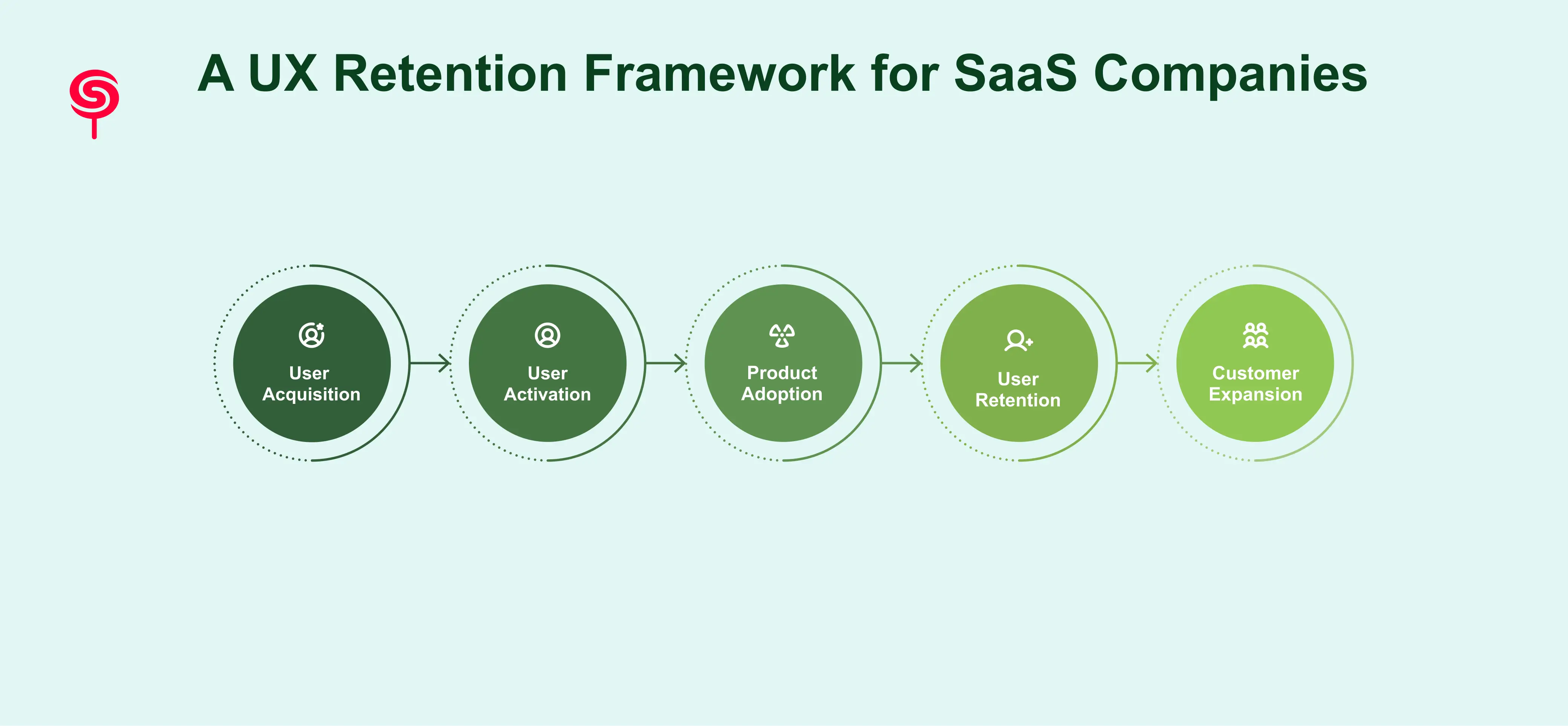
At CandyStudio, we've developed a five-stage UX Retention Framework designed specifically for SaaS products. Each stage maps to a specific user journey phase and identifies the highest-leverage UX interventions.
Stage 1 — User Acquisition
The UX goal: Set accurate expectations before the first login.
Churn begins before the product is even opened. If your marketing promises a simple, fast experience but the product is complex and slow to configure, cognitive dissonance triggers early abandonment.
Key UX interventions at this stage:
Landing pages that reflect real product UI, not idealized mockups
Transparent pricing and feature scoping
Frictionless sign-up flows (minimize required fields, enable SSO, skip unnecessary verification steps)
Segmented onboarding entry capture user role and goal at signup to personalize the activation path
Stage 2 — User Activation
The UX goal: Deliver the "aha moment" within the first session.
Activation is the highest-leverage stage in the entire retention journey. Users who activate churn at rates 3–5x lower than those who don't.
Key UX interventions at this stage:
Define a single, measurable activation event specific to your product
Design a guided onboarding flow that leads directly to that event
Use empty-state design to communicate possibility, not emptiness
Remove every unnecessary step between signup and first value
Deploy contextual tooltips and checklists not modal popups that interrupt flow
Stage 3 — Product Adoption
The UX goal: Build regular use patterns across core features.
Adoption means users are integrating your product into their workflow. UX failures here include burying key features, inconsistent navigation, and no in-app learning paths.
Key UX interventions at this stage:
Implement progressive disclosure reveal advanced features only when users are ready
Design feature discovery through contextual cues, not feature announcements
Build in-app education moments tied to user behavior (e.g., a tooltip that appears when a user could benefit from an unused feature)
Create clear navigation hierarchies with consistent mental models
Stage 4 — User Retention
The UX goal: Sustain engagement, value perception, and habit formation over the long term.
Retention UX goes beyond usability it's about making users feel the product is growing with them.
Key UX interventions at this stage:
Regular value communication: show users their progress, usage metrics, outcomes achieved
Proactive UX: use behavioral signals to identify at-risk users and trigger re-engagement flows
Design notification and communication systems that add value without creating fatigue
Conduct regular UX audits to catch friction points accumulating at scale
Stage 5 — Customer Expansion
The UX goal: Surface higher-tier features and adjacent use cases at the moment of maximum readiness.
Expansion revenue is the most profitable revenue in SaaS. UX drives it by creating natural upgrade moments.
Key UX interventions at this stage:
In-app upsell triggers designed around behavioral signals, not calendar dates
Feature gating that communicates value, not restriction
Clear upgrade paths with visual, frictionless transitions
Collaborative features and team-based workflows that increase account stickiness
UX Improvements That Reduced Churn for SaaS Companies
The connection between UX investment and churn reduction is well-documented across the SaaS industry.
Slack famously obsessed over onboarding clarity. Early versions of Slack required teams to send 2,000 messages before they were counted as truly "activated." Every UX decision in the early product was evaluated against that benchmark. The result: a product with industry-leading retention in the enterprise collaboration space.
Intercom restructured its onboarding to front-load a single compelling use case rather than exposing all features at once. By simplifying the initial product experience, they saw measurable improvements in trial-to-paid conversion and early-stage retention.
Duolingo while not a traditional SaaS pioneered streak mechanics and progress visualization as UX retention tools. Its influence on habit-forming product design has been widely adopted by SaaS products looking to drive daily active use.
Canva reduced time-to-first-design aggressively pre-loading template options and minimizing blank-canvas anxiety. The result was faster activation, stronger habit formation, and dramatically reduced early churn among new users.
What these companies share isn't unlimited budget. It's a systematic approach to identifying UX friction points and eliminating them through research, testing, and iteration exactly the process a professional UX audit enables.
Business Results SaaS Companies Can Expect from Better UX
When SaaS companies treat UX as a strategic growth lever rather than a design expense, the business outcomes are significant and compounding.
Churn Reduction: SaaS companies that conduct structured UX audits and implement strategic improvements typically see 15–30% reductions in early-stage churn within the first two quarters.
Increased Trial-to-Paid Conversion: Improved onboarding UX directly impacts conversion rates. Smoother activation flows reduce drop-off between free trial and first payment.
Higher Net Promoter Score (NPS): Users who have positive, intuitive product experiences are significantly more likely to recommend the product. NPS improvements of 20–40 points are common following comprehensive UX redesigns.
Lower Customer Acquisition Cost (CAC): When retained customers refer others and trial conversions improve, the effective cost of each new acquired customer drops compounding ROI from a single UX investment.
Expanded Lifetime Value (LTV): Retained customers upgrade, expand usage, and purchase adjacent products. A reduction in churn by even 2% can increase average LTV by 25–40% depending on your pricing structure.
Operational Efficiency: Fewer support tickets, reduced customer success load, and lower manual intervention rates follow directly from UX improvements. Your team spends less time rescuing struggling users and more time driving growth.
These aren't hypothetical gains. They're the documented outcomes of treating UX with the same strategic seriousness as your GTM motion, your pricing model, or your infrastructure.
Conclusion
Churn is not a marketing problem. It is not a pricing problem. At its core, most SaaS churn is a user experience problem one that compounds quietly until it becomes a growth crisis.
The SaaS companies consistently leading their categories have made one critical strategic decision in common: they invest in understanding and improving how their users experience the product. They conduct structured UX audits, eliminate friction from the activation journey, and build retention mechanics into the product architecture itself.
The five-stage UX Retention Framework Acquisition, Activation, Adoption, Retention, Expansion gives SaaS teams a structured way to identify where experience is breaking down and what to fix first.
If your SaaS product is experiencing churn you can't fully explain, struggling with trial-to-paid conversion, or watching hard-won users disengage before they reach their full value, the answer is almost always found in a thorough UX audit.
Frequently Asked Questions
1. What is the relationship between UX design and SaaS churn?
UX design directly affects how easily users find value in your product. Poor UX creates friction that prevents users from reaching activation milestones, forming habits, or expanding their usage all of which are the primary behavioral predictors of churn. Improving UX is one of the highest-ROI strategies for reducing SaaS churn.
2. How does a UX audit help reduce SaaS churn?
A UX audit systematically identifies friction points across the user journey from onboarding and activation through daily use and expansion. By pinpointing exactly where users are dropping off, struggling, or disengaging, a UX audit gives SaaS teams a prioritized roadmap of the highest-impact experience improvements to implement.
3. What is a good SaaS churn rate?
For B2B SaaS, annual churn rates below 5–7% are generally considered healthy. Monthly churn rates above 2% typically signal underlying product or experience problems that require attention. Best-in-class SaaS companies particularly enterprise-focused ones target annual churn below 1%.
4. What metrics should SaaS companies track for retention?
Key metrics include:
Churn Rate
Customer Retention Rate
Activation Rate
Product Adoption Rate
Customer Lifetime Value (CLTV)
Net Revenue Retention (NRR)
Time-to-Value (TTV)
Share this blog!
Latest Blogs
Explore our latest insights on design, AI, and digital innovation.