UX Design Audit process: Identify What's Killing Your Conversions
Author
Vignesh
Published On
Your product works but it’s not converting. Somewhere between onboarding and the pricing page, users drop off without explanation.
This guide explores how a UX design audit for startups uncovers hidden friction, identifies conversion blockers, and improves user experience across critical flows. Learn why teams miss key usability issues, what a professional UX audit process reveals, and how it drives measurable business outcomes higher trial-to-paid conversions, lower churn, faster feature adoption, and scalable growth.
What a UX Design Audit Actually Does
A UX audit for startups is not just a design review it’s a structured analysis of how users experience your product and where that experience breaks down.
It connects user behavior with business outcomes.
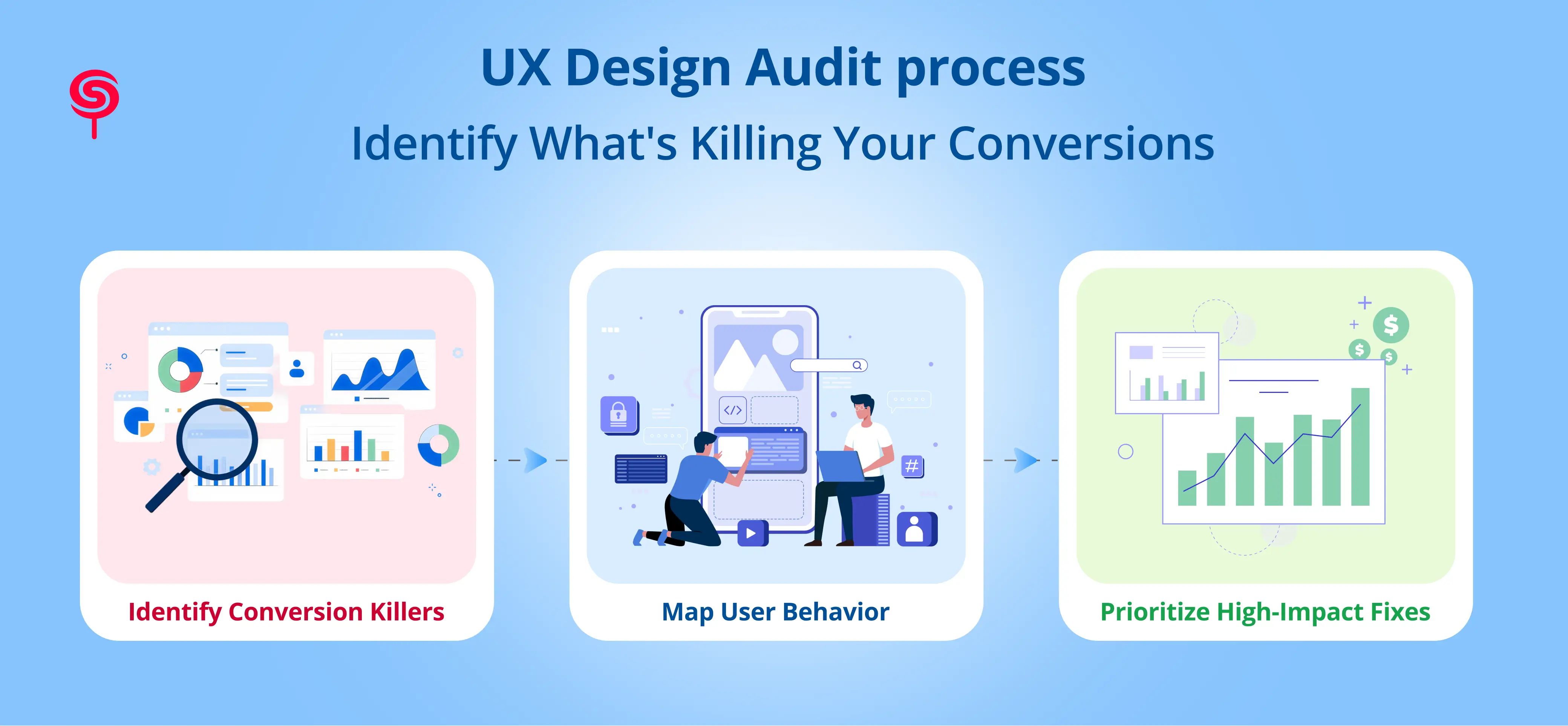
1. Identify Conversion Killers
A UX audit maps every decision point in your user's journey and tests it against established usability principles, behavioral data, and real user expectations. It surfaces friction that's suppressing activation, blocking feature adoption, and driving trial abandonment. These are your conversion killers and once named, they're fixable.
2.Map User Behavior
Good audits don't just analyze screens they reconstruct the user's experience from entry to exit. This means understanding mental models: what users expect to happen when they click something, where they look first, what confuses them, and what builds their confidence to take the next step. Mapping this behavior gives your team a shared, accurate picture of the user experience as it actually exists not as it was designed.
3. Prioritize High-Impact Fixes
The most valuable output of a professional UX audit is not the list of problems it's the prioritized action plan. Not all UX issues have equal business impact. A confusing dashboard tooltip is not the same problem as a broken trust signal on your pricing page. A UX audit distinguishes between critical blockers, moderate friction points, and low-priority polish items, so your engineering and design resources go to the right place first..
Your Product Isn't Broken But It's Not Converting
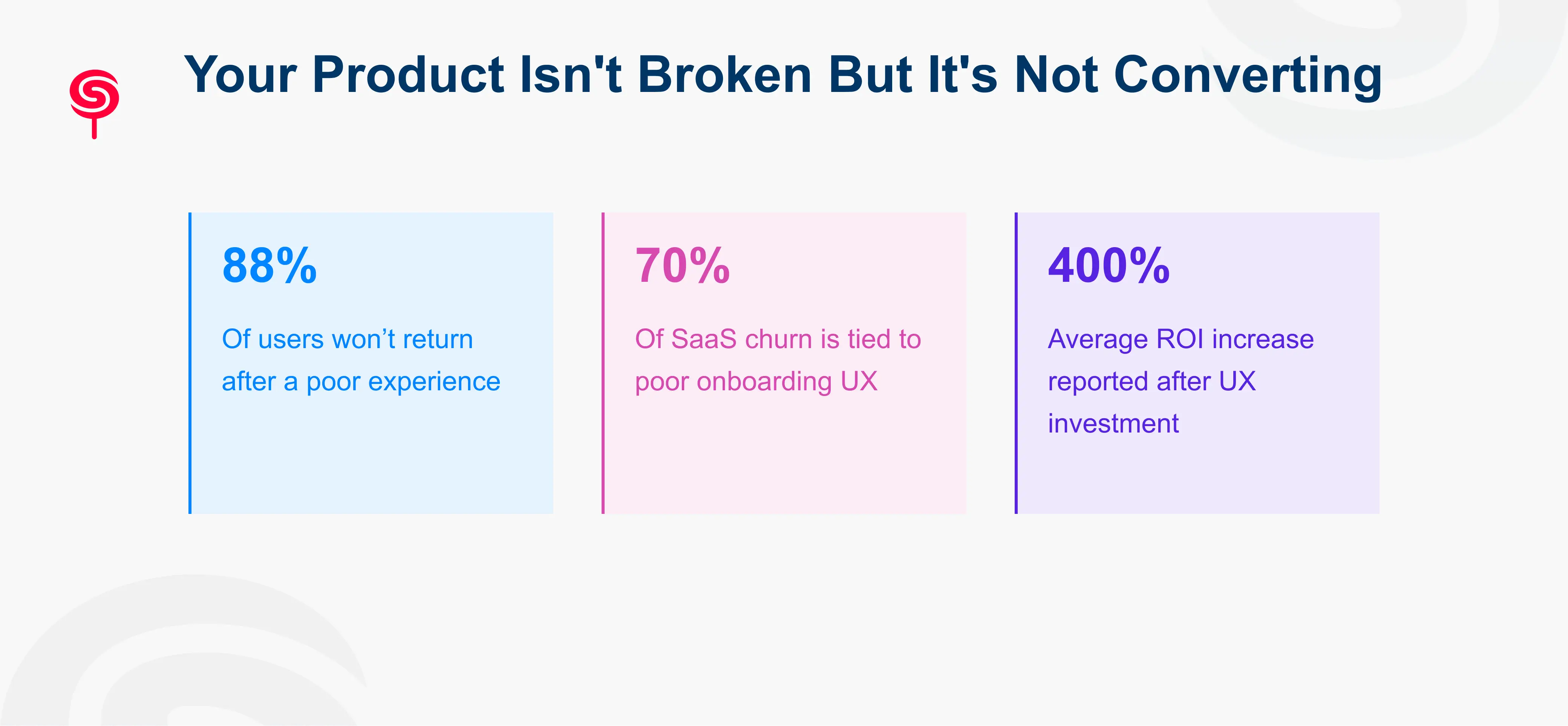
Somewhere between your onboarding flow and your pricing page, users are disappearing. They signed up, they explored and then they left. Your product didn't crash. Your server didn't go down. The bug tracker shows nothing critical. And yet, the numbers tell a quieter, more costly story.
This is the most dangerous kind of product problem: invisible friction. It doesn't trigger alerts. It doesn't show up in support tickets. It silently accumulates in your churn rate, your trial-to-paid conversion gap, and your activation metrics. For startups especially, this is a growth ceiling disguised as a plateau.
The instinct is to build more more features, more onboarding steps, more tooltips. But when conversion is the problem, adding complexity rarely solves it. What you actually need is diagnostic clarity: an honest, structured look at where your user experience breaks down. That's precisely what a UX design audit delivers.
Why Startups Miss UX Issues
Most startup teams aren't ignoring UX they just can't see the problems clearly. There are three structural reasons this happens, and they reinforce each other.
1. You're Too Close to the Product
Founders and core teams build mental shortcuts into their understanding of the product. You know where every button leads. You know what that icon means. Your users don't. When you click through your own product, you're not experiencing it you're remembering it. This cognitive proximity blinds even the most user-focused teams to friction that is immediately obvious to a first-time visitor.
2. Data Without Context
Analytics tell you what is happening drop-off rates, scroll depth, click heatmaps. They don't tell you why. A 60% abandonment rate on your checkout page is alarming data. But does it mean the pricing is confusing? The form is too long? The trust signals are missing? Without behavioral context and usability analysis layered on top, quantitative data is directional at best and dangerously misleading at worst.
3. Feature Overload
Every startup reaches a stage where the product has been patched, extended, and iterated to the point where its original user logic no longer holds. New features get bolted onto old navigation structures. Edge cases accumulate into cluttered interfaces. The product that once felt clean and purposeful now feels like it was designed by a committee because, in a sense, it was. Recognizing this from the inside is nearly impossible without external, structured evaluation.
How a UX Audit Works
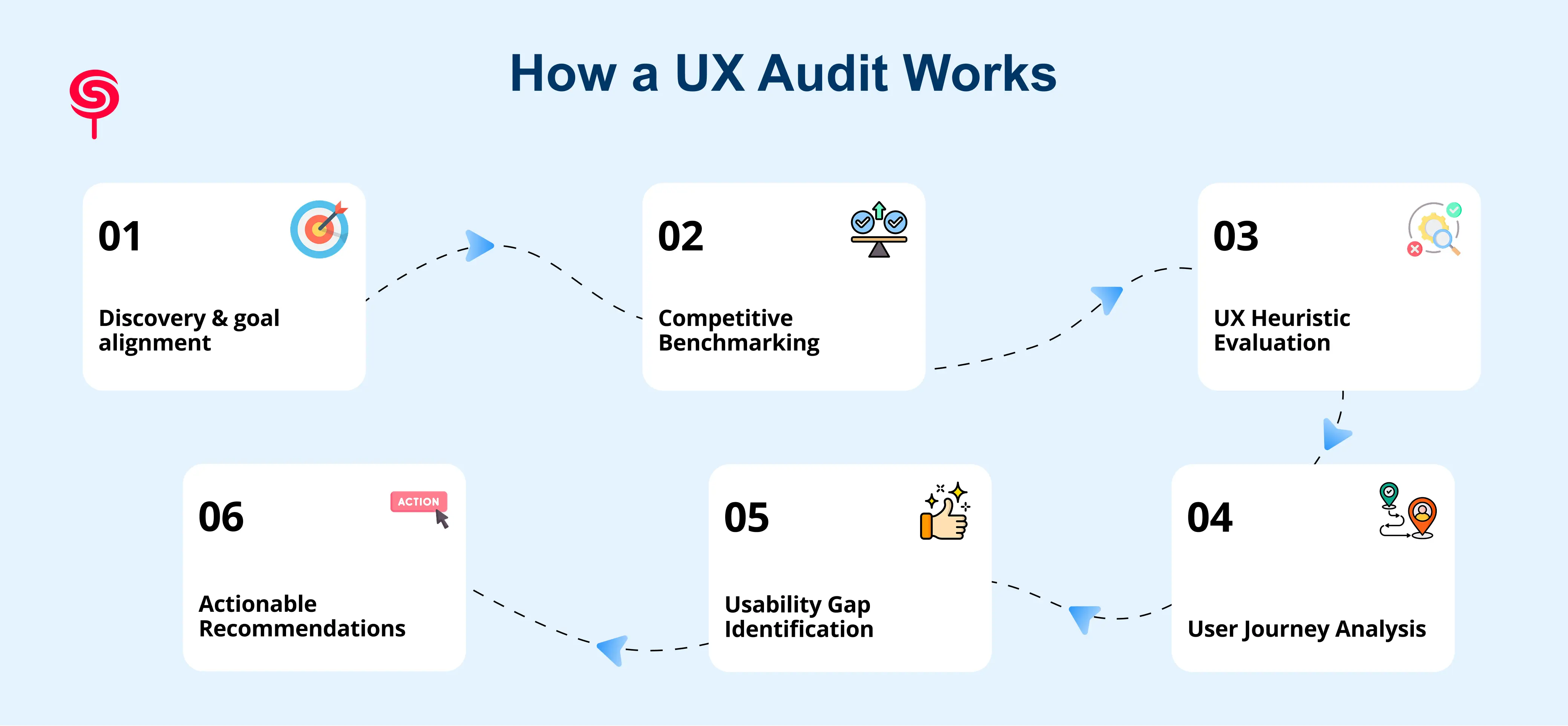
A UX audit follows a structured methodology. At a premium design agency, this process is not templated it's calibrated to your product, your users, and your specific business goals.
Step - 1: Discovery and Goal Alignment
Discovery & Goal Alignment is the foundational pre-audit phase that happens before any screen is evaluated or user journey is mapped. It's the stage where the UX team stops, listens, and aligns deeply with the business before doing any diagnostic work.
Step - 2: Competitive Benchmarking
Competitive benchmarking is the process of comparing your product’s user experience with direct and indirect competitors to understand where you stand and where you’re falling behind.
Step - 3: UX Heuristic Evaluation
Every screen, user-flow, and interaction is evaluated against established usability heuristics Nielsen's 10 principles, Gestalt laws of perception, and platform-specific interaction patterns. This gives an expert baseline of what's working and what violates the fundamental rules of good design. Issues are catalogued by severity and type.
Step - 4: User Journey Analysis
The audit reconstructs your product's core user journeys onboarding, activation, key feature discovery, upgrade path and stress-tests each stage. This step overlays behavioral analytics (session recordings, funnel drop-off data, heatmaps) with qualitative insight to understand the emotional and cognitive load at each step. Where does confidence break? Where does confusion spike?
Step - 5: Usability Gap Identification
This is where the audit moves from observation to diagnosis. Each identified issue is analyzed in terms of its root cause is it an information architecture problem? A visual hierarchy failure? A missing feedback mechanism? Understanding the type of problem determines the correct solution and prevents surface-level fixes that don't address structural issues.
Step - 6: Actionable Recommendations
The final deliverable is not a slide deck of observations it's a strategic action plan. Each recommendation comes with the business rationale, the specific UX principle it addresses, implementation complexity, and projected impact. You leave the audit knowing exactly what to fix first, why, and how to validate the improvement after release.
Why UX Audits Drive Business Growth
Let's be direct: a UX audit is not a design expense. It's a revenue optimization investment. For startups operating with limited runway, the ability to stop guessing and start fixing with precision is the difference between a product that scales and one that stalls.
The compounding effect of improved UX on business metrics is well-documented across SaaS categories. When users can navigate intuitively, reach their goals faster, and understand your product's value without friction they convert, they stay, and they refer. Each UX improvement you make isn't just a design win.
Frequently Asked Questions
1. What is a UX design audit and why does my startup need one?
A UX design audit is a structured evaluation of your product's user experience covering usability, user flows, interface design, and conversion pathways. Startups need one when growth stalls despite a functional product, when conversion rates underperform, or when user behavior data signals friction but doesn't explain it. It gives you evidence-based clarity on exactly what to fix and in what order.
2. When is the right time for a startup to get a UX audit?
The right time is before a major redesign, before a Series A raise, after reaching product-market fit but before scaling acquisition spend, or whenever conversion metrics are underperforming relative to traffic quality. Auditing before scaling is far more cost-effective than fixing UX problems after you've built paid acquisition on top of a broken funnel.
3. What business outcomes can I expect after a UX audit?
Measurable outcomes vary by product stage, but common results include improved trial-to-paid conversion rates, reduced churn in the first 30 days, faster feature adoption, reduced support volume, and higher NPS. The audit itself doesn't deliver these implementing the prioritized recommendations does.
4. Can a UX audit help with SaaS onboarding specifically?
Yes, onboarding is one of the highest-impact areas a UX audit addresses. Most SaaS churn occurs before users reach activation, and the onboarding experience is the primary driver. An audit evaluates your onboarding for clarity, progression logic, cognitive load, and value demonstration and recommends specific improvements to increase the percentage of users.
5. What’s the difference between UX audit and usability testing?
A UX audit is an expert-led evaluation, while usability testing involves real users interacting with the product. Both complement each other.
Share this blog!
Latest Blogs
Explore our latest insights on design, AI, and digital innovation.