UX Problems That Kill SaaS Trial-to-Paid Conversions
Author
Vignesh
Published On
You've done the hard part. Your paid acquisition is working. Organic traffic is climbing. Trial signups are coming in.
But somewhere between "Start Free Trial" and "Upgrade Now," users vanish.
For most SaaS founders and product teams, this isn't a marketing problem. It's not a pricing problem. It's a UX problem hiding in plain sight embedded in every confusing onboarding flow, every buried feature, every moment a trial user thinks, "I have no idea what I'm supposed to do next."
The global SaaS market is projected to exceed $700 billion by 2030, yet industry benchmarks consistently show that average trial-to-paid conversion rates hover between 2% and 5%. That means the majority of your trial users people who already showed enough intent to sign up are leaving without ever experiencing the value you built.
This post breaks down the 10 UX problems most responsible for killing SaaS trial-to-paid conversions, explains why most teams never see them coming, and shows you the exact audit framework CandyStudio uses to diagnose and eliminate conversion friction before it compounds into a revenue crisis.
The SaaS Conversion Problem Most Teams Don't See Coming
Most SaaS teams track conversion rates. Far fewer teams understand why those rates look the way they do.
The instinctive response to flat conversions is to push more traffic: run more ads, invest in more content, negotiate more partnerships. But if your product experience is leaking users at every step of the trial journey, pouring in more traffic only accelerates the loss.
The harder truth is this: the UX layer between signup and upgrade is where most SaaS growth strategies silently fail.
Unlike a broken payment gateway or a 404 error, UX friction is invisible in your analytics dashboard. It doesn't trigger an alert. It just quietly accumulates in the form of trial users who clicked around for 20 minutes, found the product confusing, and never came back.
This is what makes B2B SaaS UX design a strategic discipline, not a cosmetic one. Every interface decision every label, every workflow, every empty state either moves a trial user toward their first "aha moment" or pushes them one step closer to churning.
Why Trial Users Leave Before Becoming Customers
Trial users are not committed customers. They are skeptical, time-poor, and surrounded by alternatives.
When a trial user signs up for your product, they are not thinking, "I hope this works." They are thinking, "I have 10 minutes to figure out if this is worth my time." Every second of confusion, every unnecessary click, every moment of uncertainty about what to do next costs you that window.
Here's what research and conversion data consistently show:
Friction in the first session is fatal. If users don't reach a meaningful outcome within their first interaction, the probability of them returning drops sharply.
Users don't read they scan. Complex interfaces with heavy onboarding flows get abandoned. Users need to feel competent inside your product, fast.
Trust is fragile at the trial stage. Users haven't invested money yet. Their commitment is low. Any moment of confusion reinforces their permission to leave.
For B2B SaaS specifically, the stakes are even higher. Trial users are often evaluating your product on behalf of a team or organization. A confusing experience doesn't just lose an individual it loses a company account.
Hidden UX Friction Points That Kill SaaS Growth
Most conversion problems are not dramatic. Users don't rage-quit. They just quietly stop engaging.
The most damaging UX friction in SaaS products is the kind that:
Doesn't generate support tickets because users can't articulate the problem, they just leave
Doesn't show up in session recordings because the drop happens before users get deep enough into the product
Doesn't appear in NPS surveys because churned trial users rarely fill them out
This hidden friction lives in micro-moments: a CTA that doesn't clearly communicate value, a navigation structure that buries a key feature, a pricing page that creates doubt instead of clarity.
These aren't catastrophic failures. They're a thousand small paper cuts that, together, kill your conversion rate.
How Poor UX Impacts Revenue Beyond Conversions
The revenue impact of poor SaaS UX is not limited to trial-to-paid conversion rates.
Customer Acquisition Cost rises. When conversions are low, your CAC-to-LTV ratio deteriorates. You're spending more to acquire customers who deliver less.
Expansion revenue shrinks. Users who struggle during trial become customers who never fully adopt your product. They stay on minimum plans, never discover advanced features, and churn at renewal.
Referral and word-of-mouth dries up. B2B SaaS growth is heavily driven by referrals. Users who never reached value during trial don't become advocates they become cautionary tales.
Sales cycles lengthen. In PLG (product-led growth) models, poor trial UX forces more user journeys into sales-assisted paths inflating your cost to close.
Poor SaaS product design is not a user experience problem. It is a business model problem.
10 UX Problems That Kill SaaS Trial-to-Paid Conversions
1. Complicated Signup and Onboarding Flows
The moment a user hits friction before they've seen any value, you've lost the most critical battle in your conversion journey. Long signup forms with excessive required fields, mandatory credit card entry before value is demonstrated, multi-step email verification chains, and lengthy "Tell us about yourself" questionnaires all introduce resistance before users have any reason to trust you.
The fix: Reduce signup to the absolute minimum required to personalize the first experience. Delay progressive profiling until after users have had their first meaningful product moment. Use social login where possible, and eliminate credit card requirements for core trial flows.
2. Unclear Value Proposition During Trial
Users know why they signed up. What they don't know is how to get there inside your product. If your trial experience doesn't continuously remind users of the specific value they're trying to achieve and visibly guide them toward it they default to confusion.
The fix: Make your core value proposition visible throughout the trial. Use contextual messaging that connects feature usage to business outcomes. Frame empty states as value invitations, not blank voids.
3. Poor First-Time User Experience
The first session is your most important UX real estate. Yet many SaaS products drop users into feature-dense dashboards with no guidance, no clear starting point, and no orientation around what matters most. Users who don't know where to start quickly conclude that the product is complicated and complicated products don't get adopted.
The fix: Design a deliberate first-run experience that reduces cognitive load, celebrates early wins, and gives users a single, clear "next action." Your product tour isn't onboarding it's a distraction. Contextual, task-specific guidance is what creates momentum.
4. Feature Overload Instead of Guided Adoption
SaaS teams build features. That's what product teams do. But showing new trial users every capability your product has is not a demonstration of value it's a recipe for overwhelm. Feature overload during trial creates analysis paralysis, increases cognitive load, and makes users feel like they need to "learn" your product before they can use it.
The fix: Progressive disclosure. Show users what they need at each stage of their adoption journey, not everything you've ever built. Design activation paths that lead users through a core workflow before introducing advanced capabilities. Depth comes after commitment.
5. Missing Activation Moments
Activation is the moment when a trial user first experiences the core value your product delivers. For task management tools, it might be the first time a team member responds to an assigned task. For analytics platforms, it might be the first time a dashboard loads with real data. Missing activation moments or making them hard to reach is the single most direct cause of trial churn.
The fix: Define your product's activation event. Map the shortest path from signup to that moment. Ruthlessly remove every step that isn't essential to reaching it. Then instrument your analytics to measure time-to-activation, and relentlessly optimize it.
6. Confusing Navigation and Information Architecture
Navigation confusion is one of the most common and least diagnosed UX problems in SaaS products. When users can't find what they're looking for or when the navigation structure reflects internal engineering logic rather than user mental models they waste time, lose confidence, and disengage.
The fix: Conduct card sorting and tree testing exercises with real users to validate your information architecture. Use analytics to identify the navigation paths where users consistently get lost. Rename labels to match user vocabulary, not internal product terminology.
7. Lack of Contextual Guidance and User Education
In-app guidance is not a nice-to-have. For complex B2B SaaS products, it is a conversion-critical capability. Users who encounter friction and can't find help don't open support tickets they leave. Help content buried in documentation wikis is not contextual guidance. It is a library that users have to want to visit.
The fix: Embed guidance where users experience friction, not where it's easiest for your team to maintain. Use tooltips, inline help text, short explainer videos, and contextual checklists to support users at the exact moment they need help inside the product, not outside it.
8. Weak Trust Signals and Product Credibility
Trial users are evaluating your product before they've made a financial commitment. Everything inside your product design quality, data security messaging, social proof, testimonials, case studies, certifications either reinforces or erodes their confidence in your product's legitimacy.
The fix: Integrate trust signals throughout the trial experience. Display security certifications, compliance indicators, and usage statistics in context. Add customer testimonials near upgrade prompts. Ensure that your product's visual design quality communicates competence and reliability.
9. Pricing and Upgrade Confusion
The moment a trial user becomes interested in upgrading, your pricing UX must be flawless. Confusing plan structures, unclear feature differentiation between tiers, surprise pricing reveals, and upgrade flows that feel like traps all of these destroy conversion intent at the last possible moment.
The fix: Make the path from trial to paid frictionless and obvious. Use upgrade prompts that clearly articulate the specific value unlocked at the next tier. Eliminate pricing page confusion by reducing plan options, using plain language, and providing contextual recommendations based on the user's usage patterns.
10. Mobile Experience Neglected During Trial
For B2B SaaS, mobile is often an afterthought. But decision-makers in your target audience frequently evaluate products during commutes, between meetings, and on weekends. A broken or degraded mobile trial experience communicates that your product is not serious and that its development team doesn't prioritize quality.
The fix: Audit your trial experience across all device contexts your users actually use. If a full mobile experience isn't feasible, design a deliberate mobile-limited state that communicates value and redirects users to desktop effectively, rather than rendering a broken version of the full interface.
How UX Audits Identify Conversion Bottlenecks Before They Impact Revenue
A structured UX audit is not a design review. It is a revenue protection exercise.
The purpose of a UX audit in the context of SaaS trial-to-paid conversion is to:
Map the complete trial user journey from first touch to upgrade decision
Identify friction events moments where users experience confusion, resistance, or disengagement
Quantify the revenue impact by connecting UX friction to measurable drop-off rates and conversion gaps
Prioritize fixes by ROI not by design preference, but by the revenue value of each improvement
At CandyStudio, our UX audits combine behavioral analytics, heuristic evaluation, user session analysis, and stakeholder interviews to build a complete picture of where your product is leaking trial users and exactly what to do about it.
A UX Audit Framework for Improving Trial-to-Paid Conversions
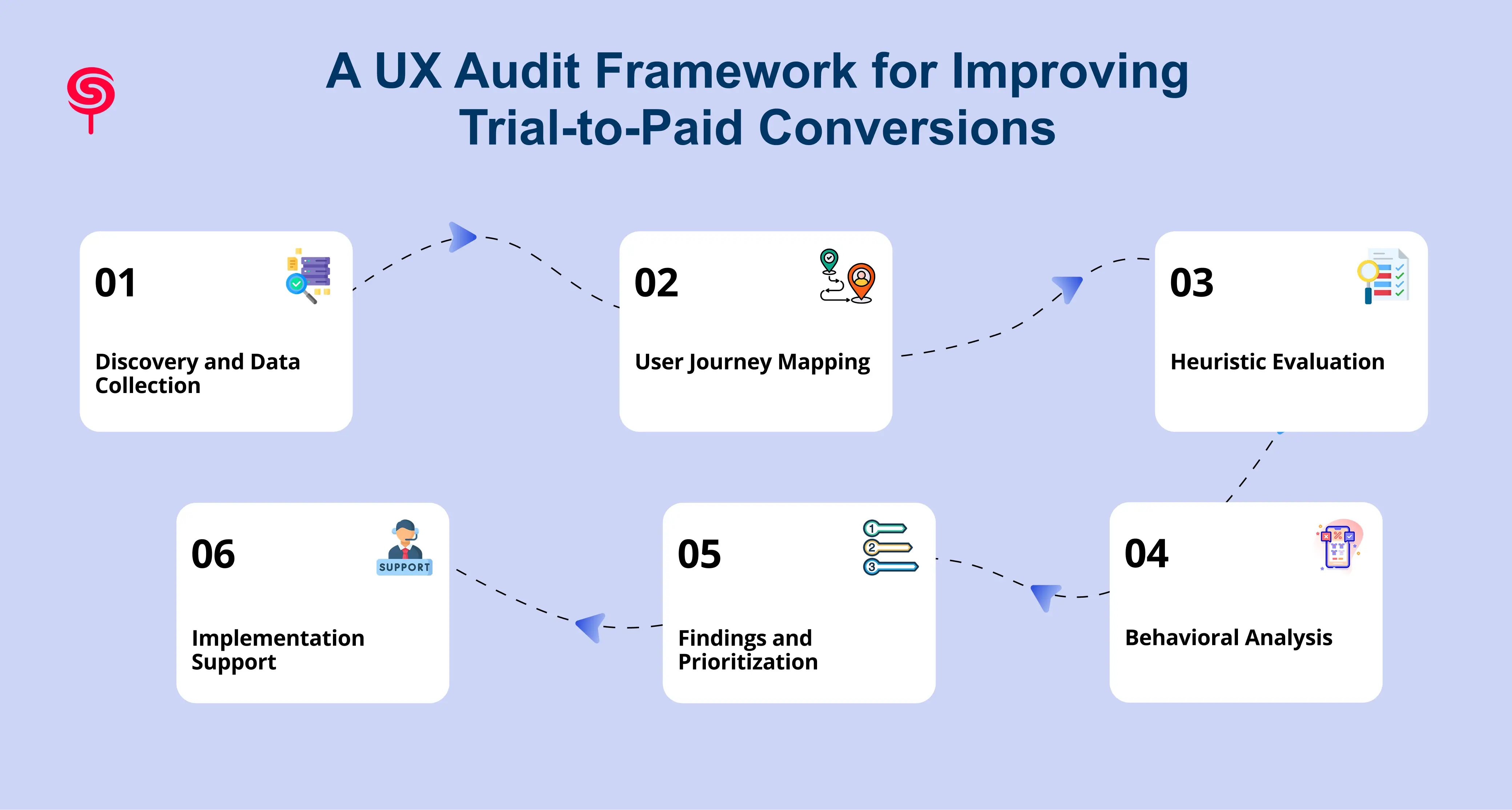
Phase 1 — Discovery and Data Collection
Review existing analytics: funnel drop-off rates, time-to-activation, feature adoption heat maps
Conduct stakeholder interviews to understand product intention vs. user reality
Establish conversion baseline metrics.
Phase 2 — User Journey Mapping
Document the complete trial-to-paid journey across all user segments
Identify key activation moments, upgrade triggers, and churn signals
Map emotional states at each journey stage (friction, confidence, confusion, motivation)
Phase 3 — Heuristic Evaluation
Evaluate product against established UX heuristics (Nielsen's 10 Usability Heuristics, WCAG 2.1 standards)
Assess onboarding flows, navigation architecture, and information hierarchy
Review all empty states, error states, and edge case experiences
Phase 4 — Behavioral Analysis
Analyze session recordings to identify where users struggle
Review heatmaps and click maps for navigation confusion signals
Conduct cohort analysis to distinguish high-converting vs. churning user behaviors
Phase 5 — Findings and Prioritization
Compile audit findings with severity ratings (critical, high, medium, low)
Map each finding to estimated revenue impact
Deliver a prioritized roadmap of UX improvements ranked by conversion ROI
Phase 6 — Implementation Support
Provide design recommendations and prototypes for high-priority fixes
Support development teams through implementation
Establish measurement plan to track improvement impact.
Business Outcomes of Fixing SaaS UX Problems
SaaS teams that invest in structured UX optimization consistently see measurable business outcomes:
Higher trial-to-paid conversion rates. Removing activation friction and clarifying value proposition during trial directly increases the percentage of trial users who convert to paid plans.
Shorter time-to-value. Faster activation means more users experience the core product value before their trial expires dramatically improving conversion probability.
Reduced customer acquisition cost. When more trial users convert organically, your CAC drops without requiring increased ad spend or headcount.
Increased average revenue per user. Users who fully activate during trial are more likely to adopt advanced features, expand their seat count, and upgrade to higher-tier plans.
Lower churn rates. Users who fully understand and adopt your product during trial become committed, engaged customers not disengaged subscribers waiting for a reason to cancel.
Stronger product-led growth momentum. A frictionless trial experience creates the foundation for true PLG: users who discover value independently, upgrade without sales involvement, and advocate for your product within their networks.
These aren't theoretical outcomes. They are the measurable results that CandyStudio clients see when systematic UX improvements are applied to their trial-to-paid conversion funnel.
Conclusion
Your trial conversion rate is not a marketing metric. It is a UX metric in disguise.
Every percentage point gap between your current trial-to-paid rate and what's achievable represents real revenue that your product is currently failing to capture not because your product doesn't work, but because the experience of discovering that it works is broken.
The 10 UX problems outlined in this post are not hypothetical. They are the specific, recurring patterns that CandyStudio audits identify in B2B SaaS products across industries, company stages, and product categories.
Frequently Asked Questions
1. Can UX improvements alone significantly increase my SaaS trial-to-paid conversions?
Yes, for most SaaS products, UX is the single highest-leverage conversion optimization variable. When the core product value is genuine and the market fit is validated, the gap between sign-up intent and paid conversion is almost always explained by UX friction. Systematic UX improvements routinely produce 20%–50% lifts in trial-to-paid conversion rates for products that previously had undiagnosed experience issues.
2. What's the difference between onboarding UX and activation UX in SaaS products?
Onboarding UX refers to the full process of orienting new users within your product account setup, interface familiarity, feature discovery. Activation UX specifically refers to the designed experience of guiding users to the moment they first receive the core value of your product. Activation is the single most conversion-critical event in the trial journey, and optimizing it delivers disproportionate impact on trial-to-paid rates.
3. How do I know if poor UX is responsible for my low trial-to-paid conversion rate?
If your trial sign-up volume is healthy but conversion rates are below 5%, if trial users engage briefly then disengage, if you're receiving frequent "I couldn't figure out how to..." support requests, or if your time-to-activation is longer than your trial period these are strong indicators that UX friction is a primary driver of conversion loss.
4. How can SaaS companies improve activation rates?
By simplifying onboarding, creating guided experiences, and helping users achieve meaningful outcomes faster.
Share this blog!
Latest Blogs
Explore our latest insights on design, AI, and digital innovation.