Struggling With Product-Market Fit? Start With Prototype Testing
Author
Vignesh
Published On
You've spent months building a SaaS product. Your team has shipped features, debugged edge cases, and refined the UI until it felt polished. You've done the pitch decks, the investor calls, the beta launch.
And yet users aren't converting. Retention is shaky. Growth is flat. This isn't a marketing problem. This isn't a hiring problem. This is a product-market fit problem and it's far more common than the startup world admits.
According to CB Insights, 35% of startups fail because there's no market need for their product. Not because the technology was bad. Not because the founders lacked hustle. Simply because nobody needed what was built.
The brutal irony? Most of these failures could have been prevented much earlier before the code was written, before the budget was burned, before the team was exhausted with one discipline that too many founders skip: prototype testing.
This guide is written for SaaS founders, product leaders, and startup teams who are serious about reaching product-market fit faster, with less waste and more certainty. We'll break down exactly why prototype testing is the highest-leverage activity in your product development process and how CandyStudio has helped startups validate ideas before they become expensive mistakes.
Why Product-Market Fit Is So Hard to Achieve
Product-market fit (PMF) is the moment when your product solves a real problem for a real audience so well that growth becomes natural. Users come back. Word spreads. Churn drops. It's the inflection point every founder is chasing.
But achieving it is deceptively difficult and not just because markets are competitive.
The deeper challenge is that founders fall in love with their solutions before they truly understand the problem. They build based on assumptions: assumptions about what users want, how they behave, what they're willing to pay for, and what "better" actually looks like to them. By the time real users interact with the product, those assumptions have calcified into features, flows, and entire product architectures that are expensive to change.
Compounding this is the speed pressure of modern startups. The pressure to ship fast creates a culture where skipping discovery feels like efficiency. But this misunderstands what speed actually requires: speed without validation is just expensive trial and error.
A product-market fit strategy that actually works must begin with one non-negotiable principle validate the problem and the solution before you invest in building the full product.
Why Most Startups Fail Before Reaching Product-Market Fit
The gap between a great idea and a product with genuine market traction is wider than most founders expect and the reasons are structural, not just strategic.
They build for themselves, not for users. Founders are often the most sophisticated users of their own industry. What frustrates them frustrates few others, or frustrates them differently. Without external testing, product decisions are filtered through the founder's lens.
They mistake activity for traction. Signups, beta interest, and positive conversations in demos feel like validation. They're not. Actual usage behavior what users do when no one is watching, when friction appears, when alternatives exist is what counts.
They iterate on the wrong things. Without a structured feedback loop, teams optimize for what's loud rather than what's important. A handful of vocal users can steer a product roadmap away from what the broader market actually needs.
They wait too long to involve real users. Many teams only show the product to outsiders after it's built. At that point, the feedback is genuinely useful but also genuinely expensive to act on.
Startup product validation, done well, fixes all of these problems systematically. And the most practical vehicle for that validation is a prototype.
What Is Product-Market Fit?
Product-market fit occurs when a product satisfies a strong market demand. It is the point at which a defined user segment finds your product so valuable that they adopt it enthusiastically, retain over time, and refer others without being asked.
Marc Andreessen, who popularized the term, described it simply: "Product-market fit means being in a good market with a product that can satisfy that market."
Product-market fit is not a single moment. It is a signal one that becomes unmistakable once you experience it. Before you reach it, nothing quite works at scale. After you reach it, growth becomes more a function of distribution than product effort.
Examples of Product-Market Fit from Top Brands
Slack found product-market fit by solving internal team communication for software teams who were drowning in email. The insight was not that people needed another messaging tool it was that context-switching between email, Slack, and project tools was destroying developer productivity. Slack eliminated one layer of that friction, and adoption was immediate and viral.
Notion spent years iterating before finding fit. The team experimented with different positioning project management, note-taking, wikis until they identified that knowledge workers wanted one tool that did all of these things without forcing them to choose. Retention exploded when they found that angle.
Figma disrupted a market dominated by Adobe by identifying a single unmet need: collaborative design. Designers were emailing files, commenting on PDFs, and losing version control. Figma solved this with browser-based real-time collaboration, and product-market fit followed almost immediately after launch.
How to Achieve Product-Market Fit In 5 Steps
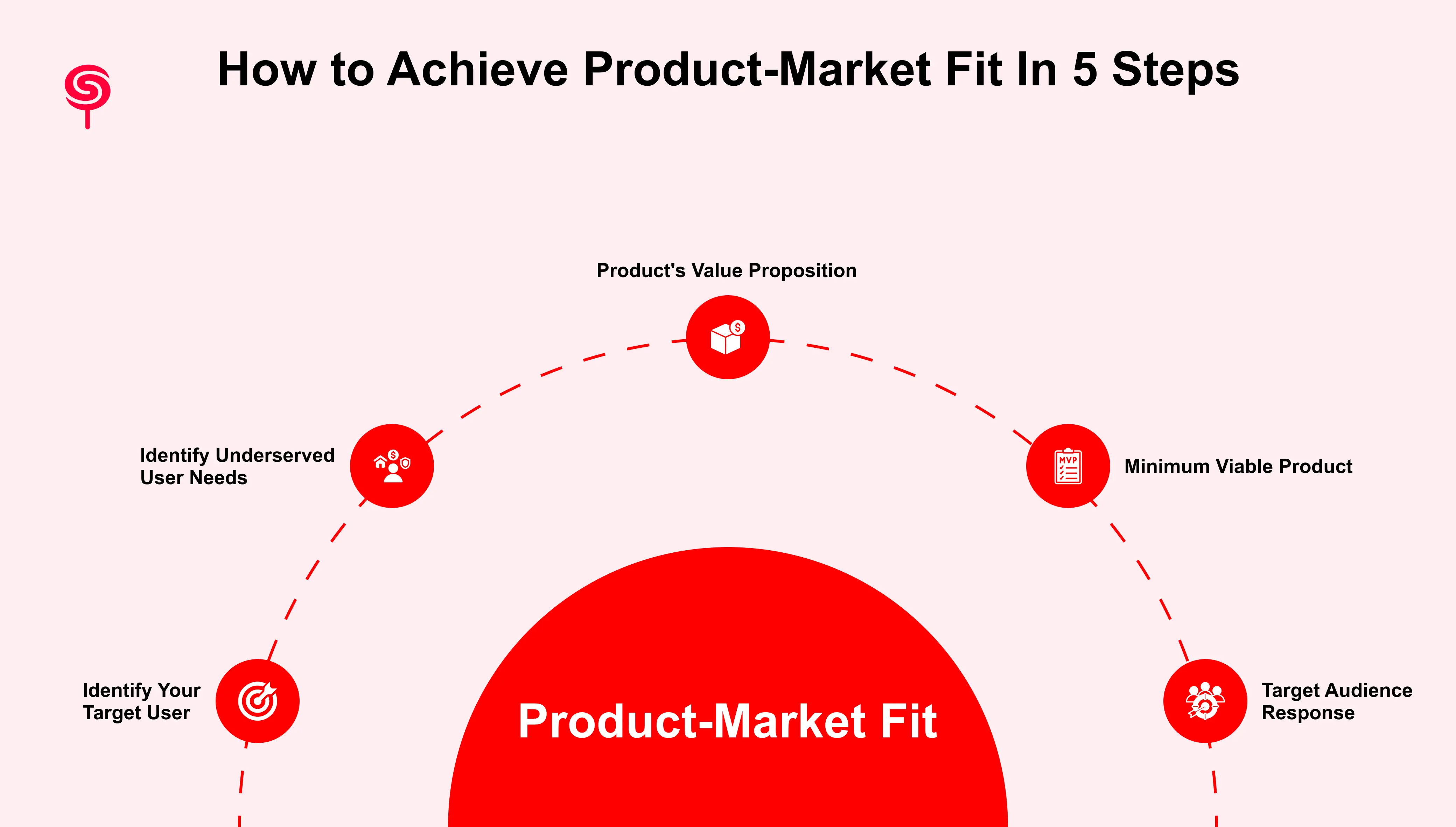
Step 1: Identify Your Target User
Product-market fit is never achieved for everyone. It is achieved for a specific user in a specific context with a specific set of unmet needs. Your first task is to define that user with precision.
Move beyond demographic profiles. Build behavioral personas that capture how your target user works, what tools they currently use, what workarounds they have developed, and what success looks like in their role. The more specific your user definition, the more targeted and effective your validation can be.
Step 2: Identify Underserved User Needs
Once you have defined your user, the goal is to identify where existing solutions fall short. Conduct structured discovery interviews not to validate your idea, but to understand the problem landscape. Ask about workflows, frustrations, current tools, and the moments when those tools fail.
Look for patterns: recurring pain points, workarounds that reveal unmet needs, and moments where users describe losing time, money, or confidence. These patterns are your product opportunity.
Step 3: Define Your Product's Value Proposition
Your value proposition is not a feature list. It is a precise statement of who you serve, what problem you solve, how you solve it differently than alternatives, and what outcome the user can expect.
A strong value proposition is validated externally it resonates with your target users when you present it, generates meaningful interest, and survives comparison with alternatives. If your value proposition requires lengthy explanation to be understood, it needs refinement.
Step 4: Specify and Create Your Minimum Viable Product (MVP) Feature Set
An MVP is not a stripped-down version of your full vision. It is the smallest set of features that delivers enough value to allow meaningful validation with real users. The goal is to test your core hypothesis does this solution solve the problem for this user with as little development investment as possible.
This step is where most teams over-engineer. Resist the temptation to build more than the minimum required to test your primary hypothesis.
Step 5: Test Your Target Audience's Response to Your MVP
Structured MVP validation means bringing your product or a prototype of it in front of real users in a controlled testing environment. Observe behavior, measure engagement, collect qualitative feedback, and look for signs of genuine enthusiasm or disengagement.
This is not a single test. It is a cycle. Each round of testing generates insights that inform the next iteration. The teams that find product-market fit fastest are the ones who move through this cycle most efficiently and prototype testing is the mechanism that makes that possible.
What Is Prototype Testing?
Prototype testing is the practice of creating a simplified, testable version of a product or feature before full development and exposing it to real users to gather behavioral feedback.
It's not about beautiful mockups. It's not about impressing investors. It's about creating enough of a product experience that users can engage authentically with it, and you can observe what happens when they do.
The goal is simple: learn fast, at the lowest possible cost, before you commit resources to building.
Types of Prototype Testing
Prototype testing takes many forms depending on what you're trying to learn:
Concept Testing validates whether the core value proposition resonates. Does the user understand what the product does? Do they immediately see why they'd need it?
Usability Testing evaluates whether users can complete core tasks intuitively. Where do they get confused? Where do they hesitate? What language do they use versus the language in your UI?
Desirability Testing measures emotional response and preference. Do users want this? Do they feel it fits their workflow or identity?
A/B Prototype Testing compares two design directions to determine which performs better against specific behavioral metrics before a single line of production code is written.
Low-Fidelity vs. High-Fidelity Prototypes
Understanding the right fidelity for your stage is critical and most teams default to higher fidelity than they need, wasting time and money.
Low-fidelity prototypes are rough, fast, and cheap to produce paper sketches, whiteboard flows, or simple wireframe click-throughs built in tools like Balsamiq or Whimsical. They're ideal for early-stage concept validation, when the goal is to test whether the idea itself makes sense. Fidelity doesn't matter here; learning speed does.
High-fidelity prototypes are pixel-accurate, interactive experiences built in tools like Figma or ProtoPie that closely mimic the final product. They're appropriate when you need to validate UX flows, test specific micro-interactions, or gather conversion-oriented feedback from users who need a realistic experience to engage meaningfully.
How Prototype Testing Accelerates Product-Market Fit
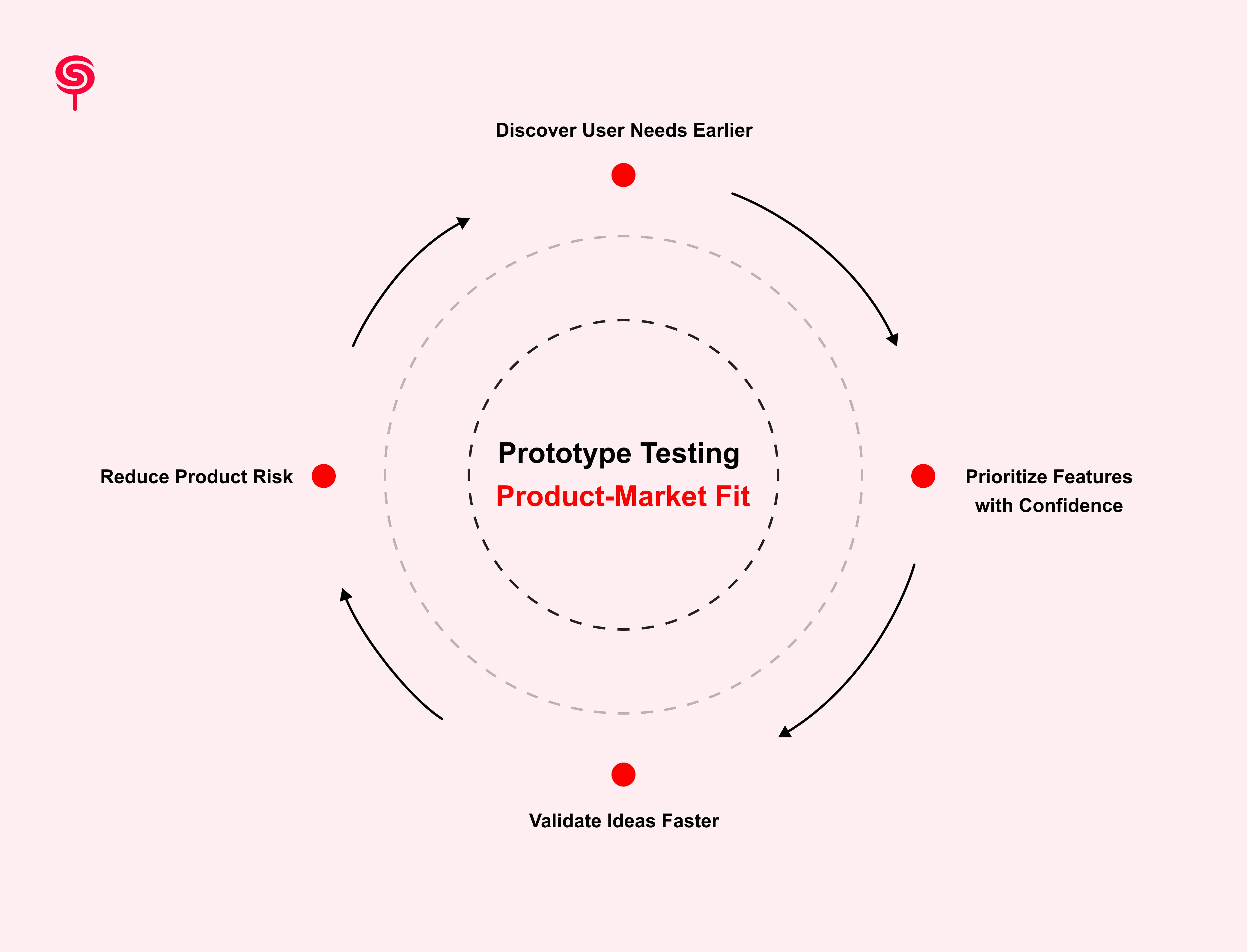
The relationship between digital prototyping and product-market fit isn't theoretical it's causal. Teams that test prototypes early consistently reach PMF faster, with fewer pivots and lower total development costs. Here's how.
Validate Ideas Faster
A prototype can be built in days, not months. Testing it with ten to fifteen users generates more signal than months of internal debate. What would have taken a full development cycle to discover that users don't understand the onboarding flow, or that a key feature solves the wrong version of the problem surfaces in a single round of testing. Validation velocity is a genuine competitive advantage.
Reduce Product Risk
Every feature you build without testing is a bet. Some bets pay off. Many don't. Prototype testing shifts the risk profile of product development by moving the point of reckoning from post-launch (expensive, public, embarrassing) to pre-build (cheap, private, learnable). Teams that prototype systematically make fewer large bets and more informed, incremental decisions.
Discover User Needs Earlier
Watching a user struggle with a prototype reveals needs that no survey or customer interview would uncover. Behavioral observation captures what users actually do, not what they say they do or think they should do. This gap between stated preference and actual behavior is where most product assumptions live. Prototype testing closes that gap before it becomes a product flaw.
Prioritize Features with Confidence
One of the most costly startup mistakes is building features that feel essential internally but are irrelevant to users. A prototype validation session answers the prioritization question definitively: not with gut instinct or stakeholder opinion, but with real behavioral data. Teams that prototype consistently build less but build the right things.
The Prototype Testing Framework Used by Successful Teams
High-performing product teams don't prototype randomly. They follow a structured, repeatable framework that generates reliable learning at every stage of product development. Here is the process CandyStudio uses with every client engagement.
Hypothesis Creation
Hypothesis creation forces the team to make their assumptions explicit before they run any tests. It transforms vague "let's see what happens" sessions into rigorous experiments with measurable outcomes.
Prototype Design
The prototype is built to answer the hypothesis not to showcase design skill or simulate the full product. Scope is controlled deliberately. Only the flows relevant to the current test are prototyped, keeping build time short and iteration cycles fast.
Design decisions at this stage are intentionally provisional. The prototype's job is to generate data, not to look final.
User Testing Sessions
Testing sessions are conducted with five to eight users per round enough to reveal consistent behavioral patterns without the noise of over-sampling. Sessions are moderated with structured tasks and open-ended follow-up questions. They are recorded, with permission, for deeper analysis.
The facilitator's role is to observe, not to guide. Leading questions are avoided. Silence during hesitation is treated as data.
Insight Analysis
Raw session data recordings, notes, task completion rates, error patterns is synthesized into actionable insights. The analysis asks: which hypotheses were confirmed? Which were invalidated? Where did users behave unexpectedly? What did we learn that we didn't know we didn't know?
Insights are ranked by frequency (how many users experienced it) and severity (how much it impacts the core user journey), giving the team a clear signal about what to act on first.
Iteration Cycles
Insights drive the next version of the prototype. Designs are updated, tested again, and refined until the core user flows perform reliably. This iteration cycle hypothesis, prototype, test, analyze, iterate is the engine of product-market fit.
Each cycle shortens the gap between what the team assumes and what users actually need. By the time development begins, the design has been validated through multiple rounds of real-user feedback.
Real Business Outcomes of Prototype Testing
Prototype testing isn't just good product practice it's good business strategy. The outcomes are measurable, and they compound.
Teams that integrate prototype testing into their development process typically see 30–50% reductions in rework costs, because they build things right the first time. Onboarding completion rates improve significantly when flows are validated before launch, because the friction points that cause drop-off are identified and eliminated during prototyping. Time-to-PMF compresses, because teams aren't spending months iterating on live products with real customers absorbing the cost of their learning.
Perhaps most importantly, prototype-tested products launch with conviction. The team knows what works and why. They can explain the design rationale clearly to investors, customers, and new hires because it's grounded in evidence, not intuition.
Investors, too, respond differently to teams that present prototype-validated products. Showing tested designs alongside user feedback data signals product maturity and operational discipline qualities that reduce perceived investment risk.
How CandyStudio Helps Startups Validate Before They Build
CandyStudio is a digital prototyping and UX design agency purpose-built for SaaS founders and startup teams who are serious about reaching product-market fit efficiently. We don't just design beautiful interfaces we build testable prototypes that generate the insights your product decisions need to be grounded in reality.
Our engagement model is structured around your stage and your risk. For early-stage teams still validating core concepts, we build rapid low-fidelity prototypes and facilitate moderated user testing sessions that generate actionable findings within days not months. For growth-stage teams refining specific flows, we design high-fidelity interactive prototypes in Figma that simulate your product experience with precision, then run structured usability testing to identify exactly where users convert, drop off, or get confused.
Conclusion
Product-market fit is not a lucky accident. It's not the result of building faster or spending more on marketing. It's the result of understanding your users deeply, validating your assumptions systematically, and making design decisions based on behavioral evidence rather than internal conviction.
Prototype testing is the discipline that makes this possible and it's available to every startup, at every stage, regardless of budget or team size.
The startups that reach product-market fit consistently aren't the ones who build the fastest. They're the ones who learn the fastest and then build with precision.
If your team is ready to stop guessing and start validating, CandyStudio is ready to help. Reach out to schedule a discovery call, and let's build something your users actually need.
Frequently Asked Questions
1. What is product-market fit?
Product-market fit occurs when a product successfully satisfies customer needs, resulting in strong adoption, retention, and sustainable demand.
2. How does prototype testing help achieve product-market fit?
Prototype testing allows you to validate your core value proposition, UX flows, and feature assumptions with real users before investing in full development. This reveals misalignments between your assumptions and user needs early when they're cheap to fix rather than after launch, when changes are expensive and disruptive.
3. When should a startup start prototype testing?
Ideally, before writing any production code. Prototype testing is most valuable at the concept stage, when you're still defining what to build. However, it's equally powerful during MVP refinement, feature expansion, and growth-stage UX optimization.
4. What's the difference between low-fidelity and high-fidelity prototypes?
Low-fidelity prototypes are rough, quick representations (wireframes, sketches, clickable flows) used for early-stage concept validation. High-fidelity prototypes are polished, interactive experiences that closely mimic the final product, used for detailed usability testing and flow validation. The right choice depends on what questions you're trying to answer.
5. What is an MVP validation and how does it differ from prototype testing?
MVP (Minimum Viable Product) validation involves releasing a stripped-down version of your product to real users to test market demand and core value proposition. Prototype testing happens before the MVP is built it validates design assumptions with simulated experiences. Both are essential; prototype testing reduces the risk of building the wrong MVP.
6. How long does a prototype testing cycle take?
A single prototype testing cycle from hypothesis creation through insight synthesis typically takes one to three weeks depending on prototype complexity and participant recruitment. Multiple rapid cycles can be completed within a single sprint, generating months' worth of product learning in compressed time.
Share this blog!
Latest Blogs
Explore our latest insights on design, AI, and digital innovation.