UX Strategies for B2B SaaS Growth
Author
Vignesh
Published On
B2B SaaS teams often build powerful products and still watch growth stall. The missing element is rarely technical horsepower, it’s user experience (UX). Great UX accelerates activation, reduces churn, increases conversion, and drives revenue predictably. This guide distills the most effective UX strategies for B2B SaaS growth, tailored for founders, CTOs, product leaders, and FinTech teams who need measurable outcomes from design investments. You’ll get pragmatic strategies, UX metrics to track, agency partnership reasons, and a roadmap to convert users into retained customers.
Why B2B SaaS Products Struggle to Grow Despite Having Great Features
The Feature Trap
Most SaaS founders fall into the same trap: they equate product value with feature volume. The roadmap grows. The changelog gets longer. But activation rates plateau and NPS scores stagnate.
Why? Because features don't create value usability does.
When a new user signs up for your platform, they're not evaluating your entire feature set. They're trying to solve one specific problem in the shortest time possible. If they can't find the path to value within minutes, they disengage. And in B2B SaaS, one disengaged seat often means the entire company churns at renewal.
The Onboarding Illusion
Many SaaS teams believe they have good onboarding because they have a welcome email sequence, a product tour tooltip, or a short tutorial video. But onboarding isn't a checklist it's an experience. If users complete your onboarding tour and still don't understand how to accomplish their primary goal, the tour failed regardless of how well it was designed.
Research from Wyzowl shows that 86% of users say they'd be more loyal to a business that invests in onboarding content. More critically, 74% say they've abandoned a product because it was too difficult to use not because it lacked functionality.
The B2B Complexity Tax
Unlike B2C products, B2B SaaS carries inherent complexity: role-based permissions, multi-stakeholder workflows, integrations with enterprise systems, and nuanced data models. This complexity isn't optional it reflects real business requirements. But it's also a design responsibility. Complexity left unmanaged becomes friction. Friction becomes churn.
How Poor UX Impacts B2B SaaS Growth Metrics
Poor B2B SaaS UX isn't just a product problem it's a revenue problem. Here's how it shows up in your business metrics:
Lower Free-to-Paid Conversion: When trial users can't reach "aha moments" fast enough, they don't convert. Even a 1% improvement in activation rates can compound into millions in ARR at scale.
Higher Churn Rates: Customers who don't achieve consistent value from your product will cancel at renewal. UX friction accelerates this timeline. According to ProfitWell, improving retention by just 5% increases profits by 25–95%.
Increased Support Costs: Every confusing UI element generates a support ticket. For a 100-seat SaaS at $50K ARR, that's often $15K–$20K per year in avoidable support costs money that should be going toward growth.
Longer Sales Cycles: Enterprise buyers increasingly demand product-led experiences, demos, and trials. If your product requires a 45-minute onboarding call before it makes sense, you're extending sales cycles and increasing CAC unnecessarily.
Lower NPS and Word-of-Mouth: Poor SaaS user experience doesn't just hurt retention it kills virality. B2B buyers trust peer recommendations more than any marketing channel. A frustrating product becomes a detractor in a buying committee.
Understanding the Role of UX in B2B SaaS Growth
UX Is Infrastructure, Not Decoration
The most dangerous misconception in SaaS product development is treating UX as a final-stage polish activity something you apply after engineering is done. In reality, UX is infrastructure. It determines how users navigate complexity, how quickly they find value, and whether they trust your product enough to expand usage across their organization.
Strong SaaS UX design operates at three levels:
Functional UX ensures the product works correctly, logically, and efficiently. Navigation is predictable. Workflows match mental models. Errors are caught before they happen.
Emotional UX creates confidence and trust. Users feel capable, not confused. The interface communicates competence through consistency, visual hierarchy, and clear feedback loops.
Strategic UX aligns design decisions with business outcomes conversion rates, activation velocity, feature adoption, and retention cohorts.
The Psychology Behind Trust in B2B Products
Trust is the currency of B2B SaaS. Enterprise buyers aren't just purchasing software they're staking their professional reputation on the decision. When your UX signals incompetence through inconsistent design patterns, broken workflows, or ambiguous error messages it erodes that trust at a subconscious level.
Cognitive load theory tells us that users have finite mental bandwidth. When your interface forces users to think too hard to decipher labels, predict outcomes, or recover from errors they experience cognitive fatigue. In consumer apps, this might mean a bounce. In B2B SaaS, it means a conversation with a competitor.
The antidote is progressive disclosure, visual hierarchy, and consistent interaction patterns that reduce cognitive load and signal reliability at every touchpoint.
10 UX Strategies for B2B SaaS Growth
1. Simplify User Onboarding
The goal of onboarding isn't to teach your product it's to deliver your first "aha moment" as fast as possible. Map your onboarding flow to a single, high-value action that demonstrates your core value proposition.
Remove everything that doesn't support that action. Eliminate multi-step profile setup forms at the start. Defer configuration options to later sessions. Use contextual tooltips triggered by user behavior rather than sequential tours that interrupt intent.
For FinTech and enterprise SaaS products, consider role-based onboarding paths. A CFO needs a different entry point than a finance analyst. Adaptive onboarding that responds to user type reduces time-to-value across personas.
Growth Impact: Reducing time-to-first-value from 7 days to 24 hours can increase trial conversion rates by 30–50%.
2. Improve User Activation
Activation is the moment a user first experiences the core value of your product. It's distinct from signup, onboarding completion, or feature exploration. Activation is the instant they realize: this actually solves my problem.
Define your activation event based on behavioral data not assumptions. Use cohort analysis to identify which in-product actions correlate most strongly with 90-day retention. Then design your entire early user experience to drive users toward those actions.
Activation nudges contextual prompts, progress indicators, and empty state CTAs are highly effective when tied to user intent rather than time-based triggers.
3. Optimize Feature Discoverability
In complex B2B SaaS products, the majority of features go undiscovered. Users default to familiar workflows and ignore capabilities that could dramatically increase their ROI and your expansion revenue.
Feature discoverability is a design problem, not a marketing problem. Solve it through contextual feature introductions (surfaced at the moment they're relevant to the user's current task), progressive feature unlocking tied to usage milestones, and in-app feature spotlights tied to role-based value propositions.
The most valuable place to surface a feature is inside the workflow where it creates the most immediate impact.
4. Build Clear Navigation Systems
Navigation is the skeleton of your SaaS UX. A navigation system that doesn't reflect how users think about their work forces them to build a mental map of your product's architecture cognitive overhead they didn't ask for.
Conduct card sorting and tree testing with real users to validate your information architecture before building. Group navigation items around user jobs-to-be-done, not internal product categories.
In B2B SaaS products with multi-module architectures (CRM, billing, analytics, settings), use progressive disclosure to surface relevant navigation contextually rather than exposing every option at once.
5. Use Data-Driven UX Decisions
Every UX decision is a hypothesis. The difference between high-growth SaaS products and stagnant ones is the discipline to test those hypotheses against behavioral data rather than stakeholder opinions.
Build a UX analytics stack that captures: heatmaps and session recordings (Hotjar, FullStory), funnel analysis and event tracking (Mixpanel, Amplitude), A/B and multivariate test results (Optimizely, LaunchDarkly), and user feedback loops (in-app micro-surveys, NPS).
Use this data to identify friction points, prioritize design investments, and measure the conversion impact of every UX change.
6. Create Personalized User Experiences
Personalization in B2B SaaS isn't about greeting users by name it's about serving the right interface, the right information, and the right recommendations at the right time based on user role, industry, usage history, and account goals.
Personalized dashboards that surface role-relevant KPIs, intelligent defaults that anticipate user needs based on prior behavior, and contextual help content tailored to a user's current workflow stage all reduce friction while increasing perceived product value.
For FinTech SaaS platforms, personalization directly impacts trust: a CFO dashboard that speaks the language of financial risk and compliance signals domain expertise that generic UX cannot.
7. Reduce User Errors and Confusion
Error prevention is one of the most undervalued UX investments in B2B SaaS. Every unhandled error state a vague 500 error, a failed import with no guidance, a form that resets on submission failure is a trust-destroying experience.
Apply Nielsen's error prevention heuristics: design workflows that make errors hard to commit, provide inline validation before submission, write error messages in plain language that explain what happened and what to do next, and build recovery paths that restore user progress rather than starting over.
In FinTech UX specifically, where errors can have financial consequences, robust error prevention is a compliance requirement as much as a UX one.
8. Design for Retention
Acquisition-focused design optimizes for the signup moment. Retention-focused design optimizes for the 30th, 60th, and 90th day of product use the periods when churn risk is highest.
Retention design strategies include: habit-forming engagement loops that pull users back to value-generating workflows, meaningful progress indicators that show users their ROI over time, re-engagement prompts triggered by behavioral signals of disengagement (not by calendar), and proactive success milestones that celebrate user achievements within the product.
The goal is to make using your product a professional habit, not a one-off task.
9. Improve Mobile and Cross-Platform Experiences
B2B buyers no longer confine their product usage to desktop environments. Executives review dashboards on mobile. Operations teams manage workflows from tablets. Approval flows are completed between meetings on phones.
A mobile-responsive interface is no longer a differentiator it's a baseline expectation. But responsive design isn't enough. Mobile B2B UX requires rethinking workflows for thumb-first navigation, reducing data entry requirements on small screens, and prioritizing the most time-sensitive tasks for mobile contexts.
Cross-platform consistency maintaining visual language, interaction patterns, and data state across web, mobile, and integrations is equally critical for B2B products used by distributed teams.
10. Continuously Test and Optimize
SaaS products are never finished. Markets evolve, user expectations shift, and product complexity grows with every feature release. A UX optimization program not a one-time redesign is the sustainable approach to maintaining and improving conversion rates over time.
Build a structured cadence of UX research: monthly usability testing with target users, quarterly UX audits against conversion benchmarks, and ongoing A/B testing of high-traffic interface elements. Prioritize tests based on potential revenue impact rather than engineering effort alone.
The most successful SaaS companies treat UX optimization as a continuous growth discipline, not a reactive fire-fighting exercise.
Key UX Metrics Every SaaS Team Should Track
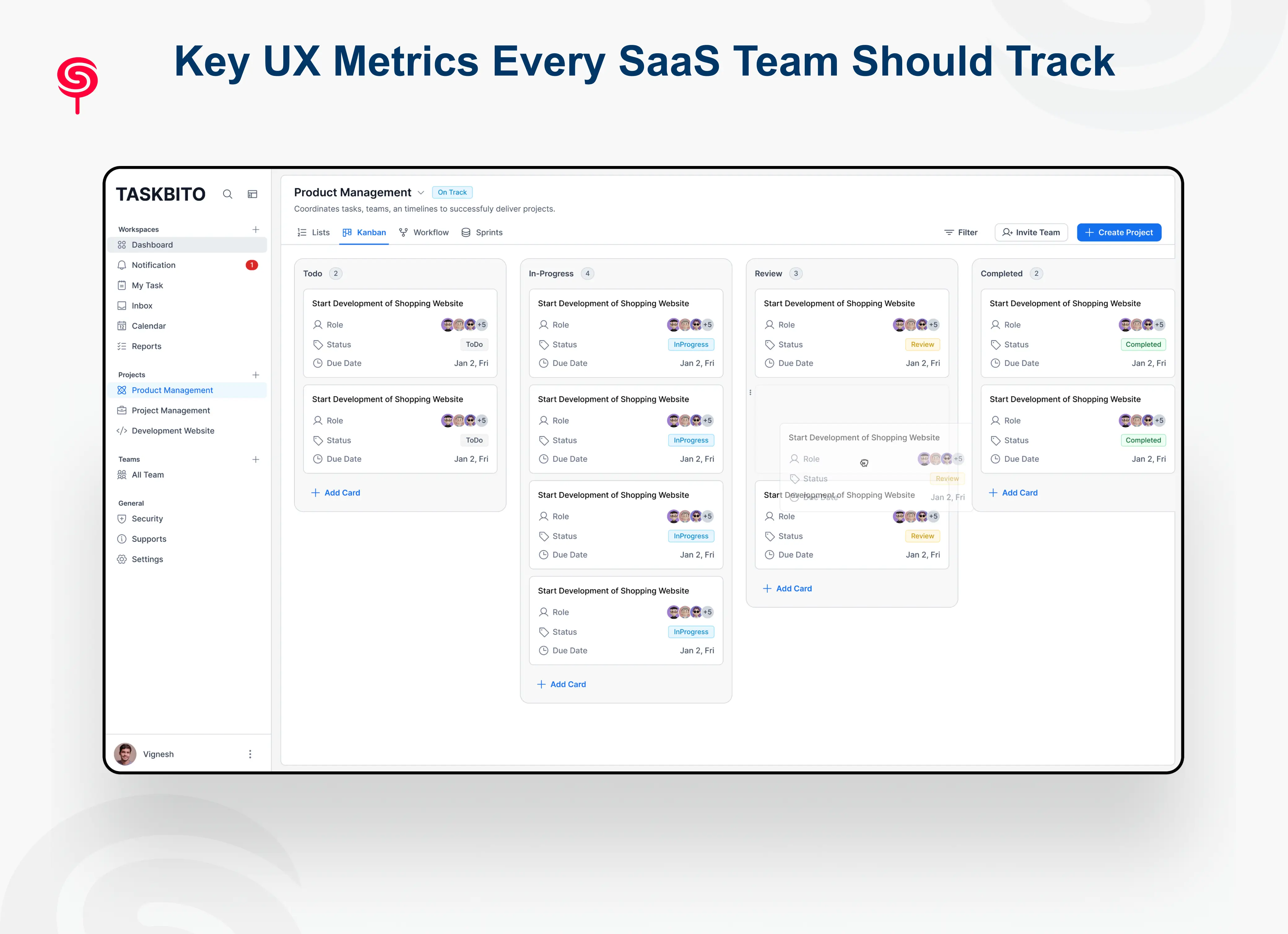
Data without context is noise. These are the UX metrics that map directly to business outcomes:
Time-to-First-Value (TTFV): How long does it take a new user to complete the core activation event? Shorter TTFV correlates directly with higher trial conversion rates.
Feature Adoption Rate: What percentage of users discover and use each feature within 30 days of signup? Low adoption on high-value features signals discoverability or onboarding gaps.
User Activation Rate: What percentage of signups complete the defined activation event? This is the leading indicator of long-term retention.
Task Success Rate: In usability testing, what percentage of users complete key workflows without error or assistance? Below 80% is a red flag.
Error Rate and Recovery Time: How frequently do users encounter errors, and how long does it take them to recover? High error rates in critical workflows signal urgent UX debt.
Monthly Active User (MAU) Growth: Active usage growth not just seat count indicates that users are finding consistent value from the product.
Net Promoter Score (NPS): Tracks the relationship between user experience quality and organic growth potential. A below-average NPS in your category signals UX problems before churn data does.
Customer Effort Score (CES): How much effort do users report expending to complete key tasks? CES is a more actionable retention predictor than satisfaction scores alone.
Why Startups and SaaS Companies Partner With UX Design Agencies
The In-House UX Gap
Most early and growth-stage SaaS companies operate with one of three UX resourcing realities: no dedicated UX function at all, a single designer stretched across product, marketing, and brand, or engineering-led design that optimizes for technical feasibility over user experience.
None of these setups produces the strategic UX capability required to compete in today's SaaS market. Partnering with a specialized UX design agency fills this gap with immediate access to senior UX strategists, user researchers, conversion rate optimization specialists, and FinTech domain expertise without the 6–9 month cost and risk of a senior design hire.
What a UX Audit Reveals
A professional UX audit is often the highest-ROI engagement a SaaS company can make. An expert audit maps every user touchpoint against conversion, activation, and retention goals identifying the specific friction points costing your business the most revenue.
Typical audit deliverables include: a prioritized friction inventory mapped to revenue impact, heuristic analysis benchmarked against SaaS best practices, user flow mapping with conversion bottleneck identification, and a strategic UX roadmap with effort-versus-impact scoring.
For FinTech platforms, a UX audit also covers compliance-critical interaction patterns, trust signal analysis, and security communication design areas where poor UX carries regulatory risk as well as revenue risk.
Strategic UX as a Competitive Advantage
In crowded SaaS categories, features reach parity quickly. A competitor can ship your differentiating feature in 90 days. But a UX experience built on deep user research, proven conversion optimization, and thoughtful interaction design takes years to replicate. For fast-growing SaaS businesses, strategic UX investment is a durable competitive moat.
The Business Outcomes of Strong B2B SaaS UX
Strong B2B SaaS user experience doesn't just improve user satisfaction scores it moves the metrics that boards and investors track.
Higher Conversion Rates: Optimized onboarding and activation flows convert more trial users to paid customers. For a SaaS business at $1M ARR with a 5% trial conversion rate, improving that rate to 7% adds $400K in annual revenue without increasing CAC.
Lower Churn: Users who achieve consistent value from a product don't leave. Churn rates in the bottom quartile of SaaS categories typically correlate with poor product UX, while top-quartile retention cohorts consistently correlate with superior onboarding and activation design.
Expansion Revenue: Intuitive feature discoverability drives organic feature adoption, which drives seat expansion and plan upgrades. UX is one of the few levers that simultaneously improves retention and expansion MRR.
Shorter Sales Cycles: When prospects can self-serve to an aha moment in a trial or demo environment, they arrive at sales conversations already convinced. UX quality directly compresses the enterprise sales cycle.
Reduced CAC: Organic growth from NPS-driven referrals, product-led growth driven by superior UX, and reduced support costs all lower your effective customer acquisition cost over time.
Investor Confidence: Investors in Series A and beyond increasingly scrutinize product experience quality as a signal of team capability and market defensibility. A polished, strategically designed product communicates organizational maturity.
Conclusion
Investing in UX is not a cost center; it’s a predictable lever for growth. For B2B SaaS especially FinTech and transaction-heavy products strategic UX reduces friction, builds trust, and turns product capability into measurable business outcomes. If your team struggles with activation, churn, or conversion despite strong features, a focused UX audit and a conversion-first design program will accelerate growth and improve ROI.
Frequently Asked Questions
1. What are UX strategies for B2B SaaS growth?
UX strategies for B2B SaaS growth are design and product decisions that improve how users interact with your software from onboarding and activation to retention and feature adoption with the goal of improving business metrics like conversion rates, churn, and expansion revenue. Key strategies include simplifying onboarding, optimizing feature discoverability, reducing user errors, and creating personalized user journeys.
2. How does poor UX affect B2B SaaS growth metrics?
Poor B2B SaaS UX increases churn by preventing users from consistently reaching product value, lowers free-to-paid conversion by extending time-to-first-value, inflates support costs through avoidable user confusion, and lengthens enterprise sales cycles by requiring heavy human onboarding. Research shows that 74% of users abandon products they find too difficult to use, regardless of feature quality.
3. What is the difference between B2B SaaS UX and B2C UX?
B2B SaaS UX must account for multi-stakeholder decision-making, complex role-based workflows, enterprise security and compliance requirements, and longer customer relationships than typical B2C products. B2B UX prioritizes trust, efficiency, and professional confidence whereas B2C UX often prioritizes delight and engagement. The stakes per user in B2B are also significantly higher, making UX errors more costly.
4. How does a UX audit benefit a SaaS startup?
A professional UX audit identifies the specific friction points in your product that are costing conversion and retention revenue. It provides a prioritized roadmap of design improvements ranked by effort-versus-impact, benchmarks your product against SaaS UX best practices, and gives leadership a clear picture of the ROI potential of UX investment. For early and growth-stage SaaS companies, a UX audit often delivers higher ROI than any single feature development initiative.
Share this blog!
Latest Blogs
Explore our latest insights on design, AI, and digital innovation.