How AI Is Changing Product Design in the Future
Author
Vignesh
Published On
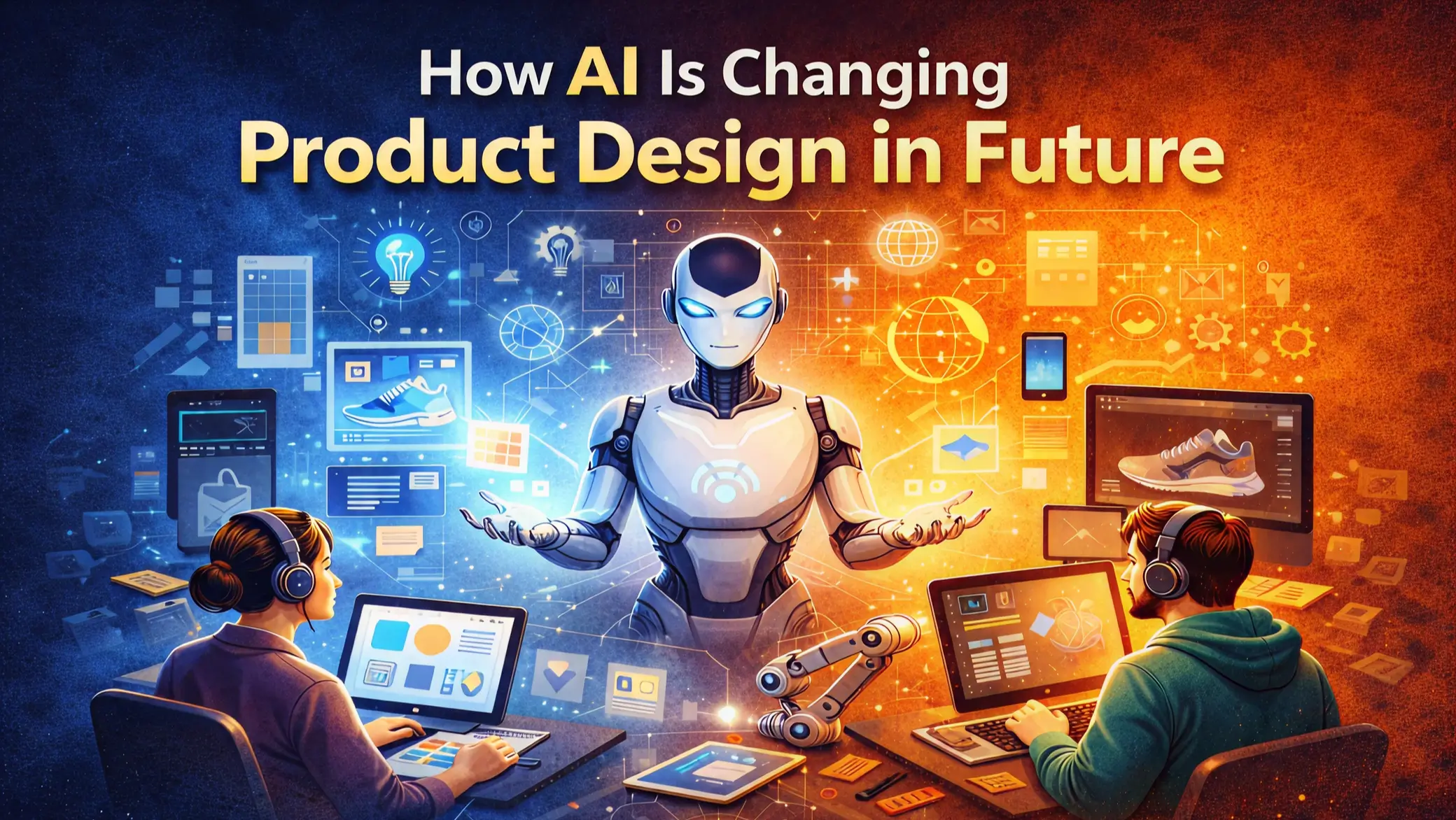
AI is changing product design in the future by transforming how teams research users, generate concepts, prototype experiences, personalize interfaces, and iterate at scale. The question is no longer whether to adopt AI it is how strategically you integrate it to build competitive advantage.
The Startup Struggle: Manual Design Bottlenecks Killing Speed-to-Market
Startup founders and product managers face brutal realities: endless revision cycles, subjective feedback loops, and designers overwhelmed by custom requests. SaaS teams at early-stage companies lose 4-6 weeks per feature on manual UX prototyping time they can't afford when competitors iterate weekly.
Consider a fintech startup we audited: their manual Figma sprints delayed MVP launch by 2 months, burning $150K in runway. Without AI, you're stuck in this grind, watching agile rivals like Notion clones surge ahead.
The Three Core Design Failures That Stall Startup Growth
First, reactive design culture where design is treated as a finishing layer rather than a strategic foundation. Teams build first and design later, leading to interfaces that are technically functional but experientially broken.
Second, disconnected design systems where inconsistency across screens signals immature product thinking to discerning users and investors alike.
Third, absence of data-informed iteration where design decisions are based on assumption rather than behavioral analytics, heatmaps, or AI-generated user flow insights. Each of these failures is individually damaging; in combination, they create a product experience that actively repels the growth you are trying to achieve.
Startup Design Struggle Indicators
Design is brought in after engineering, not alongside it from day one.
No documented design system or component library exists across the product.
User testing is skipped due to time and budget constraints on every cycle.
Investors or enterprise customers have flagged UX concerns during evaluations.
Product redesigns happen reactively after churn spikes, not proactively.
Design-to-engineering handoff produces inconsistent outputs and rework loops.
Five AI-Powered Design Solution: Transforming Product Design Workflows
From generative UI creation to predictive user behavior modeling, the toolkit available to AI-forward design teams would have been unrecognizable five years ago. Understanding these capabilities and knowing when and how to deploy them is now a core competency for any startup that wants to build products that scale.
AI isn't hype it's rewriting product design from ideation to launch. Here's how leading tools and custom integrations are reshaping the future:
1. Generative AI and Rapid Prototyping:
AI-powered tools like Figma AI, Uizard, and Framer AI can generate production-ready UI layouts from natural language prompts, user journey specifications, or competitive reference inputs. What once required a senior designer two weeks to prototype can now be generated, iterated, and tested in 48 hours. For startups operating on compressed timelines, this capability alone can mean the difference between catching a market window and missing it entirely. Internal link: See our guide on Framer AI for Startup Design Teams.
2. Predictive UX Analytics and Behavioral Modeling:
Platforms like FullStory, Hotjar AI, and Microsoft Clarity leverage machine learning to identify friction patterns, drop-off points, and engagement anomalies that human analysts would take weeks to surface. AI models can predict where users will struggle before a single session is recorded based on layout psychology, cognitive load analysis, and pattern matching against millions of behavioral data points. This means your product team is not reacting to churn; they are preventing it.
AI analyzes heatmaps and session data to forecast UX friction, optimizing flows before user testing. This cuts A/B test costs by 70%.
3. Personalized, Adaptive Interface Design:
AI-driven platforms like ours scale branding across products, ensuring consistency while adapting to user segments think dynamic themes that evolve with real-time feedback. Static, one-size-fits-all interfaces are being replaced by AI-driven adaptive UIs that reconfigure based on user role, behavior history, device context, and session intent. For SaaS products in particular, adaptive design dramatically improves activation rates, reduces support overhead, and creates a product experience that feels bespoke to every user segment. Modern AI tooling makes this achievable at seed-stage scale, not just for enterprise platforms with multi-year development cycles.
4. AI-Augmented Brand System Development:
Consistent brand identity across a product ecosystem from onboarding flows to empty states to error messages is a marker of design maturity that sophisticated buyers recognize immediately. AI-powered brand system tools can generate, audit, and enforce design tokens, typographic scales, color systems, and component hierarchies at a speed and consistency that manual processes cannot match. Internal link: Explore our AI-Driven Brand Identity for Startups guide.
5. Automated Accessibility and Compliance Auditing:
Accessibility compliance is no longer optional it is a legal risk and a market expansion opportunity. AI tools now automate WCAG compliance auditing, contrast ratio analysis, screen reader optimization, and keyboard navigation testing throughout the design pipeline, not just at launch. Startups building in regulated industries or targeting enterprise buyers will find that AI-verified accessibility documentation accelerates procurement approvals and reduces legal exposure significantly.
What AI-Driven Design Actually Delivers: Measurable Business Impact
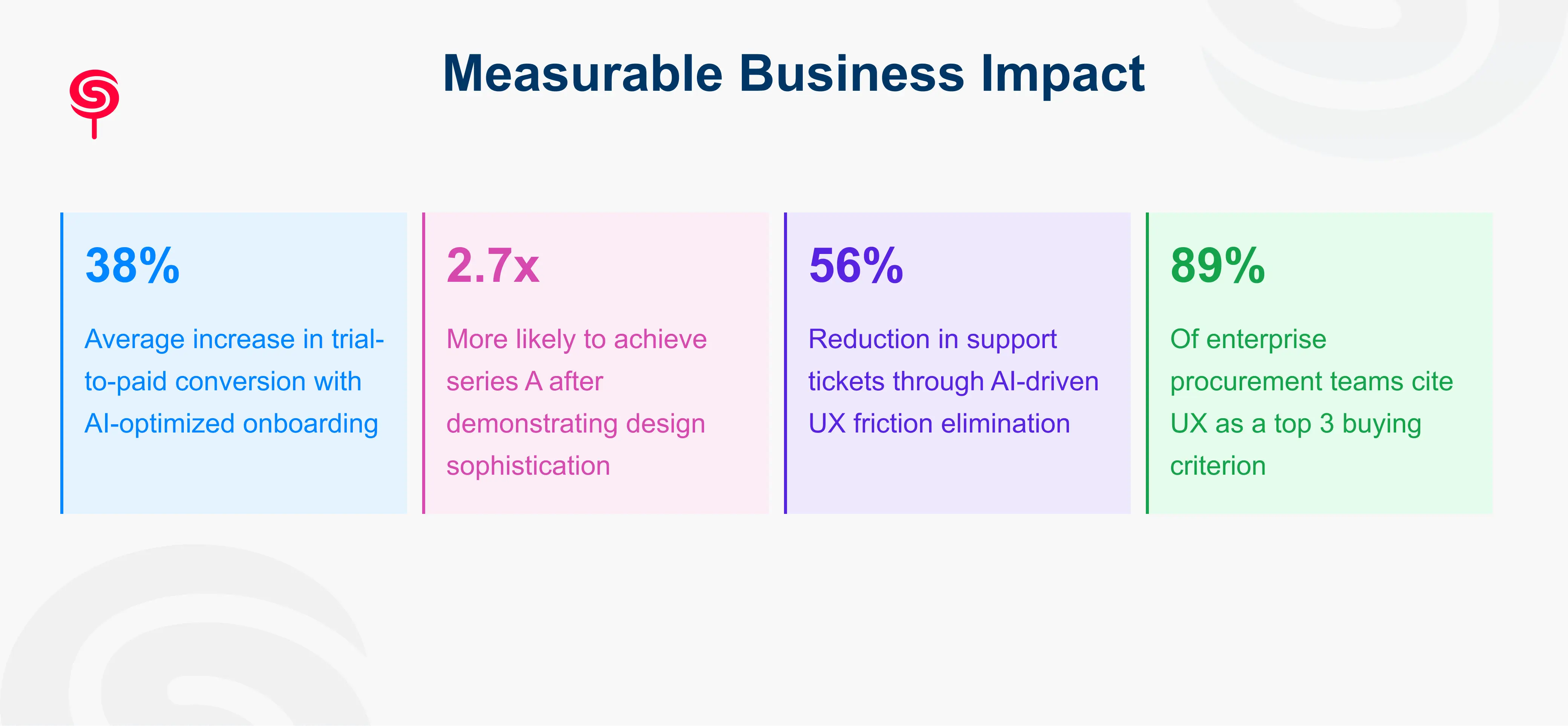
The conversation around design ROI has historically been vague, anecdotal, and dependent on case studies that may not translate to your specific context. AI-driven design changes that calculus entirely. Because AI tools generate rich behavioral data at every stage of the design process from initial prototype testing to post-launch interaction analytics the business case for design investment becomes quantifiable, attributable, and predictable.
Startups that have adopted AI-augmented design processes report measurable improvements across three critical business dimensions: user acquisition (through improved first impressions and onboarding conversion), user retention (through reduced friction and adaptive personalization), and revenue per user (through AI-optimized upgrade flows, feature discovery, and contextual upsell triggers).
Beyond the direct product metrics, there is a compounding strategic benefit that AI-driven design creates: organizational learning velocity. Because AI tools make iteration faster and cheaper, high-performing product teams can run significantly more design experiments per quarter than their competitors building a proprietary body of user insight that becomes a durable competitive asset over time.
This is the flywheel that most startup teams miss when they evaluate AI design investment: the data generated by AI-augmented design processes compounds in value. Each iteration produces richer behavioral insights, which inform more precise AI model training, which enables more accurate UX predictions, which drives better product decisions faster. The teams that start this flywheel earliest win disproportionately.
Why AI-Driven Design Capability Builds Investor Trust and Increases Startup Valuation Perception
The relationship between design quality and startup valuation is one of the most systematically underappreciated dynamics in the early-stage technology ecosystem. Founders who understand this relationship and who deliberately signal AI design capability to the market gain a measurable advantage in fundraising, partnership development, enterprise sales, and talent acquisition.
AI-driven design capability communicates four things simultaneously to every sophisticated stakeholder who encounters your product. First, it signals operational sophistication that your team understands how to leverage best-in-class tooling rather than rebuilding from scratch. Second, it signals user centricity that you have invested in understanding and serving your users at a granular level. Third, it signals scalability - that your design system is built to grow with your product, not against it. Fourth, it signals innovation velocity that your competitive moat includes the ability to iterate faster than adversaries relying on traditional design workflows.
The Trust Architecture of AI-Forward Design:
Trust, in the context of B2B SaaS and enterprise products, is not an abstract quality. It is built through a series of micro-credibility signals that accumulate across every touchpoint in the buyer journey. AI-driven design creates trust through consistency a design system that feels intentional and coherent across hundreds of screens signals that every other part of your product has been thought through with equal rigor. It creates trust through performance interfaces that feel fast, responsive, and intelligently adaptive suggest engineering quality and infrastructure maturity. And it creates trust through empathy products that anticipate user needs, surface relevant information contextually, and remove friction proactively signal that your team deeply understands the problem you are solving.
For startup founders navigating Series A through Series C fundraising, this trust architecture translates directly into valuation. A product demonstrating AI-native design maturity can credibly command a premium multiple because it signals not just current product quality, but future product velocity. Investors are not just buying what you have built; they are buying your team's demonstrated capacity to keep building better, faster, and smarter than the market.
How AI Design Signals Increase Valuation Perception:
Consistent design systems signal scalable product architecture and engineering maturity.
AI-personalized UX demonstrates proprietary user insight that competitors cannot easily replicate.
Rapid iteration history (provable through changelogs) signals operational excellence and team discipline.
Accessibility and compliance baked into design reduces perceived legal and enterprise-sales risk.
Design coherence across brand touchpoints signals leadership attention to quality at every level.
Measurable UX metrics in pitch decks convert abstract design value into investable, quantified ROI.
Design as a Defensible Competitive Moat:
In a market where feature parity between competitors can be achieved in weeks, design quality and design velocity become genuinely defensible competitive moats. Your proprietary user behavioral data generated through AI-augmented design testing is not replicable. Your design system, once mature, creates a compounding efficiency advantage that widens the gap with every product cycle. And the organizational culture of design excellence that AI-forward practices build is extraordinarily difficult to replicate from the outside.
This is why the most strategically sophisticated founders treat AI-driven design not as a cost line on a product roadmap, but as a core component of their competitive strategy - alongside engineering, sales, and talent. The startups that internalize this reality first will define the category benchmarks their competitors spend years trying to catch up to.
Conclusion
Startups that treat AI as a design multiplier not a marketing buzzword will dominate the next decade.
The future of product design is:
Intelligent
Adaptive
Predictive
Data-driven
And startups that embed AI at the design foundation level will not just compete.
Frequently Asked Questions
1. What is AI-driven product design, and why do startups need it?
AI-driven product design uses machine learning for generative prototyping, user prediction, and adaptive UIs cutting manual work by 60%. Startups need it to match Big Tech speed; without it, you're 4-6 weeks behind on MVPs, risking runway burnout.
2. How does AI change the future of product design?
AI shifts design from static to dynamic: auto-optimizing layouts based on real-time data, personalizing experiences, and forecasting churn. Expect 2x retention and 40% lower CAC for SaaS competitiveness.
3. What are the business benefits of AI-driven product design?
AI-driven design delivers measurable outcomes:
Faster time to market
Higher onboarding completion rates
Reduced feature development waste
Improved retention
Stronger product-market fit
Increased perceived startup valuation
Investors view AI-enabled products as more scalable and defensible.
4. Is AI replacing product designers in startups?
No, AI augments them, handling 70% rote tasks so designers focus on strategy. Top teams (e.g., ours) see 2x productivity, creating defensible moats.
Share this blog!
Latest Blogs
Explore our latest insights on design, AI, and digital innovation.