Designers Are Launching Websites Without Developers Here’s How Framer Makes It Possible
Author
Vignesh
Published On
Startups don’t fail because they lack ideas. They fail because they move too slowly.
You have a product idea sharp enough to cut through the market. Your pitch deck is polished. Your MVP is either live or deep in development. But your website the digital front door to your entire business still doesn't exist. Or worse, it's a half-finished template that looks like every other SaaS site in your vertical.
Designers are launching production-ready websites without developers. And the platform leading this shift is Framer.
If you're a founder, SaaS team, or tech entrepreneur, this article will show you:
Why traditional development workflows slow startups down
How Framer + AI-driven design workflows eliminate bottlenecks
Why investor perception improves when design velocity increases
How premium agencies leverage AI-powered systems to build valuation-ready websites
Let’s break it down.
The Real-World Startup Problem: Time Is Burning, and Your Website Isn’t Live
The traditional model of building a startup website was designed for an era that no longer exists. It assumed stable requirements, ample budgets, and teams with months to spare. Startups have none of these things and the gap between what the old workflow delivers and what founders actually need has never been wider.
Your audience SaaS teams and tech entrepreneurs needs websites that mirror enterprise polish: responsive Framer sites with AI-optimized UX, seamless animations, and CMS integration. Yet, most settle for subpar solutions because traditional paths demand developer bandwidth they don't have.
Every founder starts with urgency:
You need to validate your idea
You need early adopters
You need traction for investors
You need credibility
But your website the first digital handshake becomes a blocker.
What Usually Happens
Founder hires a designer.
Designer creates high-fidelity mockups in Figma.
Files are handed to a developer.
Developer rebuilds everything from scratch.
Revisions begin.
Timelines stretch.
Budget increases.
Momentum slows.
The Struggle: Speed, Cost, and Developer Dependency
Speed Bottlenecks in Traditional Development
Traditional dev workflows crush startup agility. You brief a developer on Figma designs, wait 4-6 weeks for frontend coding (React/Next.js), another 2 weeks for backend CMS (e.g., Sanity), and endless revisions for pixel-perfect responsiveness. Total timeline? 2-3 months. In that window, competitors launch, capture market share, and iterate based on real user data.
Custom-coded marketing websites typically require
Frontend development
Backend setup (if CMS required)
Performance optimization
Deployment configuration
QA testing
Even lean builds take 4–8 weeks.
Exploding Costs Without ROI
The invoice from a web development agency rarely tells the full story. Behind the line items for design and development lies a shadow cost stack that founders discover only after the project is underway:
Scope creep charges when you want to change a headline after seeing it live
Ongoing retainer fees for basic content updates or CMS training
SEO remediation costs after discovering the site wasn't built with performance in mind
Replatforming costs when the bespoke CMS your developer chose becomes unmaintainable
Lost revenue from delayed launch while your competitor's simpler site is already ranking
The full true cost of traditional web development for a startup website is frequently 2x to 3x the initial quoted price and that's before the first major redesign.
The Developer Dependency Trap
When a designer completes a layout, it doesn't go live. It enters a handoff queue. A developer interprets the design, builds it in code, flags technical constraints, sends revisions back to the designer, gets reviewed by the founder, gets revised again, and eventually ships. For a single landing page section, this cycle can take one to three weeks.
The compounding cost here isn't just financial. Every iteration cycle delayed by developer bandwidth is a hypothesis untested, a conversion rate unoptimized, a signal from the market you haven't received yet. For a pre-revenue startup, the cost of a slow website is measured not in dollars but in runway.
In the traditional model:
Designers design.
Developers build.
Founders wait.
Iteration becomes expensive because every change requires engineering bandwidth. This dependency slows validation. And slow validation kills startups.
The Solution: Framer + AI-Driven Design Workflows
Framer is not a website builder in the traditional sense. It is a professional design and publishing tool that collapses the gap between design and production enabling designers to ship fully responsive, interaction-rich, SEO-Optimized websites directly from their canvas, without writing a single line of code.
When paired with AI-driven design workflows including AI-assisted layout generation, brand-consistent component libraries, and intelligent content scaffolding Framer becomes a compounding competitive advantage. Not just for the speed of the first launch, but for the velocity of every iteration that follows.
Aspect | Traditional Dev Workflow | Framer + AI-Driven Workflow |
|---|---|---|
Timeline | 8-12 weeks | 1-2 weeks |
Cost | $20K-$50K+ | $5K-$15K (agency-led) |
Team Needed | Designer + Dev + QA | Designer only (AI assists) |
Customization | Code-limited, rigid | Infinite visuals, code overrides optional |
Scalability | High maintenance | Built-in CMS, auto-optimizes |
SEO/Performance | Manual optimization | Native Core Web Vitals, AI schema gen |
Example Output | Static React site | Dynamic Framer site w/ AI personalization |
How AI-Driven Framer Workflows Work in Practice
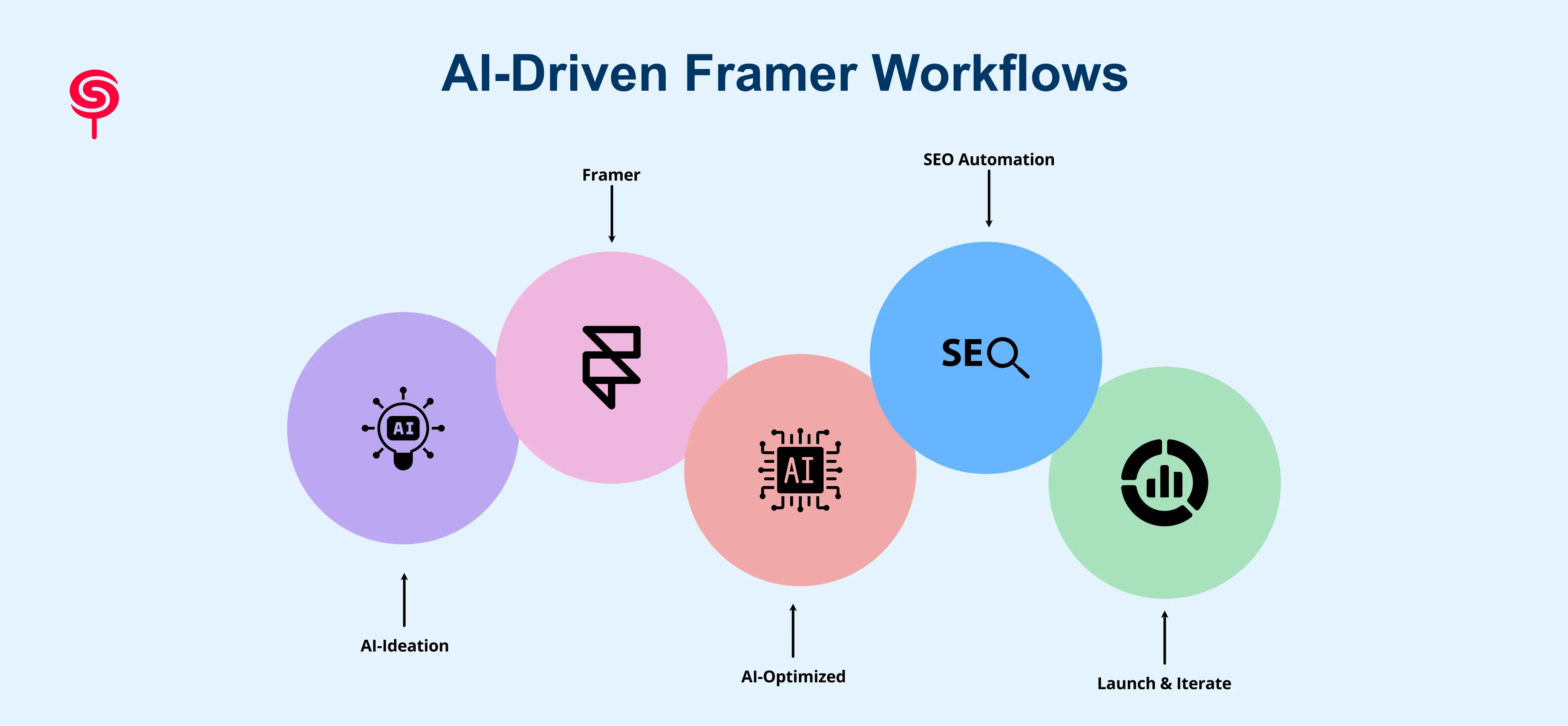
Your agency streamlines this into a 5-phase process:
Discovery & AI Ideation: Founders share vision; AI analyzes competitors (tools like Framer AI + your custom models) to generate wireframes. Output: Tailored sitemaps in hours.
Design in Framer Canvas: Designers drag-drop components no code. AI suggests color palettes, typography, and A/B variants based on conversion data from 1M+ Framer sites.
AI-Optimized UX Builds: Integrate AI for personalization (e.g., dynamic hero sections via Framer's data API). Test responsiveness instantly.
CMS & SEO Automation: Plug in headless CMS (e.g., Contentful). AI generates meta tags, schema markup, and alt text for 100% crawlability.
Launch & Iterate: Publish with one click. AI monitors analytics, suggesting tweaks like button copy lifts (20-40% uplift proven).
Why Showcasing AI-Driven Design Builds Trust and Boosts Valuation Perception
There is a compounding signal effect when a startup deploys a website that is demonstrably built with design intelligence not just aesthetic polish. For investors, enterprise clients, and strategic partners evaluating an early-stage company, the quality and thoughtfulness of the digital presence functions as a proxy for the quality and thoughtfulness of the team behind it.
The Perception Stack: How Your Website Influences Investor Confidence
Investors, particularly at seed and Series A, are making decisions under profound uncertainty. They cannot fully validate your technology, your team's execution capability, or your market thesis in a two-hour meeting. What they can evaluate quickly, intuitively, and with high confidence is whether the founders demonstrate taste, clarity of positioning, and the ability to communicate value to a market.
A website built with AI-augmented design sophistication signals all three. It communicates that the founding team understands their customer. It demonstrates the ability to allocate limited resources intelligently. And it shows that the company is built to move fast the single most important trait an early-stage investor is looking for.
Research across pitch evaluation frameworks consistently surfaces a pattern: companies that present polished, coherent digital branding in their early stages are perceived as lower-risk investments, commanding higher valuation conversations at equivalent traction levels.
The Category Authority Play
For B2B SaaS founders in particular, there is a direct line between website design authority and the ability to command premium pricing. Enterprise buyers the exact audience that determines whether a SaaS startup scales from $1M to $10M ARR are evaluating dozens of solutions simultaneously. In the absence of a deep prior relationship, the website is the sales team.
An AI-driven design agency builds more than a website. It architects a category positioning ensuring that every page, every headline, and every visual element communicates not just what the product does, but why it is the authoritative solution in its space. This is the difference between a startup that gets evaluated on price and a startup that gets evaluated on value.
Speed-to-Market as a Signal, Not Just a Metric
When a startup can launch a sophisticated, brand-aligned, conversion-optimized website in under two weeks, it communicates operational velocity that resonates far beyond the marketing team. It tells the market that this company has figured out how to compound capability without compounding headcount which is the defining challenge of scaling a venture-backed startup.
This operational signal feeds directly into valuation perception. Companies that demonstrate the ability to build high-quality outputs at high speed, with lean teams, are valued at multiples that reflect their capital efficiency. The website is often the first and most visible example of this capability in action.
The Measurable Business Outcomes Framer Delivers for Startups
Faster Market Validation
The lean startup methodology is built on a single imperative: build, measure, learn and do it faster than your runway runs out. A Framer-built website with a connected analytics stack, heatmap tools, and A/B testing capability gives founding teams the infrastructure to run proper market validation experiments from day one of launch.
This is not theoretical. Startups using AI-driven Framer workflows are running their first real user research in week three instead of month four and the insights gathered in that window directly inform product prioritization, investor narrative, and go-to-market sequencing.
When your marketing site can:
Launch in days
Test positioning weekly
Ship landing pages instantly
You build momentum. Speed builds signal. Signal attracts users. Users attract investors.
Investor-Ready Presence Without the Investor-Level Budget
The dirty secret of early-stage fundraising is that a significant portion of a founder's credibility in the room is established before they open their mouth through the perception of the business they've built. A polished, fast, thoughtfully structured website signals that this team can execute. It doesn't require a $50,000 agency engagement to achieve. With Framer and AI-driven design, it requires the right partner and the right process.
Scalable Architecture That Grows With the Business
Unlike bespoke-coded sites that require developer intervention to add pages, update navigation, or modify the CMS structure, Framer-built sites are designed for founder autonomy. The CMS is manageable without technical knowledge. New landing pages for campaigns, product updates, or geographic expansions can be cloned, modified, and published in hours.
As the startup scales, the Framer architecture scales with it adding integrations, expanding the CMS schema, deploying localized pages, or migrating content to support enterprise feature tiers all without a full site rebuild. This compounding technical flexibility has real financial value: it eliminates the $20,000–$40,000 replatforming cost that most startups face within 18 months of their initial site build.
Framer websites:
Support structured CMS collections
Integrate with analytics tools
Connect to APIs
Handle performance optimization
Allow custom code injection when needed
This means startups can scale marketing before scaling engineering.
Conclusion
The window in which moving fast is a genuine competitive differentiator is early and narrow. The founders who build on modern, AI-augmented design infrastructure rather than waiting for the 'right' development partner, the 'right' budget, or the 'right' moment are the ones who acquire the market feedback, the investor attention, and the brand authority that compounds into real competitive moats.
Framer, in the hands of a senior AI-driven design agency, is not a shortcut. It is a structurally superior approach to building a startup's digital presence one that compresses time, reduces cost, and produces outputs that traditional development workflows cannot match at the same investment level.
Frequently Asked Questions
1. What is Framer development, and why is it ideal for startups?
Framer development uses Framer's no-code platform to build responsive, high-performance websites without traditional developers. It's perfect for startups because it slashes timelines from months to weeks, cuts costs by 60-70%, and enables rapid validation letting founders focus on product-market fit.
2. How long does it take to launch a Framer website with your agency?
For a standard startup marketing site (5–8 pages, CMS blog, contact integrations), our delivery window is 7–14 business days from approved brand brief to live URL. Complex builds with custom interactions, multi-language support, or large CMS schemas typically run 3–4 weeks. Either timeline is a fraction of what traditional development requires.
3. How does Framer compare to Webflow or custom WordPress?
Framer has a faster design-to-publish pipeline than Webflow, with a more modern interaction system and cleaner default performance scores. Compared to WordPress, Framer requires no plugin management, has no security patch cycle, and loads significantly faster out of the box. For a startup focused on speed, conversion, and design quality Framer consistently outperforms both alternatives at equivalent investment levels.
4. Is a Framer website good for SEO?
Yes, Framer is one of the stronger no-code platforms for SEO performance. It generates clean, semantic HTML, supports custom meta tags and Open Graph data per page, produces fast-loading output (important for Core Web Vitals), and includes a built-in sitemap generator. For a startup focused on organic growth like SaaS Websites and Design Agency, a properly configured Framer site is a strong technical foundation.
5. Is Framer scalable for growing SaaS products?
Absolutely. Framer supports headless CMS, e-commerce plugins, and API integrations for apps/blogs. Sites scale to millions of users without tech debt, with AI optimizing performance as traffic grows.
Share this blog!
Latest Blogs
Explore our latest insights on design, AI, and digital innovation.