How AI Personalization Is Transforming Travel Platforms
Author
Vignesh
Published On
Travelers today expect more than a list of flights and hotel rooms they expect a platform that understands them. They want search results that reflect their budget, their past trips, and even their mood for this particular getaway. This is the promise of AI personalization in travel: booking experiences that feel less like filling out a form and more like talking to a well-traveled friend.
For travel startups and TravelTech founders, this shift isn't optional it's existential. Platforms that still rely on static filters and generic homepages are losing bookings to competitors who have quietly rebuilt their product around AI travel personalization. This blog breaks down what that transformation actually looks like, why so many travel platforms struggle to get it right, and how a deliberate UX and AI strategy can turn personalization into measurable revenue.
What Is AI Personalization in Travel Platforms?
At its core, AI personalization in travel platforms means using machine learning, behavioral data, and predictive models to tailor every touchpoint of the customer journey search results, itinerary suggestions, pricing nudges, and post-booking communication to the individual user rather than the average user.
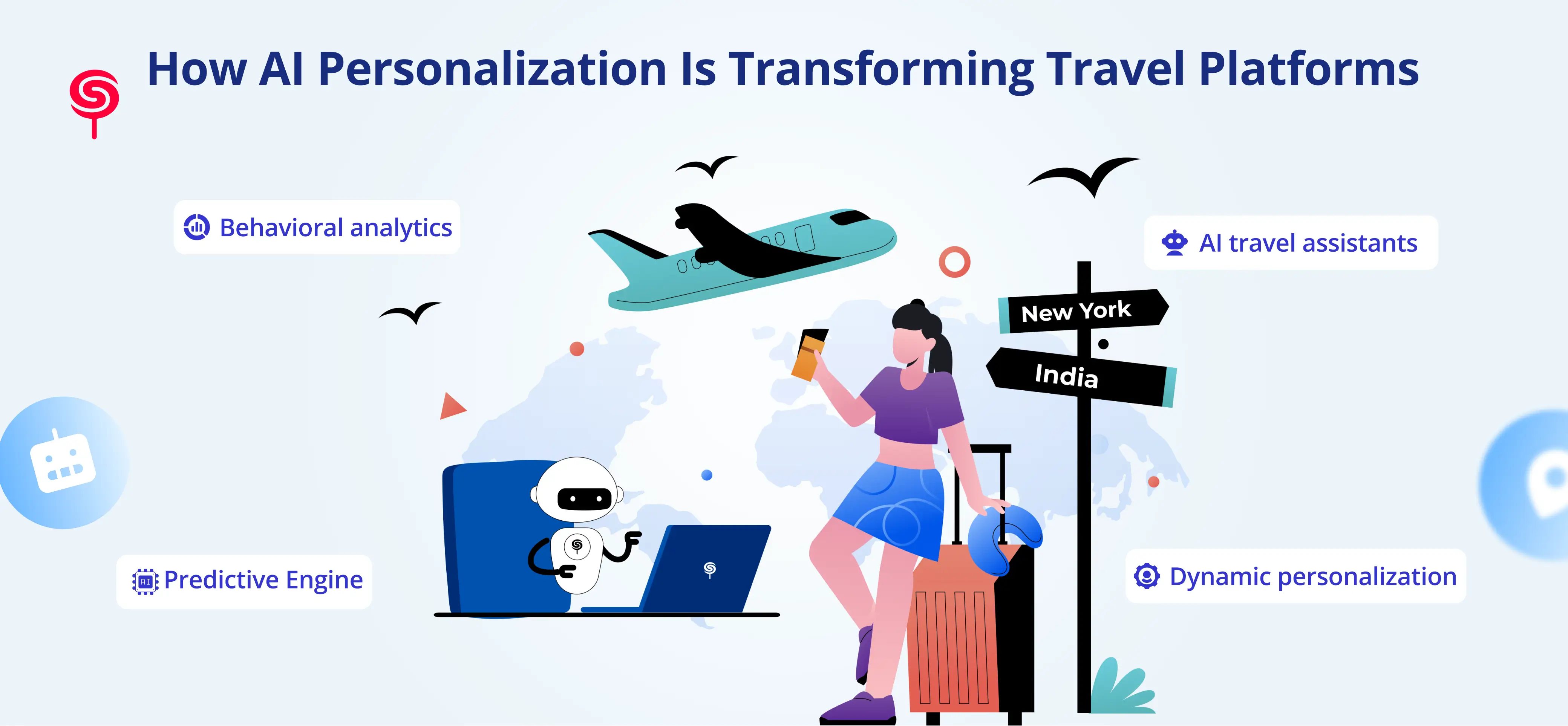
This goes far beyond "customers who booked this also booked that." A mature AI-powered travel platform blends several layers of intelligence:
Behavioral analytics tracking what users click, skip, and linger on
Predictive recommendation engines anticipating destinations, dates, and price points a user is likely to want
Natural language AI travel assistants helping users refine vague intents like "somewhere warm and quiet in December" into bookable options
Dynamic personalization adjusting homepage content, offers, and itinerary suggestions in real time
Used well, these layers combine into a personalized travel experience that feels intuitive rather than intrusive the platform seems to get the traveler with minimal effort on their part.
The Challenges Travel Startups Face Without AI Personalization
Most travel startups don't lack ambition they lack the connective tissue between data and design. Without AI personalization, a few predictable problems show up:
Generic search results. Every user sees the same results for "beach vacation," regardless of whether they're a solo backpacker or a family of five.
High bounce rates on search and booking pages. Travelers abandon platforms that make them scroll through irrelevant listings before finding something worth booking.
Low repeat-booking rates. Without behavioral memory, a returning customer is treated like a stranger every time they log back in.
Disjointed booking funnels. Search, itinerary building, and checkout often feel like three separate products stitched together, frustrating users and hurting conversion.
Missed upsell and cross-sell opportunities. Static platforms can't surface the right add-on (a transfer, an excursion, travel insurance) at the right moment.
These aren't cosmetic issues they show up directly in conversion rate, customer lifetime value, and churn. This is precisely why travel booking UX and AI strategy need to be solved together, not as separate initiatives.
How AI Technologies Drive Smart Travel
Several underlying technologies power what we now call smart travel platforms:
Recommendation engines built on collaborative filtering and content-based models suggest destinations, hotels, and activities based on a user's own behavior and the behavior of similar travelers.
Predictive analytics models forecast demand, price sensitivity, and even the likelihood a user will convert on a given day enabling smarter pricing and timely nudges.
Natural Language Processing (NLP) powers conversational AI travel assistants that let users describe trips in plain language instead of navigating rigid filters.
Computer vision and image recognition can match user-uploaded inspiration photos to real destinations and accommodations.
Customer behavior analytics platforms stitch together clickstream, search, and transaction data into a single traveler profile that updates continuously.
Together, these technologies form the backbone of AI-powered recommendations but technology alone doesn't create a good experience. That connective layer is UX design, which we'll come back to shortly.
How AI Personalization Is Transforming Modern Travel Platforms
The shift from static to intelligent platforms is visible across the entire customer journey:
Search becomes conversational. Instead of ten filter dropdowns, users type or speak what they want, and an AI travel search engine interprets intent.
Homepages become dynamic. Returning users see destinations and offers shaped by their history, not a one-size-fits-all banner rotation.
Itineraries become adaptive. AI itinerary planning tools assemble multi-day plans that adjust in real time to weather, budget changes, or booking availability.
Pricing becomes contextual. Predictive travel recommendations surface the right offer at the right moment a flash deal for a price-sensitive browser, a premium upgrade for a loyal repeat customer.
Support becomes proactive. AI assistants flag potential issues (a missed connection, a visa requirement) before the traveler has to ask.
This is the essence of the transformation: personalization is no longer a feature bolted onto the platform it's the operating logic of the entire product.
The Role of UX Design in Successful AI Personalization
Here's the part many travel startups underestimate: AI personalization for travel startups succeeds or fails based on UX design, not just model accuracy. A brilliant recommendation engine buried in a confusing interface still produces a bad personalized booking experience.
Good UX design for AI personalization does three things:
Makes intelligence visible without being creepy. Users should feel understood, not surveilled. Subtle cues "Because you looked at Bali" build trust; opaque, over-personalized experiences erode it.
Reduces cognitive load at decision points. AI should narrow choices, not multiply them. A well-designed AI recommendation engine presents three curated options, not thirty algorithmically-ranked ones.
Keeps the human in control. The best travel platforms let users override, refine, or dismiss AI suggestions easily, preserving a sense of agency throughout the AI customer journey.
This is where a UX audit becomes essential before any AI feature ships. It's not enough to ask "does the model work?" the real question is "does the interface make the model's intelligence usable?"
A Step-by-Step Roadmap to Implement AI Personalization
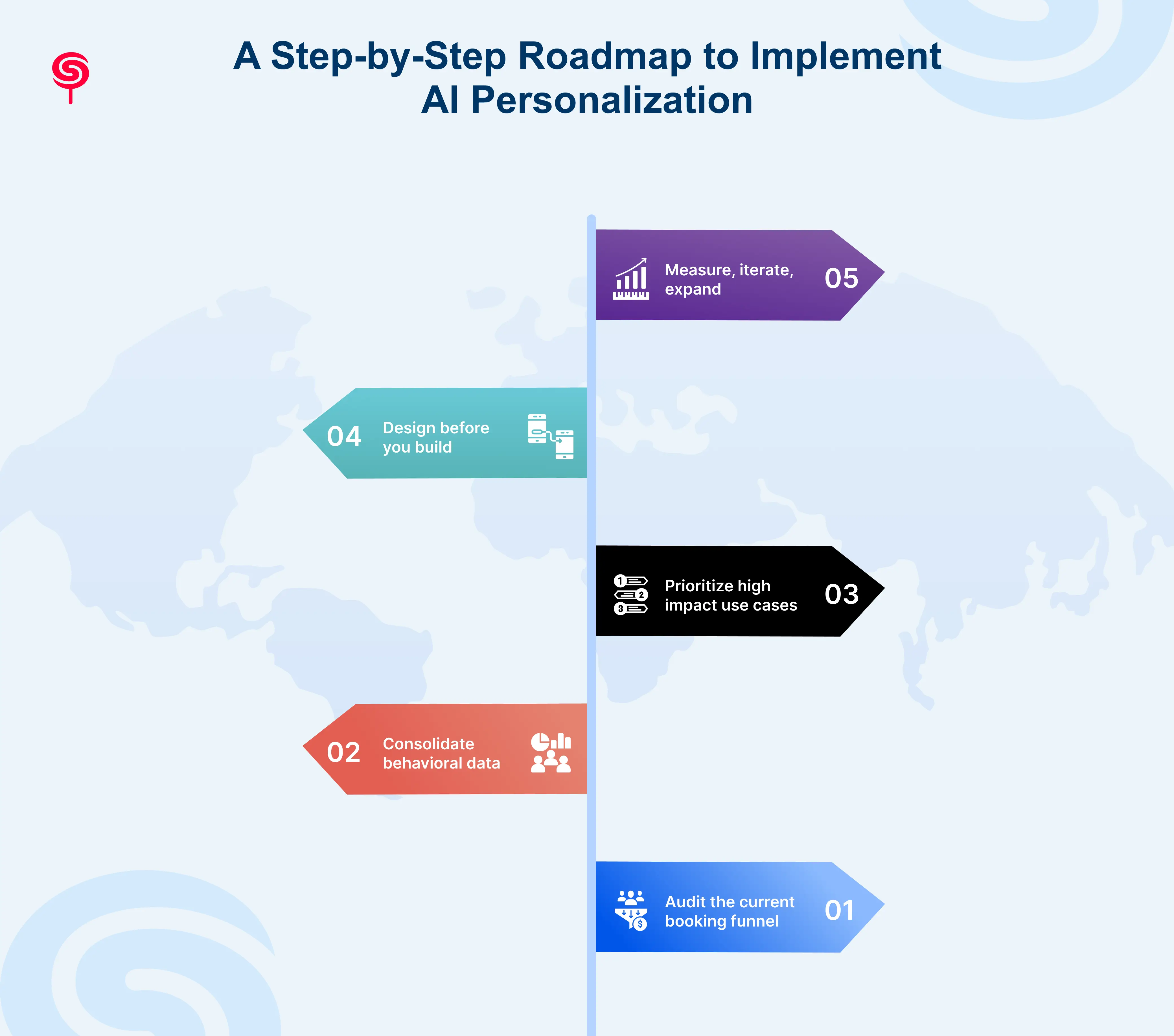
For founders and CTOs weighing where to start, a practical rollout typically follows five stages:
Step 1 — Audit the current booking funnel
Identify friction points using session recordings, funnel analytics, and a structured UX audit of search, itinerary, and checkout flows.
Step 2 — Consolidate behavioral data
Unify clickstream, booking history, and support interactions into a single customer data layer the foundation any recommendation engine needs.
Step 3 — Prioritize high-impact use cases
Rather than personalizing everything at once, start where it moves the needle most often search ranking and post-search recommendations.
Step 4 — Design before you build
Prototype the personalized experience (dynamic homepage, AI assistant, adaptive itinerary) and test it with real users before full engineering investment.
Step 5 — Measure, iterate, expand
Track conversion lift, average order value, and repeat-booking rate; use those signals to prioritize the next wave of personalization.
This sequencing matters because AI personalization for travel startups. Skipping the UX and data-foundation steps to jump straight to "add an AI feature" is the most common and most expensive mistake we see.
Real-World Examples of AI Personalization in Travel
Several patterns recur across successful AI-powered travel platforms:
Dynamic homepages that reorder destination carousels based on a returning user's past searches and bookings, rather than showing every visitor the same layout.
AI itinerary builders that assemble a day-by-day plan from a single prompt, then let users drag, remove, or swap activities combining automation with control.
Conversational travel assistants that handle rebooking, seat changes, or last-minute itinerary adjustments through chat rather than forcing users back through multi-step forms.
Predictive pricing nudges that surface time-sensitive offers only to users whose behavior signals genuine intent to book soon, rather than blasting discounts to everyone.
These aren't hypothetical they represent the direction the entire industry is moving, and platforms that adopt them early tend to compound their conversion advantage over competitors still running static experiences.
Business Benefits of AI Personalization for Travel Startups
When personalization is designed well, the business impact shows up in several measurable ways:
Higher conversion rates because users see relevant options faster and abandon less often during search.
Increased average order value through smarter upsells (add-on experiences, upgrades, insurance) surfaced at the right moment.
Improved retention and repeat bookings because returning users feel recognized rather than starting from zero each visit.
Reduced customer acquisition cost pressure since a better on-platform experience increases organic word-of-mouth and reduces reliance on paid channels to drive every booking.
Stronger brand differentiation in a crowded travel market, a genuinely intelligent, well-designed experience is one of the few defensible advantages left.
For Travel SaaS founders, these outcomes translate directly into stronger unit economics the numbers investors and boards actually care about.
Future Trends in AI Personalization for Travel Platforms
Looking ahead, a few trends are likely to define the next phase of travel technology trends:
Multimodal AI travel assistants that combine text, voice, and image input to plan trips in a single conversation.
Hyper-local personalization that adapts recommendations not just to the traveler but to real-time conditions at the destination weather, events, crowd levels.
Predictive disruption management, where AI anticipates flight delays or itinerary conflicts and proactively rebuilds the plan.
Privacy-first personalization, where platforms shift toward on-device or federated learning approaches that personalize experiences without over-collecting personal data an increasingly important trust signal for travelers.
Travel startups that start building toward this future now rather than reacting later will have a structural advantage as AI in the travel industry continues to mature.
How CandyStudio Helps Travel Startups Build AI-Driven User Experiences
This is exactly the intersection CandyStudio works in: the space between AI capability and usable, conversion-driven design. Our process for travel platforms typically combines a UX audit of the existing booking funnel, a product strategy sprint to identify the highest-impact personalization opportunities, and hands-on AI feature design from recommendation engine interfaces to conversational assistants grounded in CRO principles so every design decision ties back to bookings and revenue, not just aesthetics.
Rather than treating AI as a bolt-on feature, we help travel startups and TravelTech teams rebuild the experience around intelligence from the ground up so personalization feels native to the product, not layered on top of it.
Conclusion
AI personalization is no longer a competitive edge in travel it's quickly becoming the baseline expectation. The startups that will win the next few years won't simply be the ones with the most sophisticated models, but the ones who pair that intelligence with thoughtful, conversion-focused UX design. If your platform still treats every visitor the same way, the gap between you and AI-native competitors will only widen. The good news: with the right roadmap, that gap is closeable and often faster than founders expect.
Frequently Asked Questions
1. What is AI personalization in travel?
It's the use of machine learning and behavioral data to tailor search results, recommendations, pricing, and communication to individual travelers rather than showing every user the same experience.
2. How does AI personalize travel experiences?
By analyzing behavioral signals past searches, bookings, and interactions to power recommendation engines, dynamic content, and predictive suggestions throughout the booking journey.
3. What are the benefits of AI in travel booking?
Higher conversion rates, increased average order value, better retention, and stronger differentiation in a crowded travel market.
4. Can AI increase travel booking conversions?
Yes. Relevant search results, timely recommendations, and contextual pricing nudges directly reduce funnel drop-off and improve conversion rates.
5. How do travel companies use AI recommendations?
Through recommendation engines that suggest destinations, accommodations, and add-ons based on a traveler's own behavior and patterns from similar users.
Share this blog!
Latest Blogs
Explore our latest insights on design, AI, and digital innovation.