How Strategic Branding Increases Revenue and Customer Trust
Author
Vignesh
Published On
Most founders assume that if their product is good enough, growth will follow. Yet many startups with genuinely strong products still struggle to convert visitors into customers, close deals at the price they deserve, or build the kind of loyalty that fuels referrals. The missing piece is rarely the product itself it's strategic branding.
Strategic branding is the discipline of shaping how your company is perceived, understood, and trusted at every touchpoint. Done well, it doesn't just make a company "look good." It directly increases revenue, shortens sales cycles, and builds the customer trust that turns first-time buyers into long-term clients. This is especially true for SaaS founders, B2B companies, and early-stage startups preparing for growth or fundraising, where perception often determines whether a prospect even gives the product a chance.
In this guide, we'll break down exactly how strategic branding increases revenue and customer trust, the framework behind it, and how to start applying it to your own business.
The Power of Brand Value
Brand value isn't a soft metric it's a financial one. Companies with strong, consistent brands can command higher prices, close deals faster, and retain customers longer than competitors with equivalent products but weaker positioning. Brand equity influences nearly every business outcome that matters: customer acquisition cost, lifetime value, conversion rate, and even how investors evaluate a company during fundraising.
For startups, this is a competitive advantage that's often overlooked. While competitors pour budget into paid acquisition, a strategically branded company converts more of the traffic it already has because visitors understand what the company does, why it matters, and why they should trust it.
How Strategic Branding Increases Revenue and Customer Trust
At its core, branding works because humans make decisions based on perceived value and trust signals, not just features. Strategic branding shapes both of these simultaneously. It clarifies your value proposition so prospects understand what you do faster, and it builds the consistency and credibility that make people comfortable paying for it.
This isn't theoretical it shows up in measurable business outcomes: higher conversion rates on your website, better close rates in sales conversations, stronger pricing power, and increased customer retention. Companies that treat branding as a strategic growth lever, rather than a design afterthought, consistently outperform those that don't.
Your Product Isn't Always the Problem Your Brand Might Be
Why Good Products Still Struggle to Convert
It's common for founders to blame low conversion rates on pricing, features, or market fit. But often, the real issue is that visitors don't understand the value being offered quickly enough to act on it. If your brand messaging is unclear, your visual identity feels generic, or your positioning doesn't differentiate you from competitors, even an excellent product will underperform.
What Happens When Customers Don't Understand Your Value
When a brand fails to communicate clearly, customers hesitate. Hesitation shows up as abandoned demo requests, unanswered emails, and prospects who "need to think about it." Without strategic branding, companies end up competing on price because they haven't given customers any other reason to choose them.
What Is Strategic Branding?
Strategic branding is the intentional design of how a company is perceived its positioning, messaging, visual identity, and experience built around business goals rather than aesthetic preference. It's not just a logo or color palette; it's the strategic foundation that guides every customer-facing decision a company makes.
Strategic Branding vs. Traditional Branding
Traditional branding often focuses on visual identity alone: logos, fonts, and color schemes. Strategic branding goes further. It starts with research into the target audience, competitive landscape, and business goals, then builds positioning and messaging before any visual design begins. The result is a brand that isn't just attractive it's built to convert, retain, and scale.
The Key Components of a Strategic Brand
A strategic brand typically includes:
Brand positioning — where you sit relative to competitors
Brand messaging — how you communicate value and differentiation
Brand identity — the visual and verbal expression of the brand
Brand experience — how customers feel at every touchpoint
Brand consistency — the discipline of applying all of the above uniformly
Why Strategic Branding Matters for Startup
Early-stage companies often have the least room for error. Budgets are limited, and every touchpoint website, pitch deck, product UI has to work hard to build trust with a skeptical market. Strategic branding gives startups an outsized advantage: it lets a small team look and feel as credible as a much larger competitor, which matters enormously when trying to close enterprise deals or attract investors during fundraising.
How Does Branding Impact Sales?
Branding impacts sales at every stage of the funnel. At the top, clear positioning attracts the right leads instead of wasting attention on the wrong audience. In the middle, consistent messaging builds the confidence prospects need to move forward. At the bottom, strong brand perception reduces price objections, because buyers associate the brand with quality and reliability. Sales teams selling for a strategically branded company consistently report shorter sales cycles and fewer objections, because the brand has already done part of the persuasion work before the first conversation happens.
How Strategic Branding Builds Customer Trust
Clarity Makes Brands Easier to Trust
Confusing messaging creates doubt. When customers immediately understand what a company does and why it's different, they're far more likely to trust it enough to take the next step whether that's booking a call, signing up for a trial, or making a purchase.
Consistency Creates Familiarity
Trust is built through repetition. When a brand looks, sounds, and behaves consistently across the website, product, emails, and sales conversations, customers develop a sense of familiarity that reduces perceived risk. Inconsistent branding, on the other hand, subtly signals disorganization and disorganization is the opposite of trustworthy.
How Strategic Branding Can Increase Revenue
Pricing Power
Strong brands are not compared on price alone. When customers perceive higher value, they become more willing to pay premium pricing, which directly protects margins and shortens negotiation cycles.
Customer Loyalty
Strategic branding builds emotional and psychological consistency that keeps customers coming back. Loyal customers not only generate repeat revenue, they refer others reducing customer acquisition costs over time.
Better Messaging Can Improve Conversion
Clear, benefit-driven messaging directly improves conversion rates by helping visitors understand value faster and act with confidence, rather than bouncing to compare alternatives.
The Strategic Branding Framework for Startups
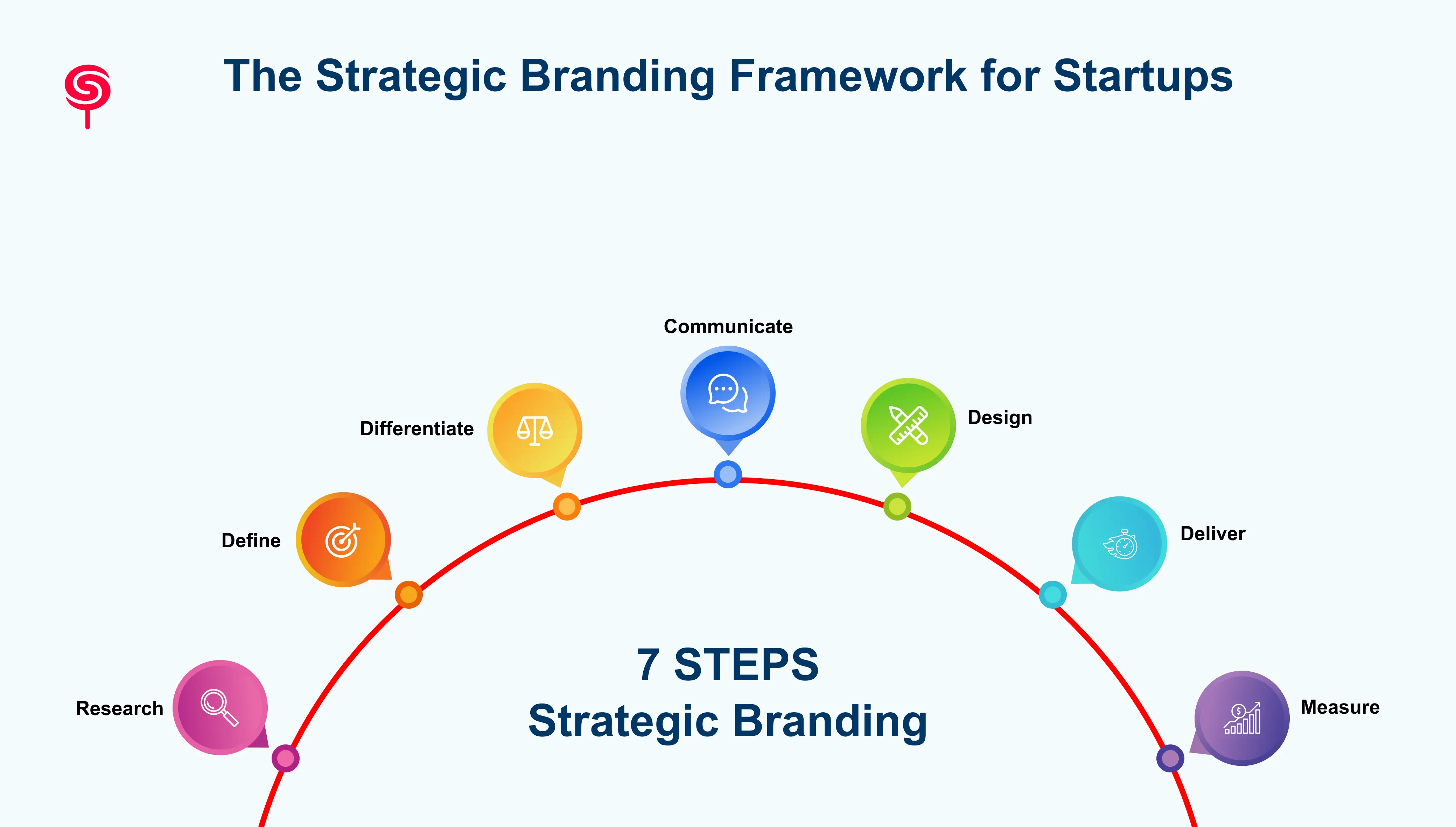
CandyStudio Design uses a seven-step framework to turn branding into a growth lever for startups and SaaS companies.
Step 1 — Research
Understand your audience, competitors, and market position before making any design decisions.
Step 2 — Define
Establish your brand promise, personality, and core positioning statement.
Step 3 — Differentiate
Identify what makes your company genuinely different not just what you say, but what you can prove.
Step 4 — Communicate
Build a messaging framework that translates your differentiation into language customers actually understand.
Step 5 — Design
Create the visual identity system that expresses your positioning consistently across every touchpoint.
Step 6 — Deliver
Apply the brand consistently across your website, product, sales materials, and customer experience.
Step 7 — Measure
Track how brand changes affect conversion, trust signals, and revenue over time then refine.
Real-World Examples of Strategic Branding
Apple — Consistency and Perceived Value
Apple's branding is built on rigorous consistency across every product and touchpoint, which reinforces a premium perception that supports strong pricing power.
Nike — Emotional Differentiation
Nike differentiates not through product specs alone, but through emotional brand storytelling that connects with customer identity and aspiration.
Airbnb — Building Trust Through Experience
Airbnb rebuilt trust in a category (staying in a stranger's home) that was inherently uncomfortable, using design, messaging, and consistent experience to make the unfamiliar feel safe.
How to Measure the ROI of Branding
Brand Awareness Metrics
Track direct traffic, branded search volume, and share of voice to understand how recognition is growing.
Trust and Engagement Metrics
Monitor time on site, return visits, and engagement with key trust-building pages like case studies or testimonials.
Conversion Metrics
Measure conversion rate changes on key pages before and after brand updates.
Revenue Metrics
Track average deal size and pricing power over time as brand perception strengthens.
Sales Metrics
Watch for shorter sales cycles and fewer price-based objections as leading indicators of brand trust.
The Branding ROI Formula
A simple way to frame branding ROI:
Branding ROI = (Increase in Conversion Rate × Average Deal Value × Deal Volume) − Branding Investment
While not every variable is perfectly quantifiable, this framing helps leadership teams connect branding investment to tangible business outcomes rather than treating it as a cost center.
Conclusion
Strategic branding isn't decoration it's a growth strategy. For startups, SaaS companies, and B2B founders preparing to scale, rebrand, or raise funding, the way your company is perceived directly determines how much revenue you capture and how much trust you earn. Companies that treat branding as strategically as they treat product or sales consistently see the results: higher conversion, stronger pricing power, and customers who stay.
If your website is generating traffic but not enough qualified leads, the problem may not be your product it may be that your brand hasn't been given the strategic foundation it needs to convert. That's exactly the kind of problem a human-centered design studio like CandyStudio Design is built to solve.
Frequently Asked Questions
1. How does branding influence sales?
A strong brand can make sales conversations easier by giving prospects a clear understanding of the company's value proposition and differentiation. Consistent messaging across marketing, website, product, and sales can create a more connected buying experience.
2. Why is branding important for startups?
Startups need to communicate their value quickly because customers have many alternatives. Strategic branding can help startups establish positioning, differentiate their product, communicate their value proposition, and create a scalable foundation for growth.
3. How does branding build customer trust?
Branding can build trust through clarity, consistency, credible messaging, recognizable experiences, social proof, and delivering on the brand promise. Trust develops through the total customer experience rather than visual identity alone.
4. How does strategic branding increase revenue?
Strategic branding increases revenue through pricing power, improved conversion rates, higher customer retention, and reduced customer acquisition cost. Strong brand positioning makes customers willing to pay more and stay longer.
5. Why is strategic branding important?
Strategic branding matters because it shapes customer perception, builds trust, and creates competitive advantage. For startups and SaaS companies, it's essential for differentiation, customer acquisition, and revenue growth.
Share this blog!
Latest Blogs
Explore our latest insights on design, AI, and digital innovation.