Brand Identity vs Brand Strategy: Which Actually Drives Revenue?
Author
Vignesh
Published On

Somewhere between your seed round and your Series A, a question starts nagging at you: is the business struggling because the product isn't resonating, or because nobody understands what you actually stand for? Founders often reach for a rebrand as the fix a new logo, a sleeker deck, a color palette that feels more "2026." But a fresh look rarely solves a problem rooted in positioning.
This is the confusion at the heart of the brand identity vs brand strategy debate. They get used interchangeably in founder Slack channels and investor updates, but they are not the same discipline, and confusing them is one of the most expensive mistakes an early-stage company can make. This guide breaks down what each actually is, which one moves revenue, and how to sequence both so your branding investment compounds instead of evaporating.
What Is Brand Strategy?
Brand strategy is the foundational thinking layer of a business the decisions about who you serve, what you stand for, how you're different, and why anyone should care. It includes brand positioning, brand purpose, target audience definition, value proposition, and brand messaging. Strategy answers questions like: What problem do we solve better than anyone else? Who is this really for? What do we want to be known for in five years?
Brand strategy has no visual output on its own. It's a set of decisions that everything downstream design, marketing, sales scripts, product roadmap should align to.
What Is Brand Identity?
Brand identity is the tangible, visible expression of that strategy. It includes your logo, typography, color palette, imagery style, and the broader design system that shows up across your website, product UI, and marketing. A strong visual brand identity also extends to verbal identity tone of voice, tagline, and how your brand "sounds" in copy.
Brand identity design is what people see and remember first. It's the surface layer but it's a surface that either reinforces your strategy or contradicts it.
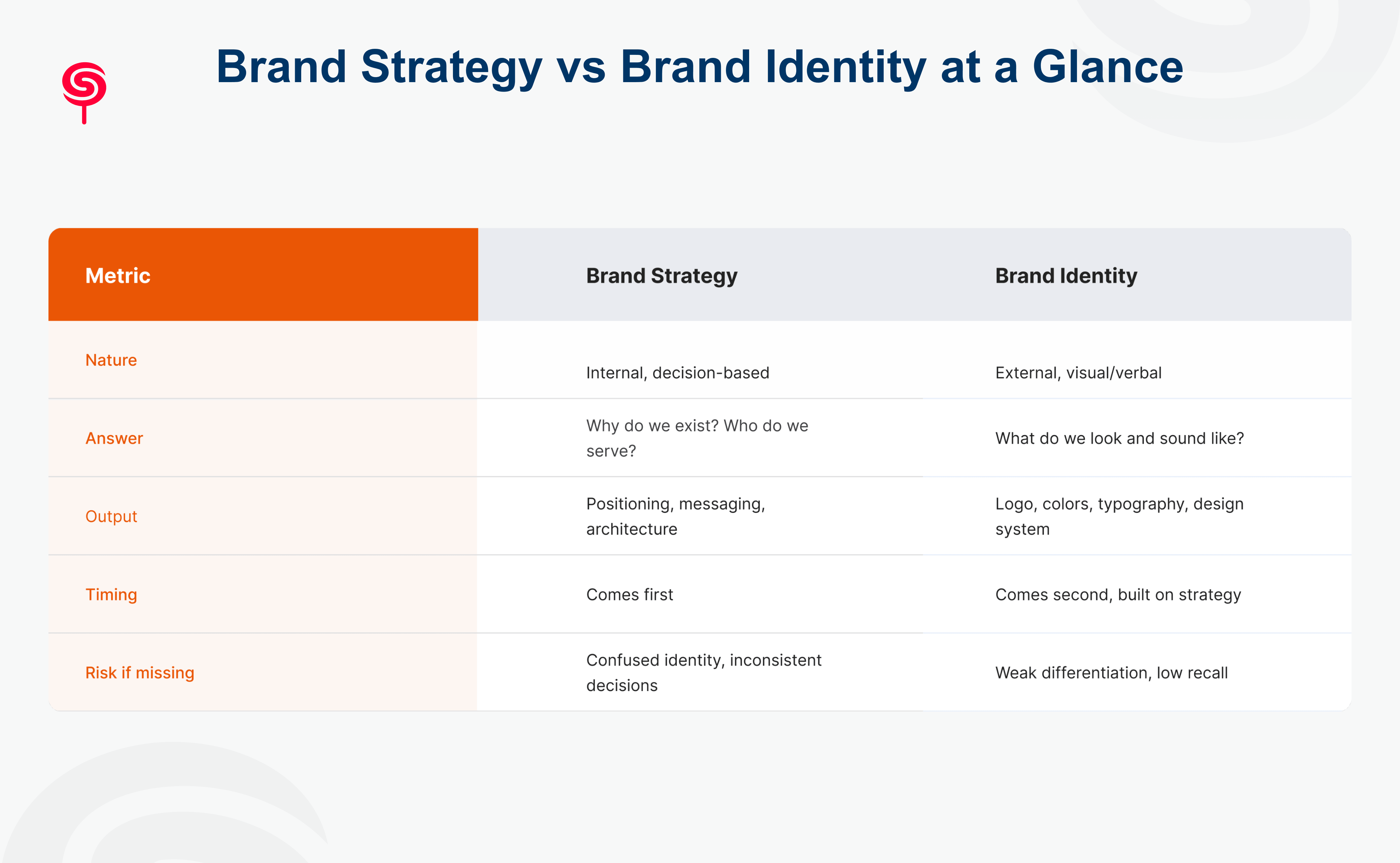
Brand Strategy vs Brand Identity at a Glance
What Does Brand Strategy Actually Do for a Business?
Brand strategy gives every future decision a filter. It shapes product priorities, informs pricing conversations, and gives your sales team language that actually differentiates you instead of sounding like every other SaaS landing page. Companies with clear brand positioning close deals faster because prospects understand the "why us" before the first call even starts.
What Does Brand Identity Actually Do?
Brand identity builds recognition and trust at a glance. In a crowded SaaS category, a polished, distinctive brand identity system signals credibility it tells a buyer "this company is serious" before they've read a single feature list. It also improves usability and conversion: consistent visual language across your product and marketing reduces cognitive friction and builds familiarity, which shortens the path to purchase.
Which Drives Revenue: Brand Strategy or Brand Identity?
The honest answer: neither drives revenue alone, but they drive it differently, and strategy is the multiplier. Brand identity without strategy is decoration it might get attention, but it won't hold it. Brand strategy without identity is invisible the right message trapped with no distinctive way to reach the market. Revenue comes from the combination: a sharp strategy that gets remembered because the identity carries it well.
How Brand Strategy Can Influence Revenue
Brand positioning strategy directly affects your ability to charge premium pricing buyers pay more when they believe you're solving a specific, well-articulated problem better than alternatives. Clear brand messaging shortens sales cycles because prospects self-qualify faster. Differentiation strategy reduces reliance on discounting, since the business isn't competing on price alone. And brand architecture decisions (how you name and structure products) directly affect expansion revenue and cross-sell clarity.
How Brand Identity Can Influence Revenue
Visual brand identity affects conversion rate optimization in very concrete ways: trust signals on a landing page, consistency between ad creative and product UI, and a design system that makes onboarding feel premium instead of janky. First impressions form in milliseconds, and a founder-designed logo next to inconsistent fonts can quietly undercut a strong sales pitch. Strong brand identity also compounds it reduces the marketing cost of repetition, because people recognize you faster in a crowded feed.
What Happens When You Build Identity Without Strategy?
This is the classic "pretty but pointless" rebrand. The company invests in a striking new visual identity, but the underlying positioning is still vague, so the new look doesn't change how the market perceives the business. Messaging stays generic, sales conversations don't improve, and within 18 months the identity feels stale again because it was never anchored to anything.
What Happens When You Have Strategy Without Identity?
Here, the thinking is sharp but the execution is invisible. A founder can articulate positioning perfectly in a pitch deck, but the website, product, and marketing still look like a template. The market never encounters the strategy in a form it can recognize or remember, so the differentiation exists only in internal documents not in the buyer's mind.
Why Startups Need Both Brand Strategy and Brand Identity
Startups operate with limited attention and limited budget, which makes half-measures especially costly. Strategy without identity fails to reach the market. Identity without strategy fails to convert it. Together, they compound: a sharp position, expressed through a distinctive, consistent identity, is what lets an early-stage company punch above its size against better-funded competitors.
When Should a Startup Invest in Brand Strategy?
Brand strategy should come early ideally before a public launch, and definitely before a rebrand. Signals that it's time: messaging feels inconsistent across the team, sales reps describe the product differently in every call, or the company is entering a new market segment. A brand strategy for startup exercises doesn't need to be exhaustive, but it needs to exist before design work starts.
When Should a Startup Invest in Brand Identity?
Brand identity investment makes sense once positioning is stable typically around a funding milestone, a product relaunch, or when the current visual identity is actively undermining credibility (inconsistent, outdated, or clearly built in an afternoon). Investing in identity before strategy is settled usually means redoing it within a year.
Brand Strategy + Brand Identity: The Complete Framework
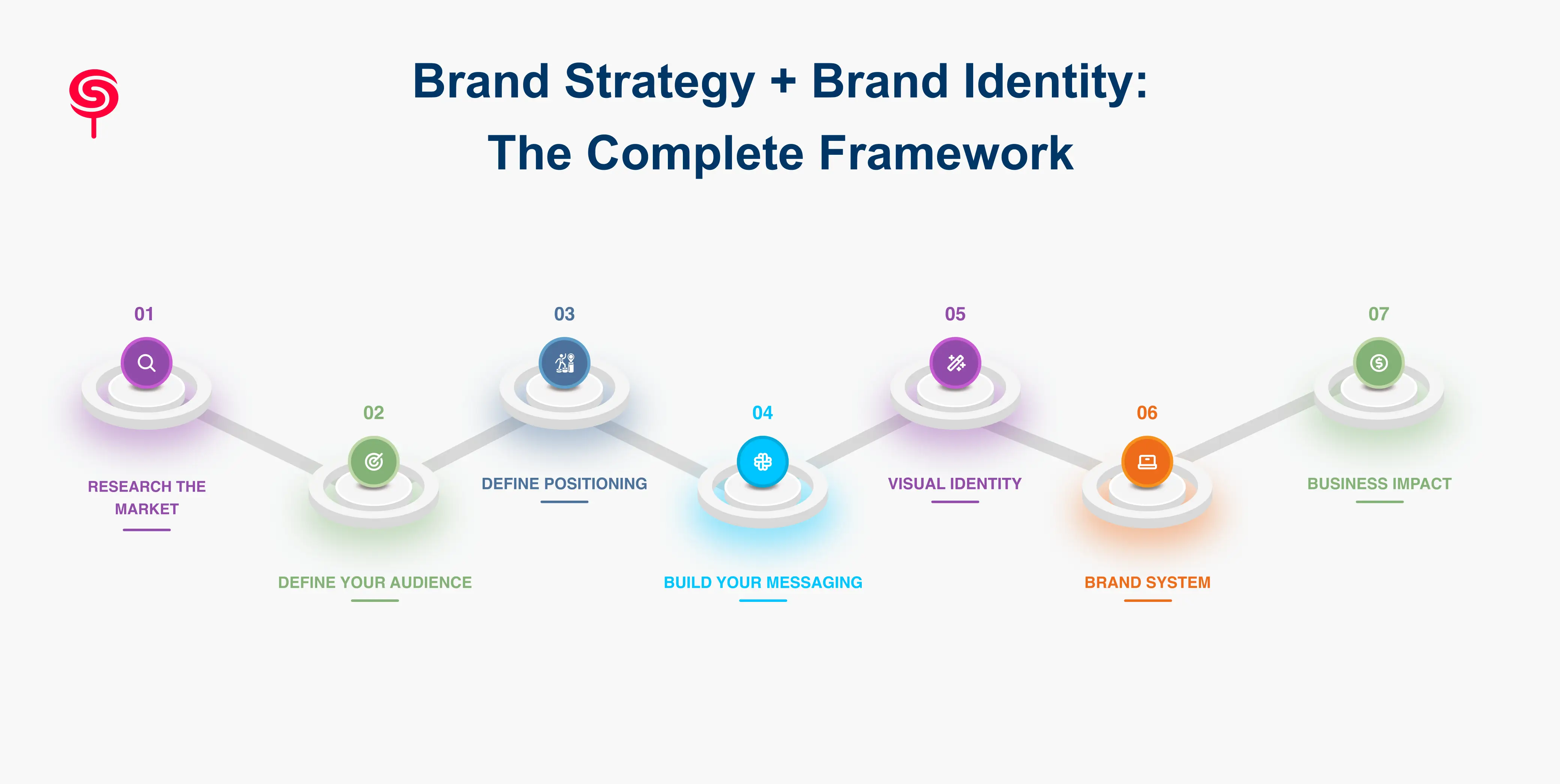
Step 1: Research the Market
Understand competitors, category conventions, and where genuine white space exists.
Step 2: Define Your Audience
Get specific about who you're for and, just as importantly, who you're not for.
Step 3: Define Positioning
Articulate the one thing you want to own in the buyer's mind.
Step 4: Build Your Messaging
Translate positioning into language your team can actually use website copy, sales scripts, onboarding flows.
Step 5: Create the Visual Identity
Design the logo, typography, color system, and imagery that express the positioning.
Step 6: Build the Brand System
Document guidelines so the identity stays consistent as the team scales past the founders.
Step 7: Measure Business Impact
Track whether the rebrand actually moved the metrics that matter more on this below.
Real-World Examples: Strategy vs Identity
Consider two SaaS companies at similar stages. One invests heavily in a slick new visual identity but keeps generic "all-in-one platform" messaging conversion barely moves. The other tightens its positioning around a single, specific outcome for a defined audience, then builds an identity system that reflects that focus consistently across product and marketing. The second company sees faster sales cycles and stronger word-of-mouth, not because the design is objectively "better," but because strategy and identity are pulling in the same direction.
The Real Revenue Impact of Strong Branding
Strong branding strategy and identity working together shows up in business metrics over time: higher close rates because positioning pre-qualifies leads, better retention because product and brand experience feel coherent, and lower customer acquisition costs because a recognizable brand needs less repetition to land. Branding ROI is rarely instant; it's a compounding asset, similar to product quality or customer trust.
How to Measure Whether Your Branding Is Working
Brand Awareness
Are you showing up in category conversations, search results, and referrals without paid spend?
Customer Perception
Do prospects describe you the way you intend to be described in your words, not a generic category description?
Marketing Performance
Are conversion rates, click-throughs, and cost-per-lead improving across owned channels?
Sales Performance
Are sales cycles shortening? Are reps spending less time explaining what you do and more time closing?
Business Performance
Ultimately is revenue growing, is churn declining, and is pricing power increasing?
Conclusion
Brand identity and brand strategy aren't competing priorities they're sequential ones. Strategy defines what your business should be known for; identity makes sure the market actually notices. Startups that treat branding as "just a logo" leave revenue on the table, and startups that over-invest in strategy decks without ever building a market-facing identity stay invisible. The founders who get this right treat branding as infrastructure, not decoration and build both, in the right order, with a partner who understands how design decisions connect to business outcomes.
Frequently Asked Questions
1. What is the difference between brand identity and brand strategy?
Brand strategy is the internal thinking positioning, audience, messaging that defines what a business stands for. Brand identity is the visual and verbal expression of that strategy, including logo, color, typography, and tone of voice.
2. Do startups need brand strategy or brand identity?
Startups need both, but strategy should be defined first, even briefly, before investing in a full visual identity system.
3. How much does startup branding cost?
Costs vary widely by scope a focused strategy engagement and a full identity system are priced differently, and most agencies scope based on company stage and goals rather than a flat rate.
4. Should a startup hire a branding agency?
It depends on internal expertise and stage. Startups without dedicated brand or design leadership often benefit from an agency partner who can align strategy and identity from the start, rather than solving each in isolation.
Share this blog!
Latest Blogs
Explore our latest insights on design, AI, and digital innovation.