Branding Mistakes That Are Quietly Killing Your Conversion Rate
Author
Vignesh
Published On

Your website gets traffic. Your product is solid. Your team works hard on messaging, design, and campaigns. And yet the leads aren't converting the way they should.
If this sounds familiar, the problem probably isn't your marketing funnel. It's your brand.
Most founders assume branding is about looking good a nice logo, a clean color palette, a polished homepage. But branding is actually a trust mechanism. It answers the questions your visitors are silently asking before they ever fill out a form: Is this company credible? Do they understand my problem? Can I trust them with my money, my data, or my business?
When branding fails to answer those questions clearly, visitors leave not because your product is wrong for them, but because your brand never gave them a reason to believe it was right.
This is the quiet conversion killer nobody talks about. Not a broken CTA button. Not a slow page load. A brand that doesn't build trust fast enough to keep someone from bouncing.
In this guide, we'll break down the 10 branding mistakes most commonly responsible for weak conversion rates especially among startups, SaaS companies, and B2B founders and exactly how to fix each one.
How Branding Impacts Your Conversion Rate
Conversion rate optimization is usually treated as a UX and copywriting problem: better headlines, better CTAs, better forms. And those things matter. But brand strategy sits underneath all of it, shaping how every one of those elements is received.
Here's the connection most teams miss: branding determines trust, and trust determines conversion.
A visitor decides whether your business feels credible within seconds of landing on your site long before they read your value proposition or your pricing page. That first impression is built entirely from brand signals: visual identity, tone of voice, positioning clarity, and consistency across every touchpoint.
When brand strategy and conversion rate optimization are treated as separate disciplines, companies end up with beautifully designed pages that still don't convert, because the underlying brand doesn't earn trust quickly enough. This is especially true for SaaS conversion rate performance, where buyers are comparing multiple vendors and using brand perception as a filtering mechanism before they even evaluate features.
The businesses that win aren't necessarily the ones with the best product. They're the ones whose brand removes friction and builds confidence at every single step of the buyer journey.
10 Branding Mistakes That Are Quietly Killing Your Conversions
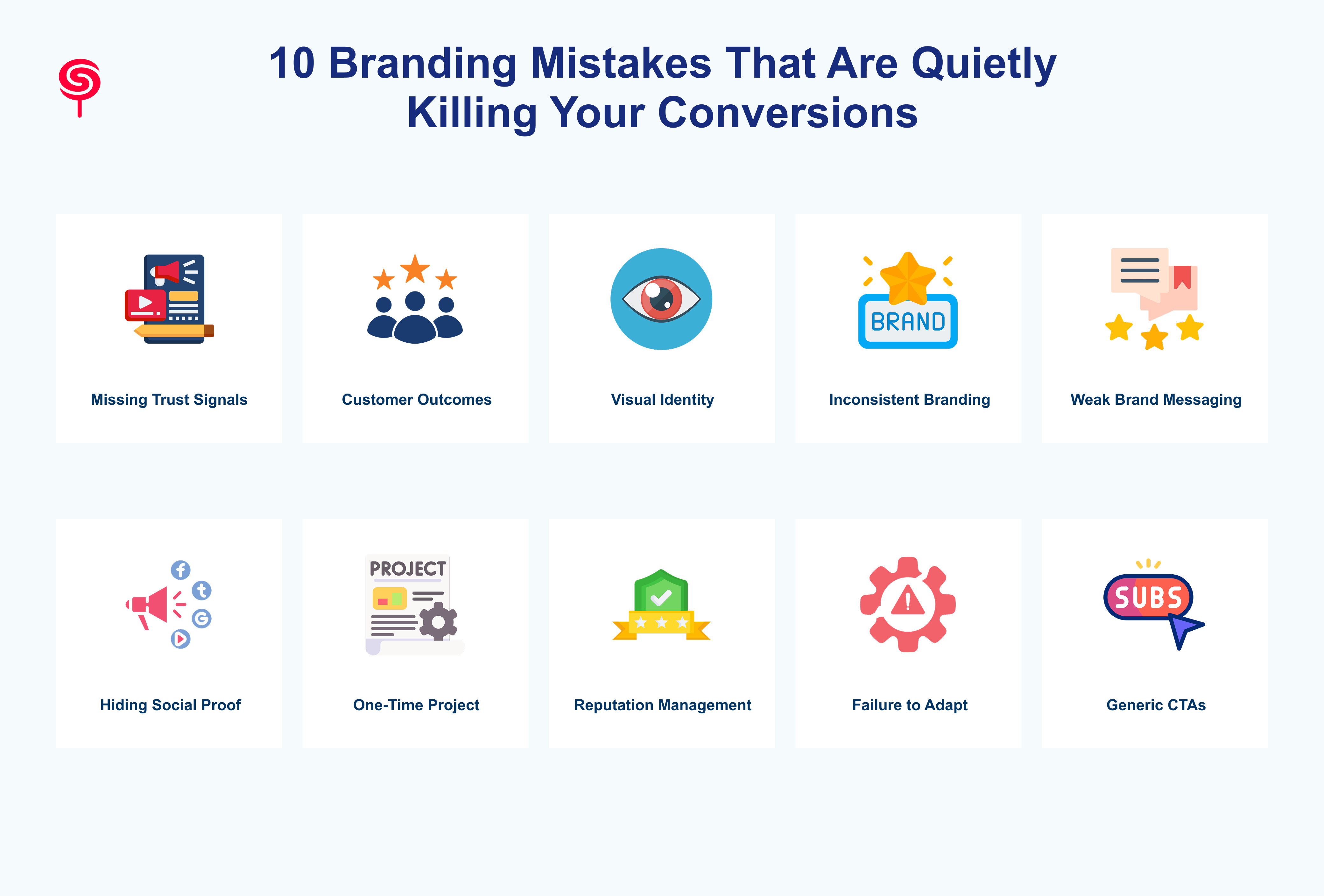
Mistake 1: Missing Trust Signals
Startups often assume their product speaks for itself. It doesn't to a stranger seeing your brand for the first time. Without visible proof of credibility (client logos, certifications, security badges, founder credentials, press mentions), visitors have no reason to move past the homepage.
How to Fix It
Audit every key page and ask: "If I knew nothing about this company, what would convince me they're legitimate?" Add client logos above the fold, include specific results (not vague claims), and make credentials visible not buried in an About page.
How to Know It's Working
Watch for reduced bounce rate on landing pages and increased scroll depth. If visitors are engaging past the hero section, your trust signals are doing their job.
Mistake 2: Talking About Features Instead of Customer Outcomes
Many B2B and SaaS websites read like spec sheets. They list what the product does instead of what changes for the customer once they use it. Feature-first messaging forces visitors to do the translation work themselves and most won't bother.
How to Fix It
Rewrite your messaging hierarchy so outcomes lead and features support. Instead of "AI-powered analytics dashboard," lead with "Know exactly which campaigns are making you money in real time."
How to Know It's Working
Track time-on-page and demo request rates. Outcome-driven messaging typically increases qualified form submissions because visitors self-select based on relevance, not curiosity.
Mistake 3: Having a Visual Identity That Doesn't Match Your Positioning
If your brand positioning claims "premium" or "enterprise-grade," but your visual identity looks like a weekend side project, the mismatch creates subconscious doubt. Brand perception is judged visually before it's judged verbally.
How to Fix It
Align your visual identity typography, color system, imagery, spacing with the tier of business you're positioning yourself as. A premium brand strategy agency will treat design as a strategic asset, not decoration.
How to Know It's Working
Look at qualitative signals: are inbound leads describing you the way you want to be described? Are you attracting the pricing tier and client type your positioning intends to attract?
Mistake 4: Inconsistent Branding Across Every Customer Touchpoint
A polished website paired with a generic sales deck, mismatched email signatures, and a completely different tone on social media tells visitors your brand isn't fully in control of its own story. Inconsistency quietly erodes brand recognition and trust.
How to Fix It
Create (or update) brand guidelines covering tone, visuals, and messaging then apply them everywhere: website, sales collateral, onboarding emails, social presence, and support interactions.
How to Know It's Working
Customers and prospects should be able to recognize your brand without seeing your logo, based on tone and visual consistency alone.
Mistake 5: Having a Beautiful Website With Weak Brand Messaging
Design can only carry a brand so far. A visually stunning site with vague, jargon-filled, or generic messaging still fails to convert because visitors don't understand what you actually do or why it matters to them.
How to Fix It
Pair every design decision with a messaging strategy session. Before touching visuals, define your positioning statement, your core value proposition, and the specific language your ideal customer already uses to describe their problem.
How to Know It's Working
Sales and support teams should notice prospects using your own messaging language back at you a sign your positioning has landed.
Mistake 6: Hiding Social Proof and Trust Signals
Testimonials, case studies, and reviews are often treated as an afterthought tucked into a footer or a separate page nobody visits. But social proof is one of the strongest conversion levers available, and hiding it wastes its impact entirely.
How to Fix It
Place specific, outcome-focused testimonials near key decision points: pricing pages, CTAs, and feature sections not just a dedicated testimonials page.
How to Know It's Working
A/B test pages with and without visible social proof near conversion points. Expect measurable lifts in form completions and demo bookings.
Mistake 7: Treating Branding as a One-Time Project
Many founders invest in a brand once usually at launch and never revisit it. But your positioning, audience, and competitive landscape evolve. A brand identity frozen in time gradually drifts out of sync with the business it represents.
How to Fix It
Treat brand strategy as an ongoing function, not a one-off deliverable. Revisit positioning and messaging at every major milestone: new funding round, new product line, or shift in target market.
How to Know It's Working
Your brand should always feel like an accurate reflection of where the company is today not where it was 18 months ago.
Mistake 8: Neglecting Reputation Management
Brand perception isn't only shaped by what you say about yourself it's shaped by what others say about you, too. Unanswered reviews, inconsistent public messaging, or ignored feedback all quietly damage brand trust for prospects doing due diligence.
How to Fix It
Actively monitor and respond to reviews, mentions, and public feedback. Build a lightweight reputation management process into your marketing operations.
How to Know It's Working
Track review sentiment and response rates over time, and monitor whether prospects mention reputation as a factor in sales conversations (in a positive way).
Mistake 9: Failure to Adapt and Evolve
Brands that don't evolve alongside their market start to feel outdated even if the product itself is cutting-edge. This mismatch between an evolving product and a static brand quietly signals stagnation to sophisticated buyers.
How to Fix It
Schedule regular brand health audits (annually, at minimum) covering positioning, visual identity, and messaging relevance against your current market and competitors.
How to Know It's Working
Your brand should be actively discussed internally, not just maintained. If leadership references brand positioning in strategic decisions, it's alive and working.
Mistake 10: Using Weak or Generic CTAs
"Learn More" and "Submit" are conversion killers disguised as harmless defaults. Generic CTAs fail to communicate value or urgency, leaving visitors with no compelling reason to act right now.
How to Fix It
Replace generic CTAs with outcome- and action-specific language: "Get Your Free UX Audit," "See Your Custom Brand Strategy," or "Book a Discovery Call." Make the next step feel like a clear, low-risk decision.
How to Know It's Working
Click-through rate on CTAs is the clearest early signal. Expect improvement almost immediately after testing more specific, benefit-driven copy.
How to Fix Branding Problems That Hurt Conversion
Fixing these mistakes individually helps but the highest-impact approach is treating brand strategy and conversion rate optimization as one integrated system, not two separate workstreams.
That means starting with a full UX and brand audit: analyzing how your current positioning, visual identity, and messaging perform against real user behavior, not assumptions. From there, the fix usually involves three coordinated moves sharpening brand positioning, rebuilding messaging around customer outcomes, and redesigning key touchpoints so visual identity and conversion-focused UX reinforce each other instead of working against each other.
This is precisely the gap most in-house teams struggle to close, because it requires brand strategists, UX designers, and conversion specialists working from the same strategic brief not three disconnected initiatives.
How Better Branding Creates Better Business Outcomes
When branding and conversion strategy are aligned, the results compound. Trust builds faster, so sales cycles shorten. Messaging resonates immediately, so marketing spend goes further. Visual identity reinforces credibility, so fundraising conversations start from a stronger position.
Companies preparing for a rebrand, a new product launch, or a fundraising round are especially vulnerable to the mistakes above because in those moments, brand perception is being judged more intensely than usual, by investors, partners, and new customers alike. Getting brand strategy right at these inflection points isn't cosmetic. It directly protects revenue, valuation, and growth velocity.
When Should a Startup Invest in Brand Strategy?
There's no single "right" moment, but a few signals reliably indicate it's time:
Your website gets consistent traffic, but conversion rates stay flat despite UX and copy tweaks.
You're preparing for a fundraising round and need to present a credible, investable brand.
You're launching a new product or entering a new market segment.
Your positioning no longer reflects who you actually serve or how you've evolved.
Sales teams are struggling to explain "why us" in a way that lands consistently.
If two or more of these apply, brand strategy isn't a nice-to-have it's the highest-leverage investment available for improving conversion performance.
Conclusion
Conversion rate problems are rarely just a UX or copywriting issue. More often, they're a symptom of deeper branding mistakes missing trust signals, mismatched visual identity, inconsistent touchpoints, and messaging that talks about features instead of outcomes.
Fixing these issues requires more than isolated tweaks. It requires a strategic partner who understands branding, UX, and conversion as one connected system.
That's exactly the kind of work we do at CandyStudio helping startup founders, SaaS companies, and growth-stage teams turn weak brand positioning into a genuine competitive advantage. If your traffic isn't converting the way it should, the fix might not be your funnel. It might be your brand.
Ready to find out what's really holding your conversion rate back? [Book a discovery call with CandyStudio]
Frequently Asked Questions
1. How does branding affect conversion rates?
Branding shapes how quickly visitors trust a company. Strong brand positioning, consistent visual identity, and outcome-focused messaging reduce hesitation and friction, which directly increases conversion rates especially for SaaS and B2B companies with longer buying cycles.
2. What are the most common branding mistakes startups make?
The most common mistakes include missing trust signals, feature-focused messaging instead of outcome-focused messaging, inconsistent branding across touchpoints, weak CTAs, and treating branding as a one-time project instead of an evolving strategy.
3. Is branding different from marketing for startups?
Yes. Marketing drives traffic and awareness; branding determines whether that traffic converts once it arrives. Strong marketing paired with weak branding often produces high traffic but low conversion a common and costly mismatch.
4. When should a startup invest in brand strategy versus just optimizing the website?
If conversion issues persist after UX and copy improvements, or if you're preparing for fundraising, a rebrand, or a new product launch, brand strategy delivers more leverage than isolated website optimization.
5. Can branding really improve conversion rates by 20–50%?
Yes. Data from 2026 shows strong brand execution can improve conversion rates by 20–50% depending on category and starting point. This comes from reduced friction, increased trust, clearer messaging, and stronger differentiation.
Share this blog!
Latest Blogs
Explore our latest insights on design, AI, and digital innovation.