Why Great Products Fail Without Great Branding
Author
Vignesh
Published On
Every year, thousands of genuinely well-built products quietly disappear. The code was clean. The features solved real problems. The founders worked around the clock to ship something useful. And yet, the product never found traction.
This is one of the most persistent and least understood patterns in the startup world: why do great products fail? The answer, more often than not, has nothing to do with engineering quality or feature depth. It has everything to do with branding.
A product without a brand is a commodity. It competes on price, on feature checklists, and on whoever shouts loudest in a crowded market. A product wrapped in strong branding competes on trust, memorability, and perceived value and that's a fight most competitors can't win against.
This article breaks down why branding is the missing multiplier behind product success, what branding actually means beyond logos and colors, and how founders can build a brand that customers trust from day one.
Why Great Products Fail Without Great Branding (And How Startups Can Build Brands That Customers Trust)
Founders tend to assume that product quality is the primary driver of adoption. In reality, customers rarely evaluate products on merit alone they evaluate them through the lens of trust, clarity, and emotional resonance, all of which are functions of branding, not engineering.
The Real-World Problem
A founder builds a product that objectively outperforms the market leader. It's faster, cheaper, and more flexible. Yet six months after launch, the market leader is still winning nearly every competitive deal. Sales calls turn into "let us think about it." Free trials go unconverted. Investors ask, politely, why growth has stalled.
This isn't a product problem. It's a perception problem and perception is branding's job.
Pain Points & Business Struggles
Startups without strong branding tend to experience the same recurring struggles:
High customer acquisition cost because nothing about the product is memorable enough to spread by word of mouth
Price-based competition, since without differentiation, price becomes the only lever left
Low trust from enterprise buyers who can't tell if the company will exist in two years
Inconsistent messaging across the website, sales deck, and product UI, which quietly erodes credibility
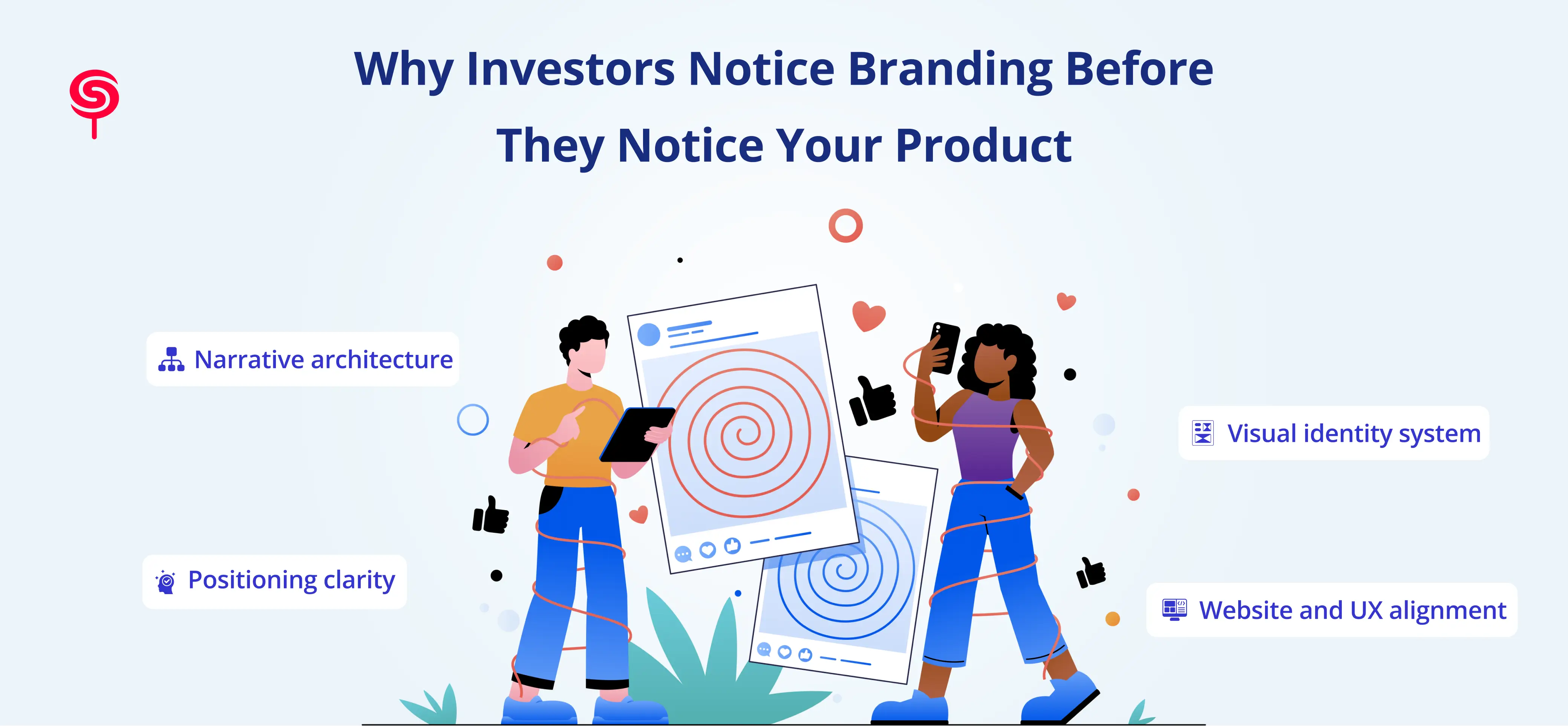
Difficulty raising funding, because investors read weak branding as a signal of unclear positioning.
Why Branding Changes Everything
Branding is not decoration layered on top of a finished product. It's the strategic framework that determines how the product is perceived, remembered, and chosen. When branding is strong, every other growth lever sales, retention, referrals, pricing power becomes easier to pull.
What Branding Really Means (Beyond Logos and Colors)
Most founders equate branding with visual identity: a logo, a color palette, a font pairing. That's brand design, and it's only the surface layer.
Branding, in the strategic sense, is the sum total of every belief a customer holds about a company. It includes:
Positioning what the product stands for, and what it deliberately doesn't
Voice how the company sounds across every piece of communication
Experience how the product feels to use, moment by moment
Perception the story customers tell themselves and others about why they chose you
A logo can be redesigned in a weekend. A brand takes months of consistent, deliberate decisions to build and moments of inconsistency to damage.
How Great Branding Creates Competitive Advantage
Strong branding creates advantage in ways that are difficult for competitors to replicate, because they compound over time rather than existing as a single feature that can be copied.
Brand trust reduces the perceived risk of buying, which shortens sales cycles
Brand recognition lowers acquisition costs, since recognized brands see improved organic and referral traffic
Brand consistency increases retention, because customers who know what to expect stay longer
Brand equity increases valuation, since investors price in the intangible value of market position, not just revenue
In a market where most products eventually reach feature parity, brand becomes the primary basis for differentiation.
The Five Pillars of a Strong Startup Brand
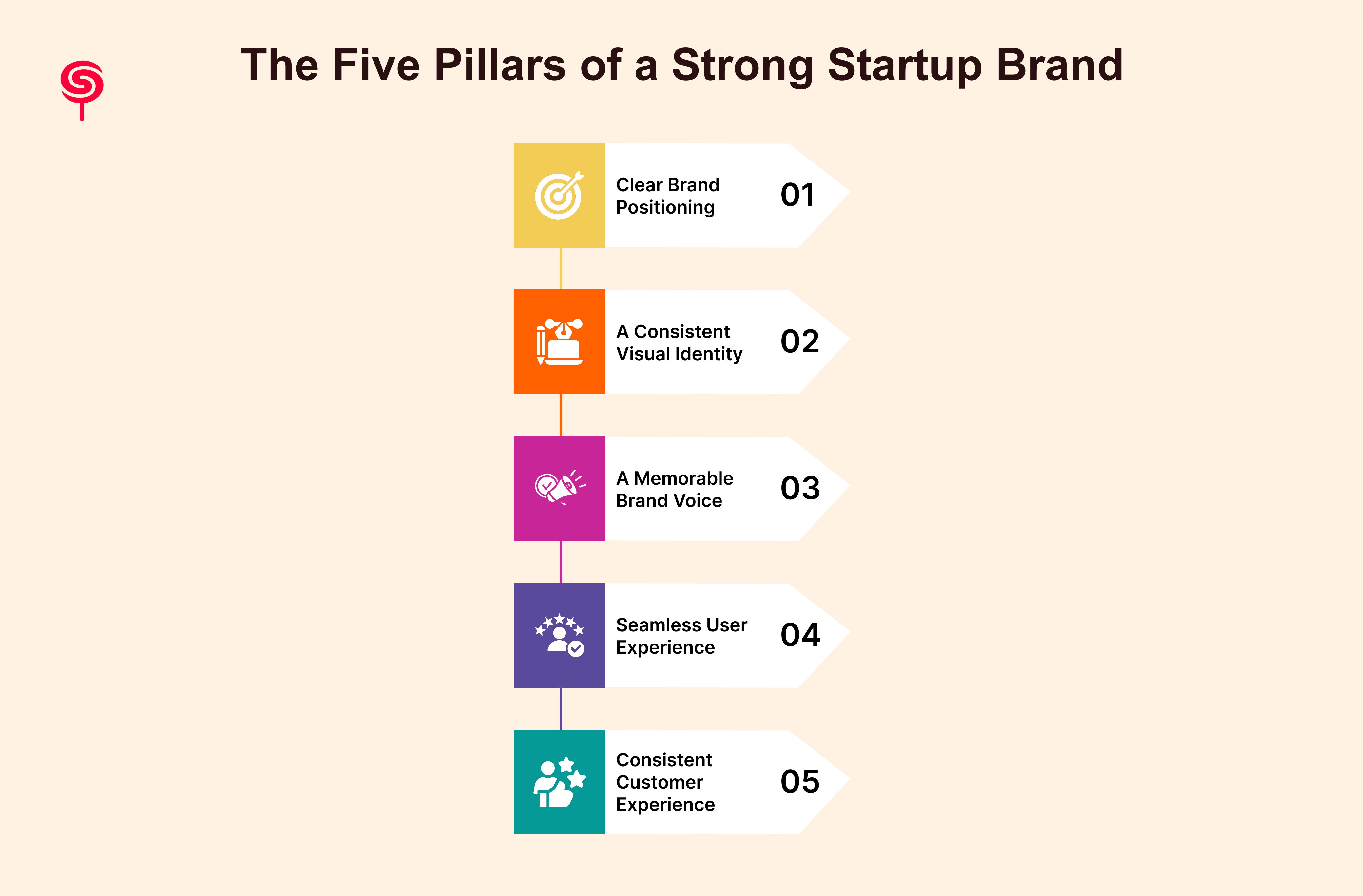
Pillar 1 – Clear Brand Positioning
Positioning answers a simple but rarely well-answered question: why should this specific customer choose us over every other option, including doing nothing? Without a sharp answer, marketing messages become generic, and generic messages don't convert.
Pillar 2 – A Consistent Visual Identity
Visual identity logo, typography, color, iconography should function as a recognition system. The goal isn't to look impressive in isolation; it's to be instantly recognizable across every touchpoint, from the product UI to a LinkedIn post.
Pillar 3 – A Memorable Brand Voice
Voice is how the brand sounds in writing: in onboarding emails, error messages, landing pages, and support chats. A distinct voice makes a brand feel like a consistent entity rather than a patchwork of departments writing in isolation.
Pillar 4 – Seamless User Experience
Branding lives inside the product, not just around it. Every interaction onboarding flow, empty states, loading screens, error handling either reinforces the brand promise or contradicts it. This is where branding and UX design become inseparable.
Pillar 5 – Consistent Customer Experience Across Every Touchpoint
From the first ad impression to the renewal email eighteen months later, the experience needs to feel like it comes from the same company with the same standards. Inconsistency at any single touchpoint quietly undermines the trust built everywhere else.
Why Branding and UX Must Work Together
Branding and product design are often managed by separate teams with separate goals, which is one of the most common and costly structural mistakes a startup can make.
UX determines how a product functions. Branding determines how a product feels and what it means. When they're aligned, the product experience actively reinforces the brand promise a fintech brand built on "clarity" should have an interface that is genuinely uncluttered; a brand built on "speed" should have an onboarding flow with zero unnecessary friction.
When branding and UX are disconnected, the result is a product that looks polished in the marketing deck but feels inconsistent the moment a user actually opens the app. That gap is where trust and conversions are lost.
This is precisely the intersection where product design agencies add the most strategic value: not just making interfaces attractive, but ensuring the interface itself is an expression of the brand strategy.
Real-World Examples of Great Products with Great Branding
Companies that scale successfully rarely win purely on technical superiority. They win because branding and product experience reinforce each other at every step:
Category-defining SaaS companies invest early in a distinct visual and verbal identity, well before they have significant revenue, because they understand brand recognition compounds
Consumer fintech brands succeed by pairing a simple, trustworthy visual language with a genuinely simplified user experience the design is the trust signal
Developer tools that scale rapidly often build strong brand voice into documentation and error messages, turning routine technical touchpoints into brand-reinforcing moments
The common thread: none of these companies treated branding as a launch-day afterthought. It was embedded into the product strategy from the beginning.
A Practical Branding Roadmap for Early-Stage Startups
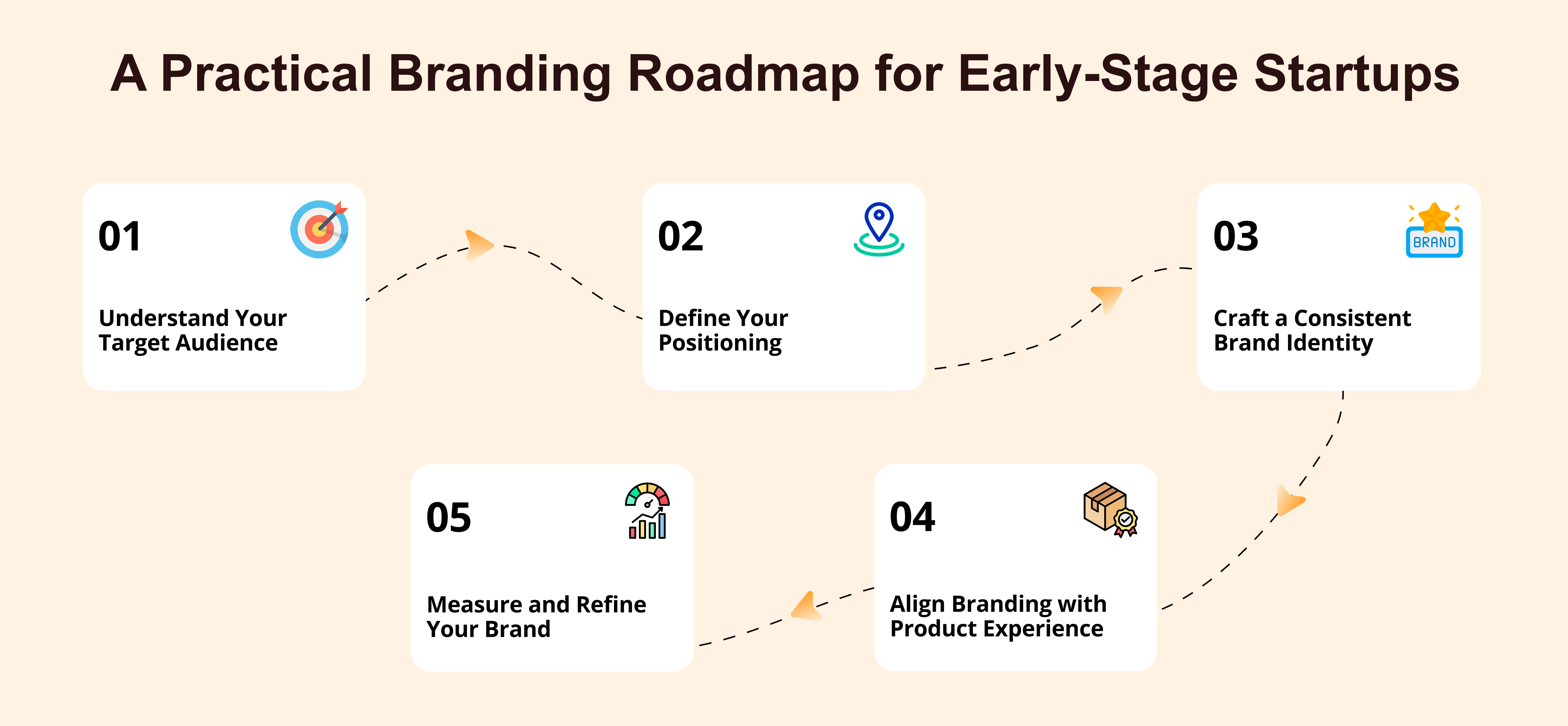
Step 1 – Understand Your Target Audience
Branding decisions are meaningless without clarity on who they're for. Define the specific customer segment, their pain points, and the language they already use to describe their problems.
Step 2 – Define Your Positioning
Articulate what makes the product different, in a single clear sentence a customer could repeat to a colleague. If the team can't do this internally, customers won't be able to either.
Step 3 – Craft a Consistent Brand Identity
Build the visual and verbal identity system logo, color, typography, voice guidelines as a unified system, not a collection of disconnected assets.
Step 4 – Align Branding with Product Experience
UX Audit the actual product experience against the brand promise. If the brand claims simplicity but onboarding takes fifteen steps, that's the gap to close first.
Step 5 – Measure and Refine Your Brand
Track brand-level metrics alongside product metrics: unaided brand recall, referral rate, customer-reported trust, and consistency of perception across customer interviews. Branding, like product, should be iterated based on evidence.
The Business Outcomes of Investing in Strategic Branding
Startups that invest early in strategic branding consistently see measurable outcomes:
Shorter sales cycles, as buyers spend less time evaluating credibility
Lower customer acquisition costs, driven by stronger organic and referral growth
Higher customer retention, as consistent brand experience builds long-term trust
Improved pricing power, since strong brands are less commoditized
Stronger investor confidence, as clear positioning signals a defensible market strategy
Conclusion
Great products don't fail because they lack functionality. They fail because customers never come to trust, remember, or understand them. Branding is the strategic layer that turns a good product into a chosen one and when branding and UX are built together, rather than in isolation, startups create the kind of compounding advantage that's genuinely difficult to copy.
Frequently Asked Questions
1. Why do great products fail without branding?
Because customers make decisions based on trust and perceived value, not feature lists alone. Without branding, even superior products struggle to communicate why they deserve to be chosen.
2. When should a startup invest in branding?
Ideally from the earliest stages of building the product not after a launch has already underperformed. Early branding decisions shape positioning, messaging, and product experience simultaneously.
3. What happens without branding?
Without branding, you compete on features and price. Prospects require more education, sales cycles drag on, and investors hesitate. Your product becomes a commodity, not a category leader.
4. Does branding improve customer trust?
Yes. Consistent branding across all platforms can increase perceived trust by 33%, and 81% of consumers say they must trust a brand before buying.
5. Why is branding important for SaaS companies?
In crowded SaaS markets, branding is one of the most powerful shortcuts available. It reduces churn, shortens sales cycles, and commands premium pricing by signaling credibility and differentiation.
Share this blog!
Latest Blogs
Explore our latest insights on design, AI, and digital innovation.