How UX Research Helps SaaS Teams Build the Right Features
Author
Vignesh
Published On

Every SaaS team has a version of the same painful story. The product roadmap is packed. Engineers are shipping. The design looks polished. And yet growth stalls, churn climbs, and the features that took months to build barely get used.
The problem isn't effort. SaaS teams work incredibly hard. The problem is direction. Without a structured way to understand what users actually need, product decisions get driven by the loudest stakeholder in the room, the most vocal customer on a support thread, or an internal assumption that's never been tested in the real world.
That's where UX research changes everything.
UX research is not a nice-to-have for product teams with extra budget. It is the discipline that separates SaaS companies that build what the market wants from those that build what they think the market wants. In an era where product-market fit is the defining factor between hypergrowth and stagnation, user research for SaaS products has become a competitive advantage and for many leading companies, a survival mechanism.
This post breaks down exactly how UX research helps SaaS teams make better feature decisions, what methods actually work, and how to build a practical validation framework that reduces product risk while accelerating SaaS growth strategy.
Why SaaS Teams Struggle to Prioritize the Right Features
Feature prioritization is one of the hardest problems in product management. Not because SaaS teams lack ideas they typically have more ideas than they could ever ship. The challenge is that there's no reliable internal signal for which features will actually move the needle for users and for the business.
Most SaaS teams fall into one of three traps. The first is the HiPPO problem the Highest Paid Person's Opinion dominates roadmap decisions. When a founder, VP of Product, or major enterprise client makes a request, it gets prioritized regardless of whether it reflects the needs of the broader user base. The second trap is reactive roadmapping building features in direct response to support tickets and churn surveys, which captures the loudest voices but misses the silent majority who quietly leave. The third trap is internal echo chambers where the product team, disconnected from day-to-day user behavior, makes assumptions that feel reasonable internally but fall apart in the field.
The result is a roadmap that feels strategic on paper but is tactically fragmented in practice. Teams ship feature after feature, each individually justified, but collectively failing to add up to a product that genuinely solves user problems at scale.
The Real-World Impact of Building the Wrong Features
The cost of building the wrong features is not just wasted engineering hours. It's compounding opportunity cost that hits every layer of the business.
Feature bloat increases interface complexity, which raises the cognitive load on new users and drives up time-to-value the single most predictive metric for whether a free trial converts to a paying subscription. When the product becomes harder to use, onboarding suffers, activation rates drop, and SaaS retention strategies that should be propping up revenue stop working.
Research from the Product Development and Management Association has consistently found that the majority of product features in enterprise software go unused or underused. That means the significant majority of development investment in most SaaS products is not contributing to user outcomes. It is contributing to technical debt, UI clutter, and churn.
More critically, building the wrong features means not building the right ones. While a team is spending four months on a feature that three enterprise clients requested, the core activation bottleneck that's costing them 40% of their trial-to-paid conversion goes unaddressed. That is not a product problem. That is a research problem and it has a research solution.
What Is UX Research and Why Does It Matter for SaaS Products?
UX research is the systematic study of user behavior, needs, motivations, and pain points. It uses a structured mix of qualitative and quantitative methods to generate evidence that product teams can act on. It is not customer interviews conducted informally once a quarter. It is an ongoing, disciplined practice embedded into the product development cycle.
For SaaS products specifically, UX research matters for three interconnected reasons.
First, SaaS products are inherently complex. They serve multiple user roles, support varied workflows, and need to deliver value consistently across the entire customer lifecycle not just at onboarding. Understanding how different user segments interact with the product at different stages requires research, not guesswork.
Second, SaaS is subscription-based, which means retention is the business model. A product that users find confusing, frustrating, or insufficiently valuable will be cancelled. UX research identifies friction before it becomes churn, and surfaces opportunity before a competitor does.
Third, SaaS growth strategy increasingly depends on product-led growth where the product itself drives acquisition, conversion, and expansion. For PLG to work, the product must be intuitive enough for users to self-serve their way to value. That level of product clarity only comes from deep, iterative user research.
How UX Research Helps SaaS Teams Build the Right Features
UX research creates a direct line between user reality and product decisions. It replaces assumption-driven development with evidence-driven prioritization, and it does so at every stage of the product lifecycle.
At the discovery stage, research reveals what problems are worth solving. Jobs-to-be-done interviews and contextual inquiry help teams understand not just what users do, but why they do it and what outcomes they're trying to achieve. This is the foundation of product-market fit knowing that the problem your product solves is real, urgent, and underserved.
At the definition stage, research validates that the proposed solution addresses the problem in a way users can actually adopt. Concept testing, wireframe walkthroughs, and prototype evaluations allow teams to stress-test ideas before a single line of production code is written. For SaaS product design, this reduces rework and aligns design decisions with user mental models.
At the delivery stage, usability testing and behavior analytics verify that the shipped feature works as intended and gets used. Heatmaps, session recordings, and funnel analysis close the loop between what was designed and what actually happens in the product.
At the iteration stage, longitudinal research tracking how feature usage evolves over time guides refinement and informs the next prioritization cycle. This is how SaaS companies build compounding product advantage: each research cycle generates learning that makes the next product decision smarter.
Essential UX Research Methods Used by Leading SaaS Companies
The most effective SaaS product teams do not rely on a single research method. They build a research toolkit that combines depth with breadth, and qualitative insight with quantitative evidence.
User Interviews remain the most powerful tool for generating deep understanding. Conducted regularly ideally bi-weekly or monthly structured interviews with active users, churned users, and non-users reveal the full spectrum of why users succeed, struggle, or leave. Leading SaaS companies maintain standing interview programs rather than treating research as a one-time audit.
Surveys and In-App Micro-Surveys scale research across the entire user base. Tools like NPS follow-ups, feature satisfaction prompts, and post-cancellation surveys collect quantitative signal that contextualizes qualitative findings. The key is asking specific, targeted questions tied to specific behavioral moments not generic satisfaction scores.
Behavioral Analytics tools like Mixpanel, Amplitude, or FullStory reveal what users actually do inside the product, as opposed to what they say they do. Feature adoption rates, drop-off points in key workflows, and engagement heatmaps are not hypotheses they are evidence. For product validation, behavioral data is often the fastest path to prioritization insight.
Card Sorting and Tree Testing help SaaS teams evaluate information architecture the structural logic of how the product is organized. When navigation is confusing or features are hard to find, these methods identify the specific mismatches between how the team organized the product and how users expect to find things. This is foundational work for any SaaS dashboard redesign.
Jobs-to-be-Done (JTBD) Interviews go deeper than task-level usability. They explore the underlying progress users are trying to make in their work or life, the context in which they switched to or from a product, and the competing solutions they considered. JTBD research is particularly powerful for product-market fit analysis and positioning strategy.
Usability Testing puts real users in front of the product to complete specific tasks, while researchers observe where they succeed, hesitate, or fail. For SaaS product design, usability testing is particularly valuable during onboarding redesigns and dashboard restructuring exactly the moments where design decisions have the highest impact on user retention.
A Practical UX Research Framework for SaaS Feature Validation
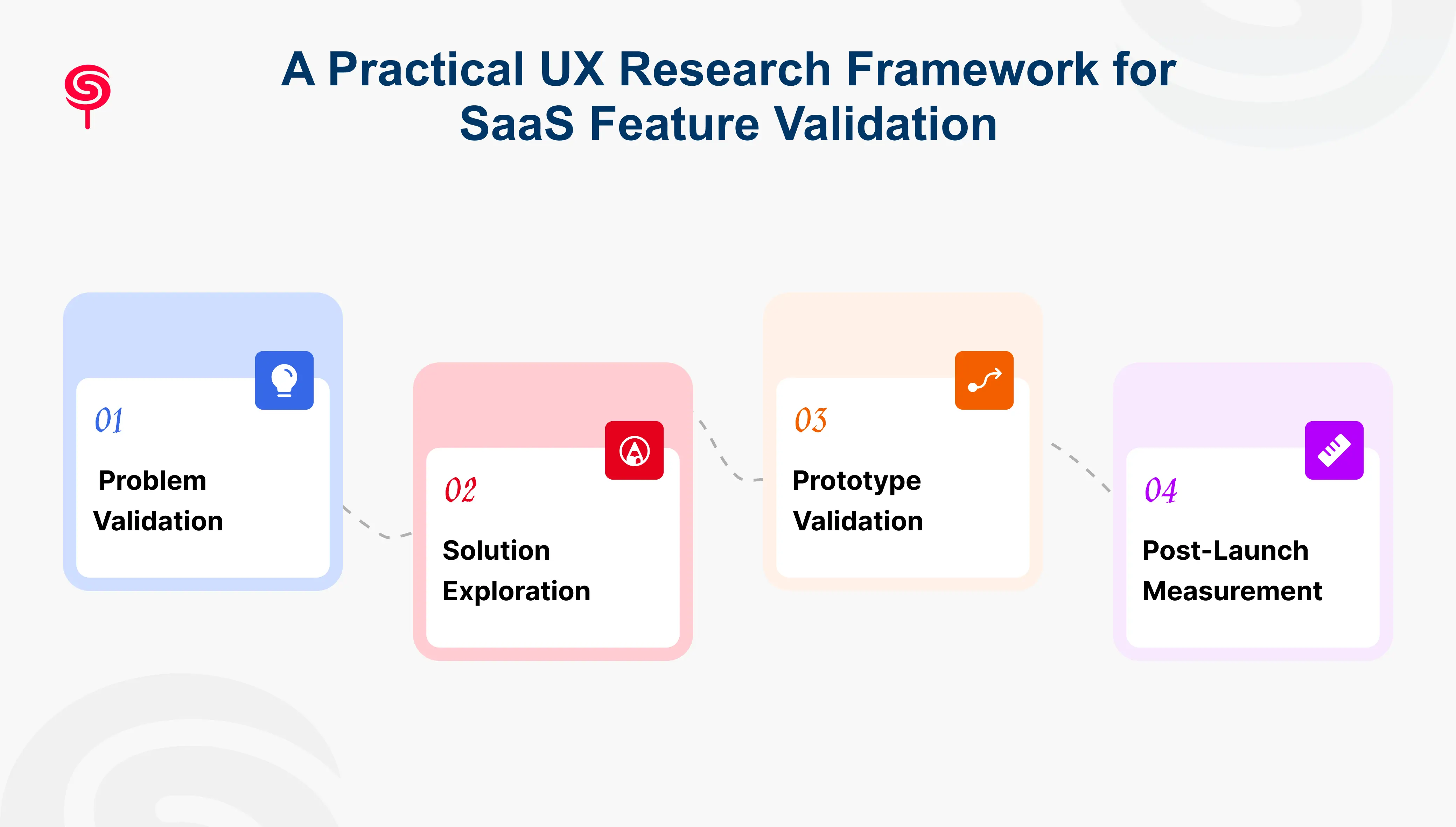
The gap between knowing that UX research matters and actually integrating it into the development cycle is where most teams struggle. Here is a practical four-stage feature validation framework built for SaaS product teams.
Stage 1 — Problem Validation
Before designing anything, confirm that the problem you're solving is real and significant. Conduct five to eight user interviews focused on the workflow area in question. Look for patterns: are users describing the same friction in different words? Are they using workarounds? Are they expressing frustration that reveals an unmet need? If the problem doesn't emerge clearly from this research, it's a signal that you may be solving a low-priority pain point.
Stage 2 — Solution Exploration
Once the problem is validated, explore how users conceptualize the solution. Use concept testing with rough sketches or low-fidelity wireframes not finished designs. The goal is to surface whether your proposed solution aligns with user mental models, not to get approval on visual design. Pay attention to confusion, questions, and wrong assumptions; these are gold for product refinement.
Stage 3 — Prototype Validation
With a clearer solution direction, build a clickable prototype and run structured usability tests. Recruit five to eight participants from your target user segment. Assign them realistic tasks and observe without guiding. Measure task completion rates, note failure points, and capture verbal feedback. This stage often reveals usability issues that would have been expensive to fix post-launch.
Stage 4 — Post-Launch Measurement
Define success metrics before launch and track them after. Feature adoption rate, workflow completion rate, time-on-task, and impact on adjacent metrics (like retention or upgrade rate) tell you whether the feature delivered the intended value. This data feeds directly into the next prioritization cycle, making the entire product development process smarter over time.
How Successful SaaS Companies Use UX Research to Reduce Product Risk
The SaaS companies that have scaled successfully Notion, Intercom, Figma, HubSpot share a common trait: they treat user research as a continuous organizational practice, not a project-based activity. Research is embedded into how they build, not added on as an afterthought when something goes wrong.
Intercom famously built their Jobs-to-be-Done practice into the core of their product strategy, using it to reframe their entire product line around customer progress rather than feature delivery. This research-led repositioning was a significant driver of their growth in the competitive business messaging space.
Figma's rapid expansion into collaborative design workflows was informed by continuous behavioral research into how design teams actually collaborate revealing that the real bottleneck was handoff and feedback loops, not individual design tooling. That insight led to features like multiplayer editing and developer handoff that defined their market differentiation.
The pattern is consistent: teams that build research capacity early reduce expensive pivots later. A UX audit that costs a fraction of a single engineering sprint can identify product risks that would otherwise consume months of misdirected development.
Business Outcomes of UX Research for SaaS Teams
The business case for UX research is not soft. It is quantifiable across three core SaaS growth metrics.
Improved Activation Rates. When research identifies the specific moments where new users fail to reach their "aha moment," targeted design improvements can dramatically increase trial-to-paid conversion. For the average SaaS product, a ten percentage point improvement in activation translates directly to a proportional increase in new MRR without acquiring a single additional lead.
Reduced Churn. Churn is almost always a product experience problem before it becomes a customer success problem. UX research surfaces the friction, confusion, and unmet expectations that cause users to disengage. Fixing these proactively before users have already made the mental decision to cancel is the highest-leverage SaaS retention strategy available.
Faster Time-to-Value. Products designed around real user workflows get users to their first meaningful outcome faster. Faster time-to-value improves onboarding metrics, reduces support burden, and increases the likelihood of expansion revenue the compounding engine of SaaS growth.
Stronger Product-Market Fit. Perhaps most importantly, ongoing UX research keeps the product aligned with evolving user needs. Markets shift. User expectations rise. Competitors move. The SaaS teams that maintain a continuous research practice are the ones that see these shifts early enough to respond rather than discovering them in their churn data six months too late.
Conclusion
SaaS teams don't fail because they lack talent, capital, or ambition. They struggle because they build without enough signal shipping features that feel right internally but don't land with users in the way the team imagined.
UX research is how the best SaaS product teams break this cycle. It replaces the confidence of assumption with the clarity of evidence. It transforms feature prioritization from a political exercise into a data-driven practice. And it turns the product itself into the most powerful sales, retention, and growth tool in the business.
If your SaaS product is struggling with activation, retention, or unclear product-market fit a UX audit is the fastest way to identify what's broken and build a research-backed roadmap for what to fix first.
At CandyStudio, we work with SaaS founders, product teams, and growth leaders to conduct structured UX audits, redesign critical product flows, and build the research infrastructure that makes every future product decision smarter. If you're ready to stop building in the dark, we'd love to talk.
Frequently Asked Questions
1. What is UX research in SaaS product development?
UX research is the process of understanding user needs, behaviors, pain points, and goals to make evidence-based product decisions that improve adoption and retention.
2. How does UX research support feature prioritization?
UX research replaces opinion-based prioritization with user-validated evidence. By identifying which problems users experience most frequently and which friction points cause the most drop-off, research gives product teams a clear signal for what to build next and what to deprioritize.
3. How does UX research help with product-market fit?
UX research particularly jobs-to-be-done interviews and usability studies reveals whether your product's value proposition aligns with how users actually experience it. It surfaces misalignments between what you're offering and what users are looking for, enabling targeted product and positioning improvements that strengthen product-market fit.
4. How often should SaaS teams conduct UX research?
UX research should be ongoing, not episodic. Leading SaaS companies embed research into every major product cycle. At minimum, teams should conduct user interviews monthly, run usability tests before major releases, and review behavioral analytics weekly. A dedicated research practice or a partnership with a UX strategy agency makes this sustainable.
5. How can CandyStudio help with UX research and product design?
CandyStudio specializes in UX audits, product design, dashboard redesign, and UX strategy for SaaS companies. We partner with founders, product teams, and growth leaders to conduct research-driven audits, identify product friction, and build actionable design roadmaps that improve activation, retention, and growth. Reach out to start a conversation about your product.
Share this blog!
Latest Blogs
Explore our latest insights on design, AI, and digital innovation.