How to Improve SaaS User Retention with UX Design
Author
Vignesh
Published On

You built a SaaS product that solves a real problem. You ran the ads, closed the trials, and watched sign-ups roll in. But somewhere between activation and month three, users vanished quietly, without warning, and often without explanation.
This is the silent growth killer of almost every SaaS company. Founders obsess over acquisition while retention slowly bleeds out the bottom of the funnel. The brutal math: acquiring a new customer costs 5 to 7 times more than retaining an existing one, and a 5% increase in retention can increase revenue by 25% to 95%, according to research from Bain & Company. Yet most SaaS teams continue to pour budget into growth channels while leaving the product experience the single most powerful retention lever largely unoptimized.
The underlying issue is almost always UX.
This guide breaks down why SaaS user retention is a design problem at its core, how to diagnose the signals your product is already sending, and the seven UX strategies that consistently move the needle on SaaS customer retention, conversion optimization, and sustainable product-led growth.
Why SaaS User Retention Matters More Than Customer Acquisition
In the early days of a SaaS startup, acquisition feels like progress. Every new sign-up is a win. But the unit economics of a leaky bucket never work in your favor.
Monthly Recurring Revenue only compounds when churn is under control. A SaaS business with a 10% monthly churn rate loses more than half its customer base every six months. No acquisition engine no matter how efficient can outrun that kind of attrition.
Beyond the financials, retention is the ultimate proof of product-market fit. Users who stay, expand their usage, and refer others are telling you something acquisition data never can: that your product is genuinely valuable to them. Retention rates above 85% annually are generally considered healthy for B2B SaaS. Elite products targeting enterprise customers often sustain net revenue retention above 120% meaning expansion revenue from retained users alone outpaces any losses from churn.
What drives those numbers? Product experience. Specifically, how intuitive, frictionless, and meaningful your UX makes the path from sign-up to sustained value.
Retention is not a growth team problem. It is a product design problem and it begins to be solved long before a user even considers canceling.
The Real Reason SaaS Users Leave Your Product
Founders often assume users churn because of price, competition, or shifting priorities. Sometimes that is true. But in the majority of cases, churn is a UX failure hiding in plain sight.
Users do not leave because your product lacks features. They leave because they never fully understood the value of the features you already had. This is the adoption gap the distance between what your product can do and what users actually experience on a daily basis.
The root causes are predictable and fixable.
Onboarding that overwhelms rather than guides is one of the most common culprits. When a new user logs in and faces a dense dashboard, a wall of options, or a setup process that demands too much too soon, cognitive load spikes and motivation collapses. They abandon not because they disliked your product, but because it never gave them the chance to like it.
Navigation that buries core features is another silent churn driver. If users cannot find the functionality that makes your product worth paying for, they will assume it does not exist or worse, that your product is not as capable as a competitor's.
Workflow friction, in the form of redundant steps, confusing labels, or broken feedback loops, erodes trust slowly. Users begin to associate your product with effort rather than efficiency, and that psychological shift is difficult to reverse.
Finally, a lack of personalization makes your product feel generic. When a user feels like the product does not understand their role, goals, or progress, engagement drops and the emotional connection required for long-term retention never forms.
Understanding these root causes is the foundation of a genuine SaaS growth strategy. Solving them is where UX design earns its place at the revenue table.
Signs Your SaaS Product Has a Retention Problem
Most retention problems announce themselves before users churn. You simply need to know where to look.
The most obvious signal is a drop-off in daily or weekly active users following the onboarding period. If users engage strongly in their first session and then gradually disappear, the product failed to deliver a repeatable "aha moment" the point where users clearly understand the value they are getting.
Low feature adoption rates are another red flag. When behavioral analytics reveal that a significant portion of your user base has never touched core functionality, it means either discovery is broken, the feature is poorly communicated, or the workflow leading to it is too complex.
A high volume of support tickets asking "how do I..." questions signals that your UX is not self-explanatory. Every support ticket is a UX failure and an opportunity cost time spent on reactive support is time not spent on strategic product improvement.
Qualitative signals matter too. Exit survey responses that reference confusion, frustration, or difficulty getting started are the clearest possible indication that the product experience needs redesign not the product itself.
If you are seeing any combination of these signals, your retention problem is a design problem, and a structured UX audit is likely your highest-leverage next step.
How UX Design Directly Improves SaaS User Retention
UX design is not cosmetic. In the context of SaaS retention, it is the mechanism through which your product communicates value, reduces effort, and builds habit.
Every interaction a user has with your product is a micro-decision: is this worth my continued attention? Good UX stacks those micro-decisions in your favor. Poor UX creates friction at every touchpoint, and friction accumulates into churn.
From a product-led growth perspective, great UX enables the product itself to act as the primary driver of acquisition, activation, and retention. When users can onboard without hand-holding, discover features without documentation, and accomplish goals without friction, the product sells itself and keeps selling itself through renewals, expansions, and referrals.
Improving SaaS conversion optimization is inseparable from UX. The path from free trial to paid customer, and from paid customer to long-term advocate, runs entirely through the product experience. UX design shapes that path at every stage.
7 UX Strategies to Increase SaaS User Retention
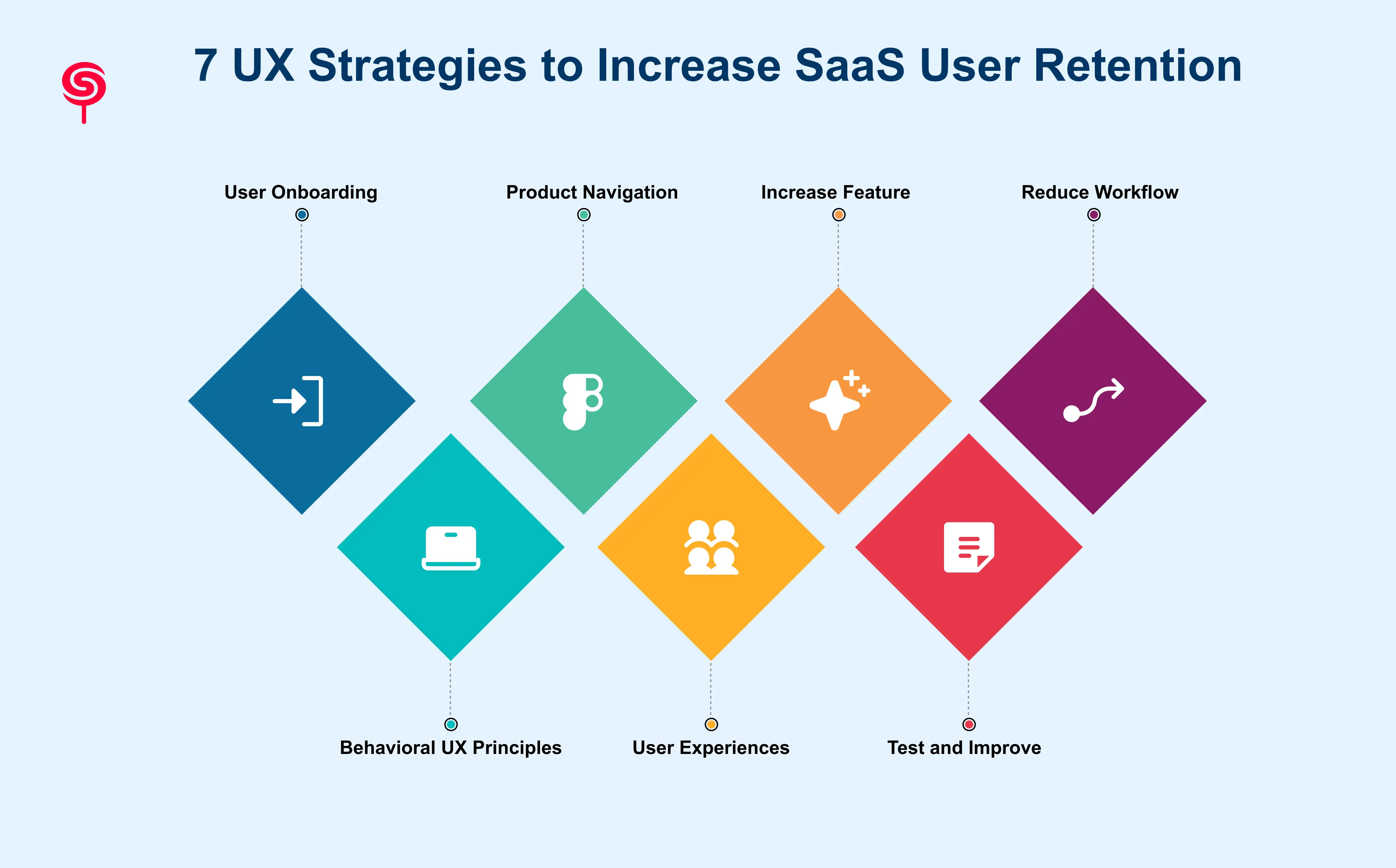
1. Optimize User Onboarding
Onboarding is the single most critical phase of the user journey. It is the moment where expectation meets reality, and where retention is either won or lost within the first 72 hours.
Effective onboarding in SaaS does not mean giving users everything at once. It means giving users exactly what they need to experience value as quickly as possible. This requires designing around the "aha moment" the specific action or outcome that makes a user say, "this product gets it."
Identify the minimal set of steps required to reach that moment, and strip everything else away from the initial experience. Use progressive disclosure to introduce advanced features only after foundational ones are understood. Replace passive product tours with interactive, task-based walkthroughs that guide users by doing, not by watching.
Contextual onboarding triggered by user behavior rather than a fixed sequence consistently outperforms generic guided tours because it meets users where they are, not where your documentation assumes they are.
2. Improve Product Navigation
Navigation is the UX infrastructure your product runs on. When it works, users don't notice it. When it fails, they spend cognitive energy on orientation instead of value creation and that cognitive cost compounds over time into disengagement.
A well-designed SaaS navigation system organizes features around user goals, not around internal product architecture. The primary navigation should surface the tasks users perform most frequently, while advanced and administrative functions live one layer deeper.
Visual hierarchy matters enormously here. Clear labeling, consistent iconography, and predictable interaction patterns reduce the mental effort required to move through your product. Users should always know where they are, how to get to where they want to go, and what the next logical step is.
Audit your navigation regularly using session recordings and heatmaps. Where users hesitate, click the wrong elements, or repeatedly backtrack, you have a navigation problem and navigation problems directly suppress retention.
3. Increase Feature Adoption
Features that users don't adopt don't retain them. Feature adoption is not a marketing challenge it is a UX challenge. The question is not "do users know this feature exists?" but "does the product experience make using this feature feel obvious and worthwhile?"
In-app contextual prompts triggered at moments of relevant user behavior are far more effective than email campaigns or onboarding checklists. When a user completes a task that relates naturally to an underused feature, that is the moment to surface it not in a newsletter they may never open.
Empty states are an underutilized retention lever. When a user encounters an empty dashboard or section, that blank canvas is an opportunity to demonstrate value through example content, guided actions, or direct calls to action. Empty states that show users what is possible once they engage consistently outperform blank screens in feature activation metrics.
Feature value communication making the benefit of a feature immediately clear through microcopy, contextual tooltips, and outcome-framing reduces the activation energy required for adoption.
4. Reduce Workflow Friction
Friction is the resistance between a user's intent and their ability to act on it. In SaaS, friction accumulates in the small moments: a redundant confirmation step, a form that asks for information users already provided, a multi-click process that could be one click, an error message that explains nothing useful.
Individually, these frictions feel minor. Collectively, they define the user's relationship with your product. Users who routinely encounter friction do not complain about it they drift toward alternatives that feel easier, and they cancel quietly.
A friction audit maps every step of your core user workflows against a simple question: is this step necessary? Every step that cannot be justified should be eliminated, automated, or simplified. The goal is not minimalism for its own sake but efficiency on behalf of the user.
Reducing workflow friction has a direct and measurable impact on daily active usage, session depth, and ultimately on SaaS customer retention because it lowers the ongoing cost of using your product.
5. Use Behavioral UX Principles
The most effective SaaS products are designed around how users actually think and behave, not around how their builders wish they would. Behavioral design principles drawn from cognitive psychology and behavioral economics give product teams a framework for building experiences that align with human motivation.
Variable reward patterns, the same mechanism behind effective habit-forming products, can be applied ethically in SaaS to reinforce usage behaviors. Progress indicators, completion percentages, and milestone celebrations create a sense of forward momentum that sustains engagement through the critical first weeks of product use.
The principle of commitment and consistency once a user has invested effort in setting up a workflow or customizing their environment, they are more likely to continue using the product underscores the importance of making early personalization steps part of onboarding rather than optional configuration.
Loss aversion, the tendency to weight losses more heavily than equivalent gains, can be applied carefully in retention-risk scenarios. Showing users what they stand to lose by canceling saved workflows, accumulated data, ongoing projects can meaningfully reduce voluntary churn when surfaced at the right moment.
6. Personalize User Experiences
Generic experiences retain nobody. When a SaaS product treats every user identically regardless of their role, industry, use case, or stage in the customer journey, it communicates that the product was built for an abstraction, not for the individual.
Personalization in product UX does not require sophisticated AI at the outset. It begins with segmentation understanding who your users are, what jobs they are hiring your product to do, and designing experiences that reflect those distinct contexts.
Role-based onboarding flows, adaptive dashboards that surface the most relevant data for each user type, and personalized in-app messaging based on usage patterns are all achievable with current product tooling and represent substantial investments in long-term retention.
The more a user feels that your product understands them, the more embedded it becomes in their workflow and embedded products are sticky products.
7. Continuously Test and Improve
Retention optimization is not a one-time redesign project. It is an ongoing discipline of measurement, hypothesis, and iteration. The SaaS products that sustain high retention rates are the ones that have institutionalized continuous UX testing as a core product process.
A/B testing UX changes against retention metrics not just conversion rates reveals what actually keeps users. User interview programs conducted regularly with both retained and churned users provide qualitative context that behavioral data alone cannot supply.
Heatmaps, session recordings, funnel drop-off analysis, and cohort-based retention curves should inform a rolling backlog of UX improvement hypotheses. Each iteration, validated against real retention data, compounds over time into a product experience that is meaningfully more effective at keeping users than it was six months ago.
SaaS Retention Metrics Every Founder Should Track
Data without context is noise. The following metrics give SaaS founders and growth leaders the clearest signal on the health of their retention engine.
Monthly Churn Rate measures the percentage of customers lost in a given month and is the most direct indicator of retention performance. For early-stage SaaS, churn rates below 5% monthly are generally considered manageable.
Net Revenue Retention (NRR) captures expansion revenue from existing customers against downgrades and cancellations. An NRR above 100% means your existing customer base is growing in revenue even without new acquisitions the defining characteristic of efficient, compounding SaaS growth.
Daily Active Users to Monthly Active Users ratio (DAU/MAU) reflects how habitually users engage with the product. A high ratio indicates strong habit formation; a declining ratio is an early warning signal of disengagement.
Time to Value measures how long it takes a new user to experience the product's core benefit. Shortening time to value is one of the most reliable levers for improving early retention and reducing trial-to-paid churn.
Feature Adoption Rate by cohort shows which features are being used, by whom, and how adoption rates change over time. Cohort-level feature adoption analysis reveals whether new users are discovering value faster than older cohorts a sign that onboarding and UX improvements are compounding.
Customer Health Score, built from a combination of engagement signals, product usage breadth, and support interactions, enables proactive retention intervention before churn intent becomes visible in cancellation data.
When Should Startups Invest in SaaS UX Improvements?
The most common mistake SaaS founders make regarding UX investment is timing. They delay it until churn becomes a crisis, when the cost of recovery is far higher than the cost of prevention would have been.
The right time to invest in UX improvements is when you have initial product-market signal when users are signing up and some are staying but retention is inconsistent or declining. At this stage, a UX audit is not a nice-to-have; it is the most capital-efficient growth investment available.
A structured UX audit identifies the specific friction points, navigation failures, and adoption gaps that are driving churn in your product. It prioritizes improvements by impact and feasibility, giving your product team a clear roadmap instead of a backlog of unvalidated assumptions.
For growth-stage SaaS companies preparing for a funding round, demonstrating improving retention metrics is increasingly critical to valuation. Investors in 2024 and beyond are applying far greater scrutiny to unit economics, and NRR is now as closely examined as ARR growth.
For mature SaaS businesses facing competitive pressure, UX differentiation not feature parity is the sustainable moat. Users do not stay because your product has every feature; they stay because your product is the one they actually enjoy using.
The Business Impact of Better UX on SaaS Growth
The case for UX investment in SaaS is not a design argument it is a financial one.
Research consistently shows that companies that prioritize design significantly outperform their industry counterparts. McKinsey's design index found that design-driven companies delivered 32% higher revenue growth and 56% higher total returns to shareholders over a five-year period compared to their industry counterparts.
In practical terms for SaaS: improving retention by even a few percentage points has a multiplicative effect on lifetime customer value. A reduction in monthly churn from 5% to 3% can increase the average customer lifetime by more than 60%. Applied across your customer base, that improvement in LTV changes the economics of every acquisition channel you operate.
Better UX also reduces customer success and support costs. When users can navigate and adopt features without hand-holding, the cost per retained customer drops. Teams that were previously managing churn reactively can redirect effort toward expansion and advocacy programs that compound growth.
The compounding effect of sustained UX investment measurably better retention, higher LTV, lower support costs, and differentiated positioning is what separates SaaS products that scale from those that plateau.
Conclusion
SaaS user retention is one of the most consequential and most addressable challenges in product growth. The users leaving your platform are not lost because your product lacks value. They are lost because the design of your product failed to communicate, deliver, and sustain that value across the entire user journey.
UX design, applied strategically and measured rigorously, is the highest-leverage retention intervention available to SaaS founders and growth leaders. Optimized onboarding, intuitive navigation, behavioral design, personalization, and continuous testing are not peripheral improvements they are the structural foundations of a product that retains users, expands revenue, and compounds growth over time.
If your SaaS product is showing signs of a retention problem, the diagnosis is almost certainly in the experience. And the experience is always fixable.
At CandyStudio, we work with SaaS founders and product teams to conduct deep-dive UX audits that identify exactly where your product is losing users and design the improvements that bring them back and keep them. If you are serious about turning your retention metrics into a growth engine, we should talk.
Frequently Asked Questions
1. What is a good SaaS retention rate?
Retention benchmarks vary by industry, but most successful SaaS companies prioritize continuous improvement rather than relying solely on industry averages.
2. What is the relationship between UX and product-led growth?
Product-led growth depends on users successfully experiencing product value. UX design helps users discover, understand, and adopt features that drive long-term engagement.
3. When should a SaaS startup invest in UX design?
The optimal time to invest in UX design is when you have initial product-market fit signal but retention is inconsistent or declining. A UX audit at this stage is a capital-efficient intervention that identifies and prioritizes the highest-impact improvements before churn becomes a crisis. For growth-stage companies, improving UX before scaling acquisition ensures that investment in new users is not eroded by poor retention of existing ones.
4. How do I know if my SaaS product has a UX problem?
Clear signals of a UX problem include high trial-to-paid churn, low feature adoption rates, a high volume of "how do I" support tickets, declining DAU/MAU ratios, and exit survey responses mentioning confusion or difficulty. Any of these individually warrants investigation. A combination of several signals is a strong indicator that a professional UX audit would uncover significant retention opportunities.
Share this blog!
Latest Blogs
Explore our latest insights on design, AI, and digital innovation.