UX Audit Vs UI Redesign: Which Delivers Better ROI?
Author
Vignesh
Published On

Product teams often face the same hard question: my signups are growing (or not), activation is stuck, and churn looks stubborn should we hire a visual designer and launch a UI redesign, or commission a UX audit to figure out what’s actually failing? The choice matters: a UI polish can look impressive on a deck, but the wrong investment wastes time and revenue. In this guide I’ll help SaaS founders, product managers, and CTOs decide when to run a Product UX Audit versus investing in a full UI Redesign, how each affects product metrics, and how CandyStudio helps translate audits and designs into measurable ARR improvements.
The Real Problem: Are You Solving a UX Issue or a UI Issue?
Most SaaS founders conflate two fundamentally different problems. When users drop off, they assume the product looks untrustworthy, outdated, or confusing so they reach for a visual overhaul. But aesthetics are rarely the root cause of poor activation, low retention, or weak adoption.
UX problems are behavioral and structural. They live in the architecture of your product: the information hierarchy, the mental models users bring to your onboarding, the friction buried inside a five-step workflow that should be two. These problems are invisible to the eye but devastating to your metrics.
UI problems are perceptual and presentational. They affect how users interpret and trust what they see: inconsistent visual language, poor contrast ratios, misaligned component design, an interface that signals "amateur" before the user even clicks.
Both matter. But they require different diagnostics, different investments, and deliver entirely different returns. Treating a UX problem with a UI solution is like repainting a car with a broken engine. It might look better in the driveway. It still won't get anyone where they need to go.
What is a UX Audit?
A Product UX Audit is a systematic, evidence-driven analysis of a product’s user experience. It combines qualitative heuristics, quantitative analytics, and customer insights to identify usability problems, friction points, and conversion blockers. Typical elements:
Heuristic evaluation against usability principles (consistency, feedback, error prevention).
Funnel and behavioral analytics review (activation, retention, task completion rates).
Session replay and click-path analysis.
Customer interview and support ticket analysis.
Task-based usability testing (moderated/unmoderated).
Accessibility and performance checks.
Deliverables typically include prioritized observations, root-cause analysis, annotated screenshots or journeys, and a roadmap of recommended experiments.
What is a UI Redesign?
A UI Redesign refactors the product’s visual design layer: layout systems, component libraries, visual language, typography, color, iconography, and interaction polish. It focuses on aesthetics, brand cohesion, and modernizing the surface layer to increase perceived value and trust. A redesign can produce reusable design systems, high-fidelity mockups, and front-end assets ready for engineering handoff.
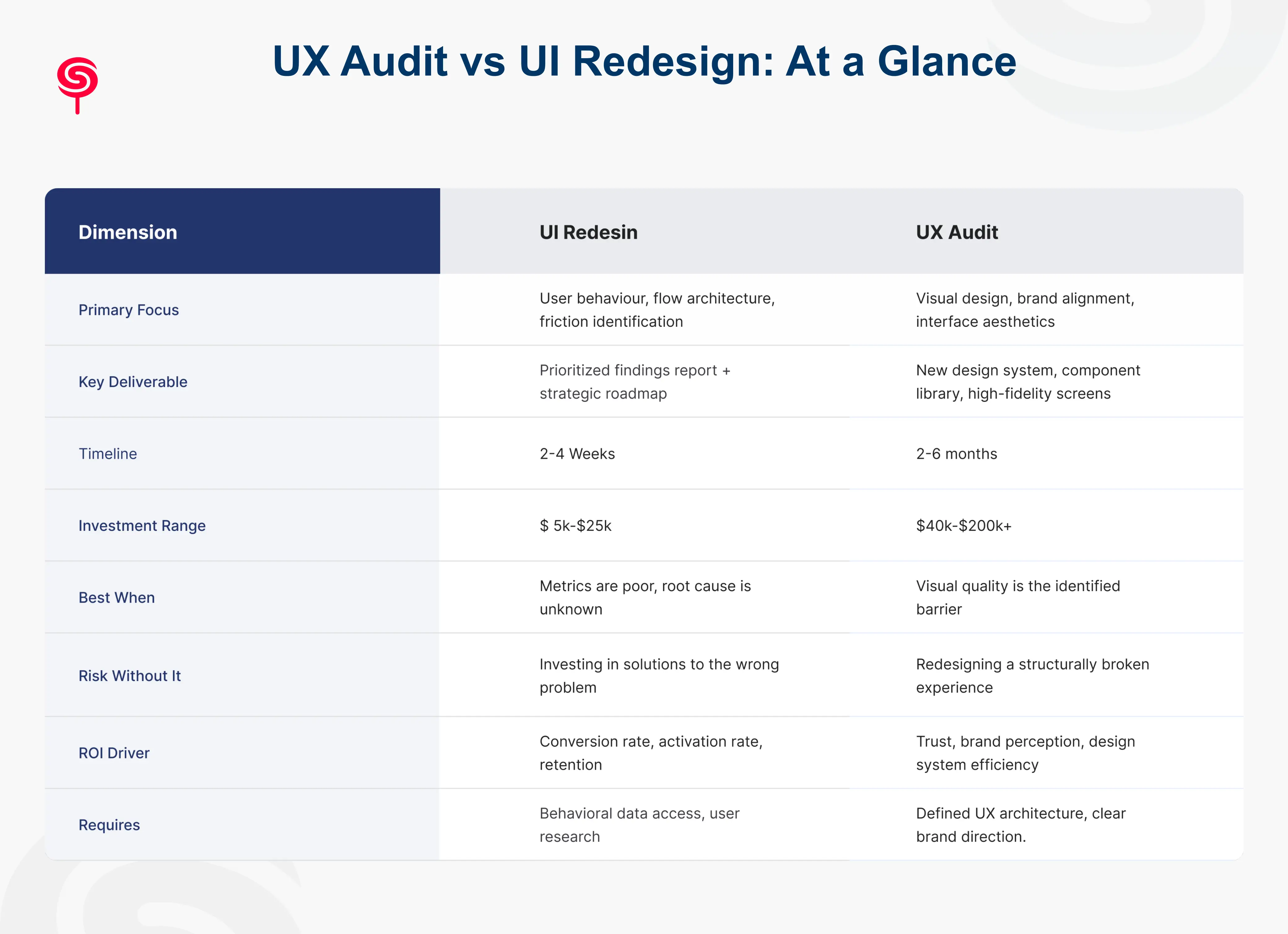
UX Audit vs UI Redesign Quick comparison
Objective: Audit finds what’s broken in the experience; redesign improves how it looks and feels.
Evidence base: Audit is data-first; redesign can be opinion-led if not paired with research.
Risk: Audit reduces risk by diagnosing; redesign without diagnosis can be risky.
Timeline: Audits are faster to deliver insights; redesigns are longer to implement.
Measurable outcome: Audit ties to conversion/activation improvements via experiments; redesign affects brand perception and long-term retention when done right.
Why Most SaaS Teams Invest in UI Redesigns Too Early
There's a predictable pattern inside early-stage SaaS companies. The product gets to a point where growth stalls. Leadership schedules a retrospective. Someone points to the dashboard and says, "it just doesn't look like a $X/month product." The room nods. A redesign is scoped.
This instinct is understandable. Visual quality is tangible. You can show stakeholders a before-and-after. You can put it in a press release. "We launched a new product experience" is a clean narrative. "We identified and resolved seventeen interaction failures in our onboarding flow" is harder to sell to a board.
But the instinct is often wrong and expensively so.
Three forces push SaaS teams toward premature redesigns. First, survivorship bias: founders see competitors with beautiful interfaces and assume that's why they're winning, ignoring the years of UX iteration underneath those polished surfaces. Second, design debt anxiety: every quarter without a visual refresh feels like falling further behind, creating urgency that isn't grounded in user data. Third, stakeholder legibility: a redesign is easier to explain than a behavioral audit, so it gets approved faster.
The result is a cycle where SaaS products get visually refreshed every 18–24 months without ever resolving the structural experience failures that actually drive churn.
7 Signs Your Product Needs a UX Audit Before a UI Redesign
1. Your activation rate is below 40%. If fewer than four in ten new users reach your product's core value moment, the problem is almost certainly structural a broken path, not a broken aesthetic.
2. Users are contacting support for tasks that should be self-evident. When your help desk tickets cluster around specific features or flows, that's a UX signal. Users shouldn't need human assistance to complete a designed workflow.
3. You have behavioral data but no clear interpretation. You've got Mixpanel, Hotjar, and FullStory running. You can see the drop-offs. But you don't know why they're happening or which to fix first. A UX Audit transforms raw data into prioritized, actionable findings.
4. Power users love the product; new users abandon it. This gap indicates that your product's value is locked behind a learning curve that UX architecture, not visual design, needs to resolve.
5. You've made feature changes that didn't move the metrics. When iterative product decisions stop generating measurable improvements, it's a sign you're optimizing the wrong variables. A UX Audit resets the diagnostic framework.
6. Churn happens in the first 30 days. Early churn is almost always an onboarding and activation failure a UX problem, not a UI problem. The product didn't deliver the promised value fast enough.
7. You're about to invest in a redesign but you're not sure why users are failing. If you can't articulate the specific behavioral failures your redesign will solve, you're not ready for a redesign. You need a UX Audit first.
7 Signs a UI Redesign Is the Right Investment
1. Your UX architecture is sound, but visual quality is creating a trust gap. When user research confirms that people understand your product but hesitate to pay for it based on how it looks, the barrier is perceptual, and a UI Redesign is the right lever.
2. You're moving upmarket and your interface doesn't reflect your new positioning. A product designed for SMB founders will struggle to close enterprise contracts if it looks like one. Visual credibility is a real commercial variable.
3. You have a fragmented design system or none at all. If your product has grown through rapid iteration into a visual patchwork of inconsistent components, a UI Redesign that establishes a true design system will return compounding value through faster development cycles.
4. A completed UX Audit has identified the problems and validated the solutions. This is the ideal state: you understand what needs to change and why. Now a UI Redesign can implement those improvements with visual precision and brand coherence.
5. Your product hasn't had a substantive visual update in 3+ years and design standards have shifted significantly. What looked modern in 2021 can actively undermine trust in 2025. Design isn't static; user expectations evolve.
6. Competitive analysis shows your interface is a meaningful differentiator risk. If prospects are choosing competitors partly because of perceived design quality, a UI Redesign is a defensible commercial investment.
7. You're preparing for a funding round, acquisition process, or major enterprise sales push. First impressions at demo are formed in seconds. Visual quality affects perceived company maturity in ways that influence deal outcomes.
Which Delivers Better ROI: UX Audit or UI Redesign?
This is the question every SaaS founder eventually asks, and the honest answer is: it depends entirely on where you are in your product's maturity curve and what's actually causing your metrics to underperform.
But when we look at the pattern across SaaS products that have invested in both, the data points in a clear direction: UX Audits almost always deliver faster, more measurable, and more capital-efficient ROI.
The reason is diagnostic precision. A UX Audit identifies the exact interventions that will move specific metrics. When you fix the flows that are failing your users, the returns are direct and attributable. Activation goes up. Churn goes down. Support volume decreases. Each change can be isolated and measured.
A UI Redesign, by contrast, delivers ROI through channels that are real but harder to attribute: improved trust, better brand perception, design system efficiency, reduced design-engineering friction. These are genuine returns but they compound over longer time horizons and are harder to link to a revenue event on a quarterly earnings call.
Industry benchmarks reinforce this. Forrester Research has found that every dollar invested in UX returns between $2 and $100, with the highest returns coming from targeted UX improvements grounded in behavioral research rather than comprehensive visual overhauls. The McKinsey Design Index shows that design-driven companies outperform the market but the design practices that drive that outperformance are heavily weighted toward user research and iterative experience improvement, not periodic visual refreshes.
The practical implication: if you're a SaaS company with growth or retention challenges and limited runway, a UX Audit is almost always the higher-leverage first move. It costs less, delivers faster, and makes any subsequent UI Redesign dramatically more effective by ensuring it solves the right problems.
A Proven Framework for Deciding Between a UX Audit and a UI Redesign
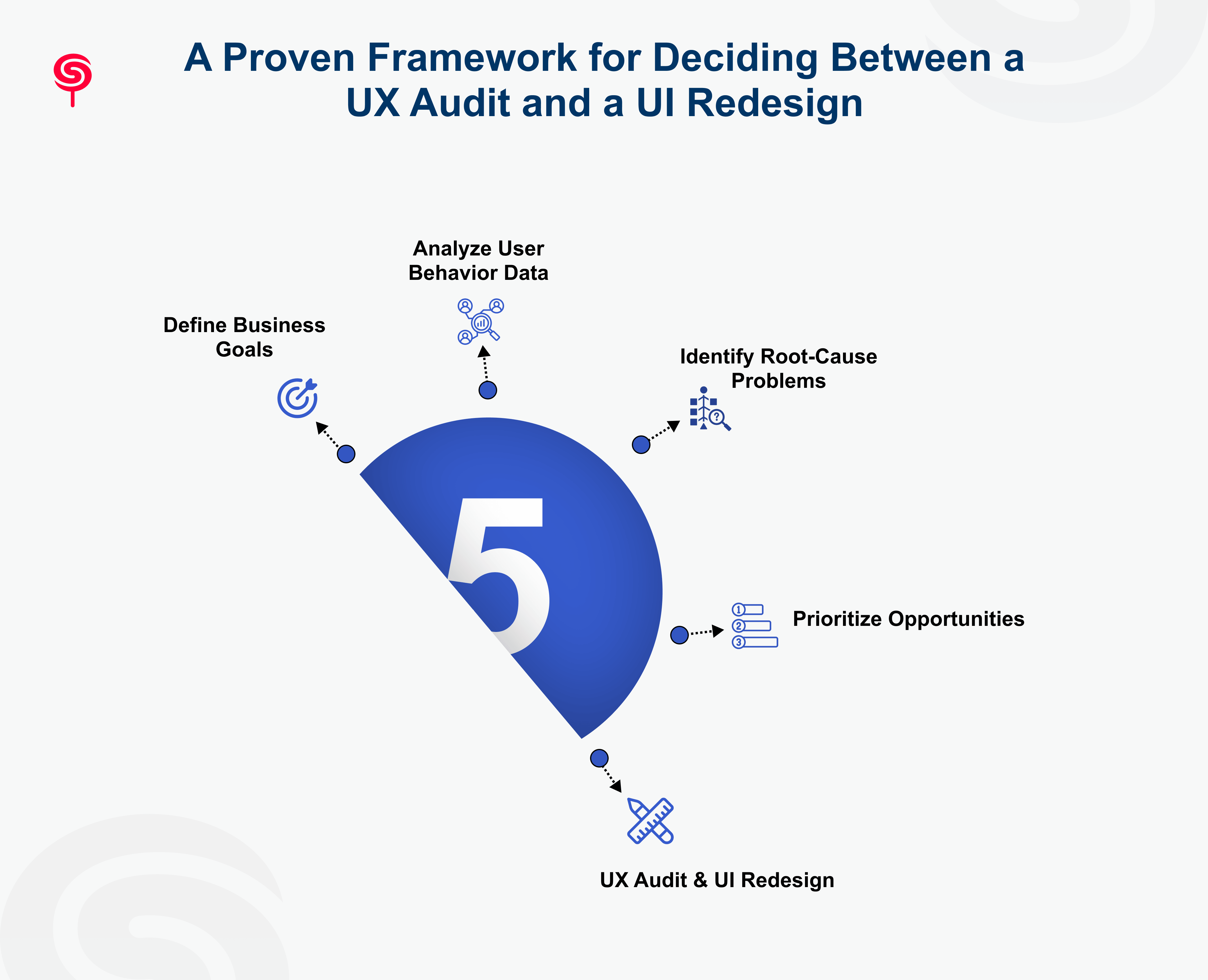
Step 1: Define Business Goals
Before evaluating design investments, get explicit about the metric you're trying to move. Is it activation rate? 30-day retention? Trial-to-paid conversion? Average revenue per user? The specific business goal determines which type of design investment is appropriate. UX interventions are most directly connected to behavioral metrics; UI investments most directly affect perception and trust metrics.
Step 2: Analyze User Behavior Data
Pull your behavioral data before making any design decision. Look at funnel drop-off rates, session recordings, feature adoption curves, support ticket clustering, and cohort retention. If you can identify where users are failing, you have the foundation for a UX Audit. If users are completing flows but not converting, the barrier may be perceptual and UI becomes more relevant.
Step 3: Identify Root-Cause Problems
Behavioral data tells you where users fail. It rarely tells you why. Root cause analysis requires qualitative research: user interviews, usability sessions, and heuristic evaluation. This step is where the distinction between UX and UI problems becomes clear. Are users confused by the architecture of the product where things are and how flows connect? That's UX. Are they hesitating because the product feels untrustworthy or amateur? That's UI.
Step 4: Prioritize Opportunities
Not all friction points are equal. Prioritize by the intersection of two variables: how many users are affected, and what is the business impact of resolving this failure? A friction point that affects 60% of new users during onboarding and directly prevents activation is a higher priority than an inconsistent button style on a settings page. This prioritization matrix is a core output of a rigorous UX Audit.
Step 5: Decide Whether to Audit, Redesign, or Combine Both
With a clear business goal, behavioral evidence, qualitative root cause data, and a prioritized opportunity map, the investment decision becomes straightforward. Most mature SaaS companies ultimately need both but the sequence matters. Audit first to understand, redesign second to implement with precision.
How UX Audits and UI Redesigns Work Together
The false choice between UX Audit and UI Redesign is itself a sign of an immature product design strategy. The best SaaS companies treat them as sequential phases of a continuous experience improvement cycle.
The UX Audit is the diagnostic instrument. It tells you what's broken, why it's broken, and which repairs will deliver the highest return. It gives your design team a prioritized mandate grounded in behavioral evidence rather than executive intuition.
The UI Redesign is the implementation layer. Once you understand the structural failures and have validated solutions through behavioral research, a UI Redesign implements those solutions with visual coherence, brand alignment, and design system discipline.
When these two investments are made in sequence audit before redesign the ROI compounds. The redesign is more focused, the design decisions are defensible, the development scope is tighter, and the resulting experience change is measurable against known baselines.
The most sophisticated SaaS companies run this cycle continuously: audit quarterly, implement iteratively, measure the impact, audit again. Design excellence isn't a project you complete. It's a practice you sustain.
How CandyStudio Helps SaaS Companies Increase Product ROI
CandyStudio works with AI startups, SaaS founders, and product teams who are serious about connecting design investment to revenue outcomes. We don't lead with aesthetics. We lead with evidence.
Our UX Audit service goes deeper than heuristic checklists. We combine behavioral data analysis, competitive benchmarking, user flow mapping, and expert usability review to produce a findings report that gives your team immediate clarity: here is what's failing, here is why, here is what to fix first, and here is the revenue impact of doing so.
If you're not sure whether your SaaS product needs a UX Audit or a UI Redesign or if you suspect you've been solving the wrong problem that conversation is exactly where we should start. Book a UX Audit Consultation with CandyStudio
Conclusion
The ROI debate between UX Audits and UI Redesigns ultimately resolves into a question of sequencing and evidence. A UI Redesign without a UX Audit is an expensive bet on an unvalidated hypothesis. A UX Audit without the willingness to act on its findings is an analytical exercise that doesn't move the business.
The SaaS companies that consistently improve product metrics treat UX Audits not as a cost center but as a strategic investment in decision quality. They know why their users fail before they invest in fixing anything. They build design systems that serve business outcomes, not just design standards.
If your product's metrics aren't moving if activation is flat, churn is persistent, and redesigns haven't delivered the returns you expected the most valuable thing you can do right now is stop guessing and start diagnosing.
Frequently Asked Questions
1. What is the difference between a UX Audit and a UI Redesign?
A UX Audit is a diagnostic process that identifies behavioral friction points, structural failures, and experience gaps in your product using behavioral data and usability research. A UI Redesign is a visual and interaction overhaul that improves how your product looks and presents itself. UX Audits diagnose problems; UI Redesigns implement solutions. For most SaaS products with performance challenges, the UX Audit should come first.
2. Is a UI Redesign worth the investment?
A UI Redesign can be highly valuable when visual inconsistency, outdated interfaces, branding challenges, or design debt affect user trust and engagement.
3. Which has a better ROI: UX Audit or UI Redesign?
For most SaaS products experiencing growth challenges, a UX Audit typically delivers faster ROI because it identifies root causes before significant redesign investments are made.
4. Will a UI redesign fix conversion problems?
Only if the problems are visual or trust-related. If the root causes are functional (flow confusion, IA, onboarding friction), a redesign alone may not improve conversions.
Share this blog!
Latest Blogs
Explore our latest insights on design, AI, and digital innovation.