From Idea to AI SaaS Launch: A UX-First Roadmap
Author
Vignesh
Published On
You have a powerful AI idea. Maybe it’s an intelligent workflow tool, a predictive analytics dashboard, or a conversational assistant that could reshape an entire industry. You’ve mapped out the business model, assembled a technical team, and secured early funding. But three months into development, something feels off. Users aren’t engaging. Early adopters churn after the first session. The product that looked brilliant on paper feels clunky in practice.
This scenario plays out in startup offices around the world every single week. And in almost every case, the root cause is the same: the product was built from the technology outward, not from the user inward.
This guide delivers a complete, UX-first roadmap for AI SaaS launch a strategic framework that CandyStudio has refined across dozens of AI product engagements. If you’re a SaaS founder, product leader, or startup team preparing to build an AI-powered application, this is the blueprint you’ve been searching for.
Common Challenges Founders Face When Launching an AI SaaS Product
Building an AI SaaS product is categorically different from building a standard software application. The complexity is exponential: you’re not just designing screens, you’re designing the relationship between a human and a machine that thinks, predicts, and adapts. Most founding teams discover the hard way that technical brilliance alone cannot carry a product to market success.
Here are the most common failure patterns we see:
Building features before validating problems. Teams spend months engineering AI models before confirming that the problem is painful enough for users to pay for a solution.
Over-indexing on AI capability, under-investing in experience. A 95% accurate model wrapped in a confusing interface will lose to a 90% accurate model that feels intuitive and trustworthy.
Skipping user research. Assumptions replace data. Product teams build for imaginary users, not real ones.
Treating UX as decoration. Design is brought in at the end to “make it look good,” rather than being embedded from day one as a strategic driver.
Launching without a measurable growth loop. Products go live without retention metrics, activation benchmarks, or feedback infrastructure in place.
The result is predictable: high acquisition costs, low retention, poor word-of-mouth, and eventual product abandonment. The antidote is a structured, user-centered development philosophy applied from the very first day.
What Is a UX-First AI SaaS Development Approach?
A UX-first approach means that user experience research, strategy, and design drive every decision from product roadmap priorities to feature scoping to architecture choices before a single line of production code is written.
In the context of AI SaaS, this is not just a preference. It is a competitive necessity. AI systems introduce unique UX challenges that traditional software never had: opaque decision-making, probabilistic outputs, latency expectations, trust deficits, and onboarding complexity. A UX-first philosophy confronts these challenges head-on, designing for trust, transparency, and usability from the ground up.
At CandyStudio, our UX-first philosophy for AI SaaS development is grounded in three principles: deep empathy for the user’s current reality, ruthless clarity about the problem worth solving, and iterative validation that replaces assumption with evidence at every stage.
The Complete UX-First Roadmap: From Idea to AI SaaS Launch
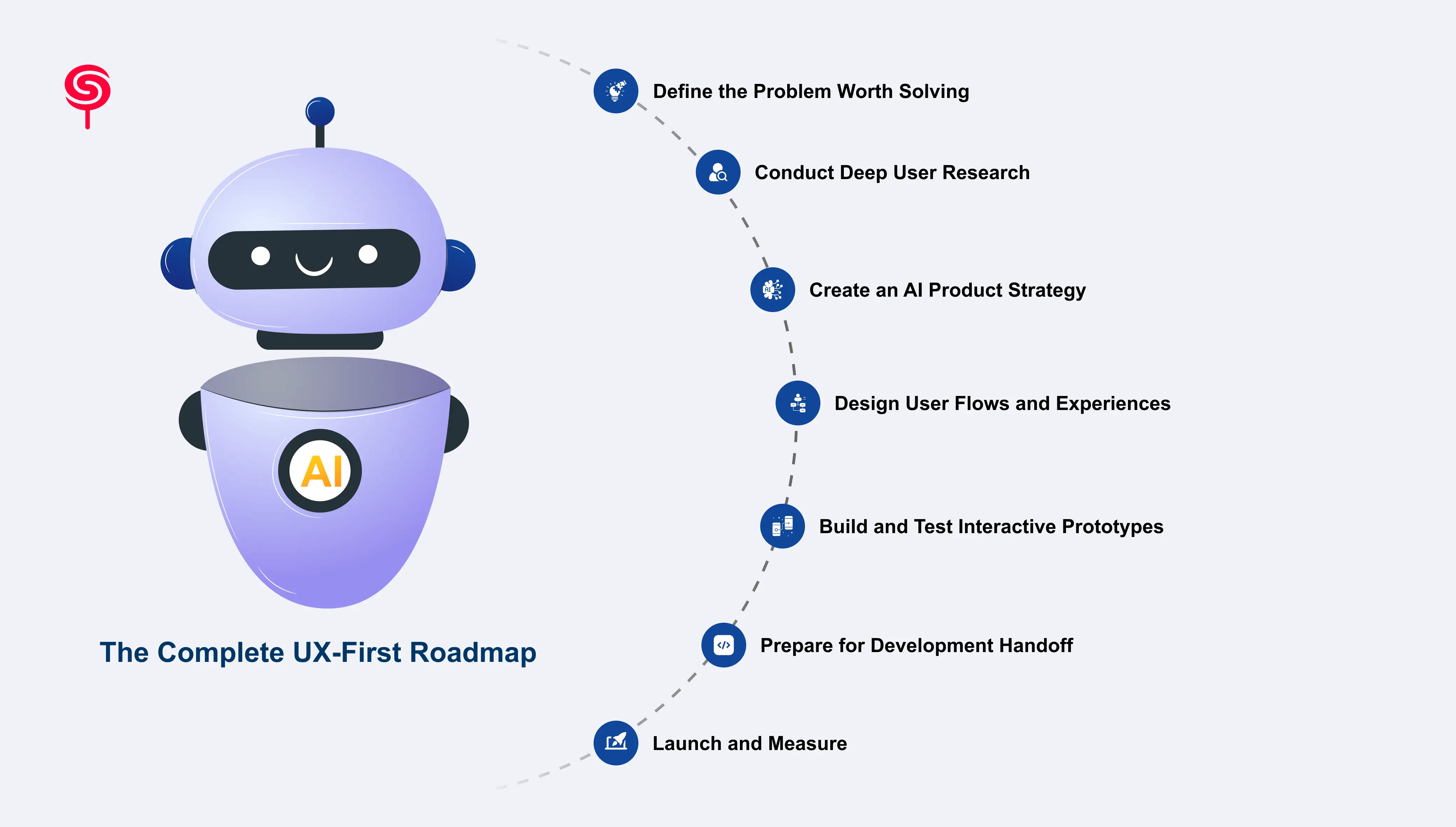
This is the exact seven-stage AI SaaS product development roadmap CandyStudio uses with every client. It is deliberately sequential: each stage builds on the outputs of the last, creating a continuous chain of validated decisions from concept to go-live.
Stage 1 — Define the Problem Worth Solving
The most expensive mistake in product development is solving the wrong problem brilliantly. Before writing a single line of code, every AI SaaS team must complete a rigorous problem definition exercise.
Start with a structured problem statement that captures four elements: who experiences the problem, what the problem is in behavioral terms, when and where it occurs, and what the cost of the problem is to the user (measured in time, money, or emotional friction). Map the competitive landscape not to replicate it, but to identify the whitespace your AI solution can credibly occupy.
Validate your problem hypothesis through stakeholder interviews before investing in solutions. The goal of Stage 1 is not a product brief. It is a validated problem hypothesis with documented evidence. This is the foundation of your entire AI SaaS product strategy.
Stage 2 — Conduct Deep User Research
Most AI SaaS MVP development guides skip this stage or compress it into a single customer discovery call. That is a fatal shortcut. Deep user research is the engine that powers every design decision downstream.
Deploy a mixed-methods research program: contextual inquiry sessions to observe users in their actual work environment, in-depth interviews with 8–12 target personas, and quantitative surveys to pressure-test qualitative themes at scale. Map the complete user journey, including the emotional arc, to identify not just friction points but the moments of maximum pain and maximum delight.
For AI-specific products, research must also explore user beliefs about AI: trust thresholds, explainability expectations, and willingness to act on AI recommendations. These findings directly shape how you design AI-to-human interaction patterns one of the most consequential UX decisions an AI SaaS team will make.
Stage 3 — Create an AI Product Strategy
Strategy is where user research transforms into product direction. Your AI product strategy document should define four things with precision: the core value proposition expressed in user language, the minimum viable feature set that delivers that value, the growth model that carries users from acquisition to advocacy, and the AI interaction model that governs how your system communicates uncertainty, confidence, and recommendations.
This is also where you define your product’s “AI personality” the tone, transparency level, and cognitive load profile of your AI-to-human interactions. Products that nail this design layer build trust at scale. Products that ignore it lose users at first contact.
Stage 4 — Design User Flows and Experiences
With strategy locked, you move into experience architecture. This stage involves designing the complete information architecture, mapping every user flow from entry point to core value delivery, and defining the design system that will govern visual consistency across the product.
For AI SaaS products, critical flows to design with exceptional care include: the onboarding sequence that builds trust before demonstrating AI capability; the AI output presentation layer that communicates results with appropriate confidence framing; the error and edge-case states that preserve user trust when the AI is wrong; and the feedback mechanism that allows users to correct, train, and improve the AI over time.
These flows are not visual decorations. They are the product’s business logic expressed in human terms. Getting them right at the design stage costs a fraction of what it costs to fix them after engineering has built them.
Stage 5 — Build and Test Interactive Prototypes
This is the most strategically valuable stage in the entire AI SaaS product development roadmap, and the one most commonly skipped in the race to ship. Interactive prototyping lets you test the actual experience of your product with real users before committing engineering resources.
Build high-fidelity, clickable prototypes that simulate the full user journey, including AI output states, loading states, error states, and empty states. Test with 5–7 participants per round using structured usability protocols. Measure task completion rates, error frequency, time-on-task, and subjective trust scores.
The insights you collect in two weeks of prototype testing would take six months to discover after launch. More importantly, they arrive before any irreversible engineering decisions have been made. This is where CandyStudio delivers some of its highest-impact work with clients: digital prototyping and iterative testing that transforms assumptions into validated design decisions.
Stage 6 — Prepare for Development Handoff
A world-class design is worth nothing if it cannot be faithfully implemented. Development handoff is not a deliverable dump it is a structured knowledge transfer that equips your engineering team to build exactly what was designed and tested.
Effective handoff packages include: a component-level design system with documented tokens (spacing, typography, color, motion); annotated flows that specify interaction behaviors, transitions, and conditional states; a prioritized component inventory aligned to engineering sprint planning; and explicit documentation of AI-specific UX patterns including loading states, confidence indicators, and error recovery flows.
When handoff is done properly, QA cycles shorten, developer questions decrease, and the product that ships matches the product that was tested. The gap between design intent and built reality is one of the most preventable sources of UX degradation in the industry.
Stage 7 — Launch and Measure
Launch is not the finish line. For AI SaaS products, it is the beginning of the most valuable data collection phase in the product lifecycle. The metrics you track in the first 90 days post-launch will determine whether you achieve product-market fit or enter an expensive rebuild cycle.
Define your activation event the specific action that indicates a user has experienced your product’s core value. Track activation rate obsessively. Instrument the product with behavioral analytics to surface drop-off points in your core flows. Build a continuous feedback loop that captures qualitative signal from churned users and quantitative signal from retained ones.
For AI SaaS specifically, measure AI trust metrics: how often users accept AI recommendations, how often they override them, and what triggers override behavior. These signals tell you more about your product’s UX health than any engagement metric.
How a UX-First Approach Accelerates AI SaaS Growth
The relationship between UX quality and growth velocity is direct and well-documented. Products with strong activation experiences grow faster because users who reach the “aha moment” earlier refer more, churn less, and expand their usage over time.
In AI SaaS, this dynamic is amplified. Every time a user trusts an AI recommendation and acts on it successfully, their confidence in the product increases. Every time the AI delivers an output the user cannot understand or act on, trust erodes. UX design is the mechanism that converts AI capability into user trust and user trust is the engine of SaaS growth.
Teams that invest in UX before engineering consistently report three measurable outcomes: lower cost-per-acquisition because word-of-mouth from satisfied users supplements paid growth; higher net revenue retention because expanded usage replaces churned seats; and faster sales cycles because prospects can evaluate the product experience before committing.
Real-World Examples of Successful AI SaaS Products
The most celebrated AI SaaS products in the market today are not celebrated because of their model accuracy. They are celebrated because of how they make users feel.
Notion AI succeeded not because it was the most powerful AI writing tool, but because it embedded AI assistance within a familiar context, made suggestions optional rather than intrusive, and gave users full control over the output. The UX design of AI-as-collaborator rather than AI-as-replacement was a deliberate strategic choice that drove mass adoption.
Grammarly built a billion-dollar business on a single UX insight: users don’t want to be corrected, they want to feel more confident. Every design decision from the tone of suggestions to the visual hierarchy of corrections was engineered to make users feel empowered, not judged. That emotional design is the product.
Superhuman charges a premium for email software in a world of free alternatives, and grows almost entirely through referral. The reason is not its AI features it is the speed, the keyboard-first interaction model, and the feeling of mastery that the UX delivers. Superhuman validated this with extensive prototype testing before building. The result is a product experience so differentiated that price sensitivity becomes irrelevant.
How CandyStudio Helps Startups Launch Better AI SaaS Products
CandyStudio is a growth-focused design agency built specifically for AI SaaS teams that want to build right before they build fast. We combine the strategic rigor of a product consultancy with the execution precision of a world-class design studio.
Our core capability is Digital Prototyping and Iterative Testing the stage where we consistently generate the highest ROI for our clients. We build high-fidelity, interactive prototypes of your AI SaaS product and test them with real users before your engineering team writes a single line of production code. The result is a validated, evidence-backed design system that your team can build with confidence.
Our AI SaaS engagements include:
UX Audits for AI Products. A rapid, high-impact review of your existing product that identifies the specific UX failures driving churn and suppressing activation.
Zero-to-One Product Design. Full-service product strategy, UX design, and prototype testing for AI SaaS teams building from scratch.
Design System Development. Component-level design systems that give your engineering team a high-fidelity blueprint and accelerate your build phase.
Growth UX Consulting. Ongoing strategic advisory for product teams seeking to optimize activation, retention, and expansion revenue through design.
We have helped AI SaaS teams in fintech, healthtech, developer tools, HR technology, and enterprise automation validate their product hypotheses, accelerate their launches, and build the user trust that drives compounding growth.
If your team is preparing to build or launch an AI SaaS product, start with a CandyStudio UX Audit. In two weeks, we’ll identify the exact UX decisions that will determine whether your product reaches product-market fit or stalls in the adoption gap. The investment is a fraction of what a single failed sprint costs.
Conclusion
The AI SaaS market is not short of good ideas. It is short of good execution. And the most consequential execution decisions happen in the UX design phase, before engineering begins and before users are exposed to a live product.
A UX-first roadmap for AI SaaS launch is not a luxury for well-funded teams. It is the minimum standard for teams that want to compete in a market where users have options, attention is finite, and trust is the single most valuable asset an AI product can possess.
Define the problem rigorously. Research users deeply. Prototype before you build. Test before you ship. Measure from day one. This is the AI SaaS product development roadmap that produces durable, defensible, growth-generating products.
Frequently Asked Questions
1. What is a UX-first roadmap for AI SaaS launch?
A UX-first roadmap is a structured product development framework that prioritizes user experience research, strategy, and design validation before engineering investment. Applied to AI SaaS, it means conducting user research, defining the AI product strategy, designing and testing interactive prototypes, and establishing a validated design system before your engineering team begins building production infrastructure.
2. How do I validate an AI SaaS idea before building?
Validate an AI SaaS idea by completing three sequential steps: conduct 8–12 user interviews to confirm the problem is real and painful, build a low-fidelity prototype that simulates the core AI interaction without real engineering, and test that prototype with 5–7 target users to measure whether they understand the value proposition and can navigate the core flow. Idea validation is complete when you have documented evidence that real users will change their behavior to use your solution.
3. What does CandyStudio’s UX Audit include?
CandyStudio’s UX Audit for AI SaaS products includes a comprehensive evaluation of your current product experience across five dimensions: information architecture and navigation clarity, onboarding flow and time-to-value, AI output presentation and trust design, core task flow efficiency, and retention experience design. The audit deliverable is an action-prioritized report that identifies the highest-impact UX improvements available to your product, with specific design recommendations and estimated ROI for each.
4. Why do most AI SaaS products fail at launch?
Most AI SaaS products fail at launch because they prioritize engineering capability over user experience quality. Specifically: they launch without validating that the problem is painful enough to justify a behavior change, they build AI outputs that are accurate but incomprehensible to non-technical users, and they design onboarding flows that fail to establish user trust before demonstrating AI functionality. All three failure modes are preventable through structured UX research and prototype testing before engineering begins.
Share this blog!
Latest Blogs
Explore our latest insights on design, AI, and digital innovation.