SaaS Product Redesign: When Is the Right Time?
Author
Vignesh
Published On
Customer retention starts declining. New users struggle during onboarding. Feature adoption remains lower than expected. Support tickets increase every month. Sales teams report that prospects are confused during product demos. Despite adding more features and investing in development, growth begins to slow.
At first, these issues appear unrelated. Teams often blame marketing, pricing, competition, or customer acquisition strategies. However, in many cases, the root cause lies much deeper within the product experience itself.
The reality is that successful SaaS products eventually outgrow the design decisions that helped them launch. What worked for the first hundred customers often fails to support the next ten thousand. User expectations evolve, competitors innovate, and business goals shift. Yet many SaaS products continue operating on outdated workflows, inconsistent interfaces, and fragmented user experiences.
This is where SaaS product redesign becomes a strategic business decision rather than a visual improvement project.
A well-executed SaaS redesign can increase retention, improve onboarding, boost feature adoption, reduce support costs, and create a scalable foundation for future growth. The challenge for most founders and product teams is knowing exactly when the time is right.
In this guide, we'll explore the warning signs that indicate your product may need a redesign, why many companies delay making the decision, and how a structured redesign process can unlock measurable business outcomes.
The Real Problem SaaS Companies Face
Every SaaS company starts with a simple goal: solve a specific customer problem as quickly as possible. During the early stages, speed matters more than perfection. Teams focus on launching features, validating assumptions, and achieving product-market fit. This approach is essential for survival. However, as products mature, complexity inevitably increases.
New features are added to satisfy customer requests. Different teams contribute to the interface. Navigation expands. Workflows multiply. User segments become more diverse. Over time, the product becomes increasingly powerful but often more difficult to use.
This creates a hidden growth problem. While the business evolves rapidly, the user experience struggles to keep up. Customers begin encountering friction at every stage of their journey. New users take longer to understand the product. Existing customers struggle to discover value from new features. Support teams spend more time answering usability questions. Product teams become hesitant to make changes because the interface has grown too complex.
The result is a product that technically does more but delivers less value from the user's perspective. Many SaaS companies assume growth challenges require more features. In reality, they often require a better experience.
Why SaaS Teams Delay Product Redesigns
Despite recognizing usability issues, many SaaS companies postpone redesign initiatives for years. One major reason is the fear of disrupting existing customers. Product teams worry that changing familiar workflows may frustrate long-term users. While this concern is understandable, it often leads organizations to tolerate poor experiences far longer than they should.
Another reason is roadmap pressure. Feature requests frequently dominate planning discussions. Leadership teams prioritize functionality because its impact appears easier to measure. As a result, user experience improvements are repeatedly pushed into future quarters.
Budget concerns also contribute to delays. Many executives view redesigns as cosmetic projects rather than business investments. Because the connection between UX and revenue isn't always immediately visible, redesign initiatives struggle to compete with engineering and sales priorities.
Technical debt presents another obstacle. Older SaaS products often rely on legacy systems that make redesign efforts seem risky and expensive. Teams choose short-term fixes over long-term solutions, creating even more complexity over time. Unfortunately, delaying a redesign rarely eliminates the problem. It simply increases the eventual cost of solving it.
What Happens When You Delay a SaaS Product Redesign?
When usability issues accumulate, they begin affecting every stage of the customer lifecycle. User retention gradually declines because customers encounter unnecessary friction. Activation rates decrease as new users struggle to reach their first meaningful outcome. Valuable features remain underutilized because users can't easily discover them.
Support costs increase as customer success teams spend more time guiding users through confusing workflows. Sales teams face longer sales cycles because prospects struggle to understand the product's value during trials and demonstrations.
Meanwhile, competitors continue improving their experiences. In today's SaaS market, customers don't compare products solely based on features. They compare the ease, speed, and simplicity of achieving their goals.
A poor experience can quickly become a competitive disadvantage. Over time, the cost of redesigning grows larger as technical debt, design inconsistencies, and customer frustration continue to accumulate. This is why identifying redesign opportunities early is critical.
10 Signs It's Time for a SaaS Product Redesign
1. Your User Retention Is Declining
Retention is one of the strongest indicators of product health. If customers consistently leave despite receiving value from your solution, usability challenges may be creating unnecessary friction. A redesign can help streamline workflows, reduce complexity, and encourage long-term engagement.
2. New Users Struggle During Onboarding
Users should quickly understand how your product helps them achieve their goals. If onboarding completion rates are low or trial users fail to activate, the experience likely needs improvement. Modern SaaS products focus on reducing time-to-value through guided onboarding and intuitive user flows.
3. Feature Adoption Remains Low
Many SaaS companies invest heavily in building new features but fail to see meaningful adoption. This often happens because features are difficult to discover, poorly integrated into existing workflows, or hidden behind confusing navigation structures.
4. Customer Support Tickets Keep Increasing
Support requests frequently reveal underlying usability problems. If customers repeatedly ask the same questions, struggle with workflows, or require extensive guidance, redesign opportunities likely exist within the product experience.
5. Your Product Feels Inconsistent
As products evolve, inconsistencies naturally emerge. Different design styles, interaction patterns, terminology, and workflows create confusion and reduce user confidence. Consistency is essential for building trust and usability at scale.
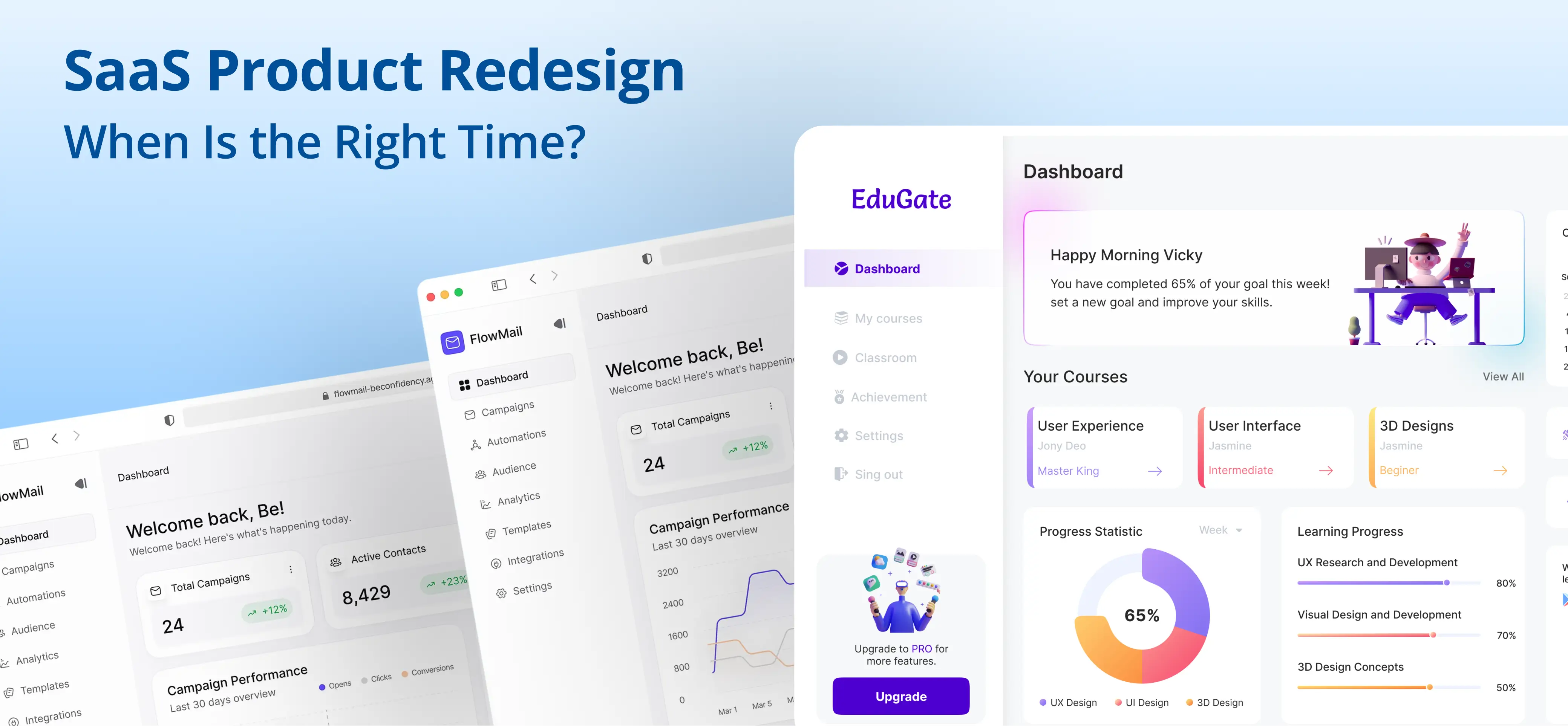
6. Your Dashboard Has Become Overwhelming
Many SaaS dashboards become cluttered as features accumulate. Users are forced to process excessive information, navigate complex layouts, and search for critical actions. Dashboard redesign projects often generate immediate improvements in usability and engagement.
7. Mobile Experience Falls Behind User Expectations
Today's users expect seamless experiences across devices. If your mobile product feels secondary or difficult to use, you risk losing engagement from an increasingly mobile-first audience.
8. Competitors Offer Better User Experiences
Competitors don't need better features to win customers. Often, a simpler, more intuitive experience is enough to shift market preference. Regular UX benchmarking helps identify gaps before they become threats.
9. Your Product Has Outgrown Its Original Design
Growth changes everything. Products designed for a small user base often struggle when serving thousands of customers, multiple user roles, and increasingly complex workflows.
10. Business Goals Have Changed
A redesign becomes essential when strategic priorities evolve. Whether you're targeting enterprise customers, entering new markets, or shifting toward product-led growth, the experience must support those objectives.
SaaS Product Redesign vs SaaS Product Refresh
Not every product requires a complete redesign. A product refresh focuses primarily on visual improvements such as updated branding, typography, colors, and interface modernization. A product redesign goes much deeper, it rethinks workflows, navigation structures, information architecture, user journeys, and strategic product experiences. The distinction is important because solving usability problems requires more than changing visual styles. Organizations that treat redesign as a strategic initiative consistently achieve stronger business outcomes than those pursuing purely aesthetic updates.
A Strategic SaaS Product Redesign Framework
Successful redesigns don't begin in design software. They begin with understanding users, business goals, and product performance.
The most effective redesign projects start with a comprehensive UX audit, followed by data analysis and user research. Insights gathered from these activities help teams identify the highest-impact opportunities.
Once problems are clearly defined, experience goals can be aligned with measurable business outcomes such as retention improvement, activation growth, and reduced support costs.
The next phase focuses on information architecture, workflow optimization, and design system creation. This ensures scalability and consistency across the product. Before development begins, prototypes should be tested with real users to validate assumptions and minimize implementation risk.
Finally, rollout strategies should prioritize incremental releases, allowing teams to gather feedback and optimize continuously. This approach reduces uncertainty while maximizing ROI.
How SaaS Product Redesign Impacts Business Growth
The strongest redesign projects produce measurable business results. Companies frequently experience improved user retention because customers can achieve their goals more efficiently. Activation rates increase as onboarding becomes clearer and more intuitive.
Feature adoption rises when users can easily discover and understand available functionality. Customer support costs decrease because common usability barriers are removed. Perhaps most importantly, conversion rates improve. When users experience value quickly and consistently, they are significantly more likely to upgrade, renew, and recommend the product to others. In many cases, redesign becomes one of the highest-return investments a SaaS company can make.
How CandyStudio Helps SaaS Companies Redesign for Growth
At CandyStudio, we believe great SaaS design is not about making products look modern. It's about creating experiences that drive measurable business outcomes.
Our redesign process combines UX audits, product strategy, user research, dashboard optimization, information architecture, design systems, and prototype validation to uncover growth opportunities hidden within the product experience.
By aligning user needs with business objectives, we help SaaS companies increase retention, improve onboarding, boost feature adoption, and create scalable experiences that support long-term growth.
Whether you're preparing for your next growth stage or modernizing an aging platform, our team helps transform complexity into clarity.
Conclusion
The best SaaS companies don't wait for growth to stall before improving their product experience. They proactively identify friction, understand user behavior, and continuously evolve their products to meet changing expectations. If your product is experiencing declining retention, onboarding challenges, low feature adoption, increasing support costs, or growing complexity, it may be time to consider a strategic redesign.
Frequently Asked Questions
1. How often should a SaaS product be redesigned?
Most SaaS products benefit from continuous optimization, with larger redesign initiatives typically occurring every 3–5 years depending on growth and market changes.
2. What is the difference between a SaaS product redesign and a SaaS product refresh?
A SaaS product refresh focuses primarily on visual updates such as branding, colors, typography, and UI improvements. A SaaS product redesign is a more strategic initiative that rethinks user flows, information architecture, workflows, navigation, and overall user experience to support business growth and customer needs.
3. Can a redesign improve SaaS retention?
Yes. By reducing friction, improving onboarding, and enhancing usability, redesigns often contribute significantly to retention improvements.
4. What are the biggest mistakes companies make during a SaaS redesign?
Common mistakes include redesigning based on assumptions instead of research, focusing only on visual changes, ignoring existing user workflows, failing to validate designs with users, and launching large-scale changes without incremental testing.
Share this blog!
Latest Blogs
Explore our latest insights on design, AI, and digital innovation.