How Design Agencies Run UX Audits That Drive Growth
Author
Vignesh
Published On
Most startups don't fail because they lack features.
They fail because users never experience the value those features provide.
Founders often invest heavily in product development, marketing campaigns, and customer acquisition, yet struggle with:
Low conversion rates
Poor onboarding completion
Low feature adoption
High churn
Weak retention metrics
When growth stalls, many teams assume they need a redesign or new features.
Experienced design agencies usually start somewhere else:
The Real-World Problem: Your Product Works But Users Still Leave
You've shipped a product. Your dev team hit every sprint. The features are live, the infrastructure is stable, and the pricing is competitive. But the numbers tell a different story.
Trial signups aren't converting. Power users aren't returning. Customer support tickets keep piling up around the same three screens. Your onboarding completion rate looks like an abandoned shopping cart.
This is the paradox that kills promising SaaS companies: a technically functional product with a broken user experience.
Consider a scenario that plays out daily across hundreds of startups: a B2B SaaS tool with a solid feature set and a free trial offer. Marketing drives traffic. Signups look healthy. But 72% of new users never return after Day 1. The founding team assumes it's a product-market fit issue. They rebuild the landing page. They tweak the pricing. They hire a growth hacker.
None of it helps because the real problem was never the marketing. It was the experience. Users arrived, got confused within 90 seconds, and left without ever discovering the core value.
That's a UX problem. And it requires a UX audit.
User Struggles and Product Friction: What's Actually Breaking Your Product
Before solving a UX problem, you have to see it clearly. Most startups can't because they're too close to their own product.
Here's what product friction looks like in the real world:
The Onboarding Black Hole
New users land on a dashboard that assumes prior knowledge. There's no guided setup. No progressive disclosure. No clear "first win." Users open the product, feel overwhelmed, and close the tab. They never return. Your activation rate flatlines.
The Feature Graveyard
Your team spent four sprints building an advanced reporting module. Usage data shows 94% of users have never opened it. Not because they don't need reports but because they can't find the feature, don't understand it from the label alone, or hit a wall the first time they tried.
The Invisible Drop-Off
Users reach the checkout page, or the upgrade screen, or the "Invite Team" prompt and they vanish. No error messages. No rage clicks. They just leave. You have no idea why. A UX audit does.
The Support Debt Loop
Your team is fielding the same 12 support questions every week. "How do I export my data?" "Where do I change my plan?" "Why did my workflow not save?" Every ticket is a signal a user who failed to accomplish something that should have been obvious.
These aren't isolated incidents. They're patterns. And patterns have root causes.
The Hidden Cost of Poor UX: What Bad Design Is Actually Costing You
Poor UX isn't an aesthetic problem. It's a revenue problem.
Revenue Loss
When users can't complete key actions upgrade, integrate, invite, checkout you lose the conversion. Multiply that friction across your monthly trial volume, and you're looking at a compounding revenue gap that no amount of paid acquisition can close.
Churn Increase
Users who struggle in their first 30 days churn at significantly higher rates. According to industry benchmarks, improving onboarding UX alone can reduce first-month churn by 20–40%. When users don't reach their "aha moment" early, they leave and they don't come back.
Acquisition Waste
You're paying to acquire users who never activate. CAC (Customer Acquisition Cost) becomes a leaky bucket when your product fails to convert trials to paid. Every dollar spent on ads, SEO, and outbound is partially wasted if the product experience doesn't do its job.
Low Activation Rates
The industry average for SaaS trial activation hovers around 20–30%. Products with strong UX regularly achieve 50–60%+. That delta is pure revenue sitting on the table and the difference is almost always the onboarding experience and the clarity of your core workflow.
Customer Support Costs
Every confused user who contacts support is a UX failure made visible. Reduce friction at the source, and you reduce support volume. One SaaS company reduced inbound support tickets by 34% after a focused UX audit and redesign of their settings and account management flow.
Why Agencies Perform UX Audits Before Redesigning Products
Here's a mistake that costs companies months and hundreds of thousands of dollars: redesigning before diagnosing.
When a SaaS team feels the pain low conversions, high churn, poor onboarding the instinct is to rebuild. New UI. New flows. New design system. Sometimes a full rebrand.
But redesigning a product without understanding why it's failing is like prescribing surgery without running tests. You might fix something. You might break something else. You almost certainly won't solve the root problem.
Design agencies perform UX audits first because:
They need to know which problems are worth solving and which are symptoms of deeper structural issues
They need baseline metrics to measure improvement against after the redesign
They need to understand user mental models before redesigning flows that clash with them
They need to prioritize because redesigning everything at once is expensive and disruptive
A UX audit is the diagnostic layer. It transforms vague complaints ("our app feels clunky") into specific, actionable findings ("users fail to complete the profile setup step because the progress indicator doesn't communicate completion criteria").
That specificity is what separates effective redesigns from expensive guesswork.
How Design Agencies Conduct UX Audits: The Process Explained
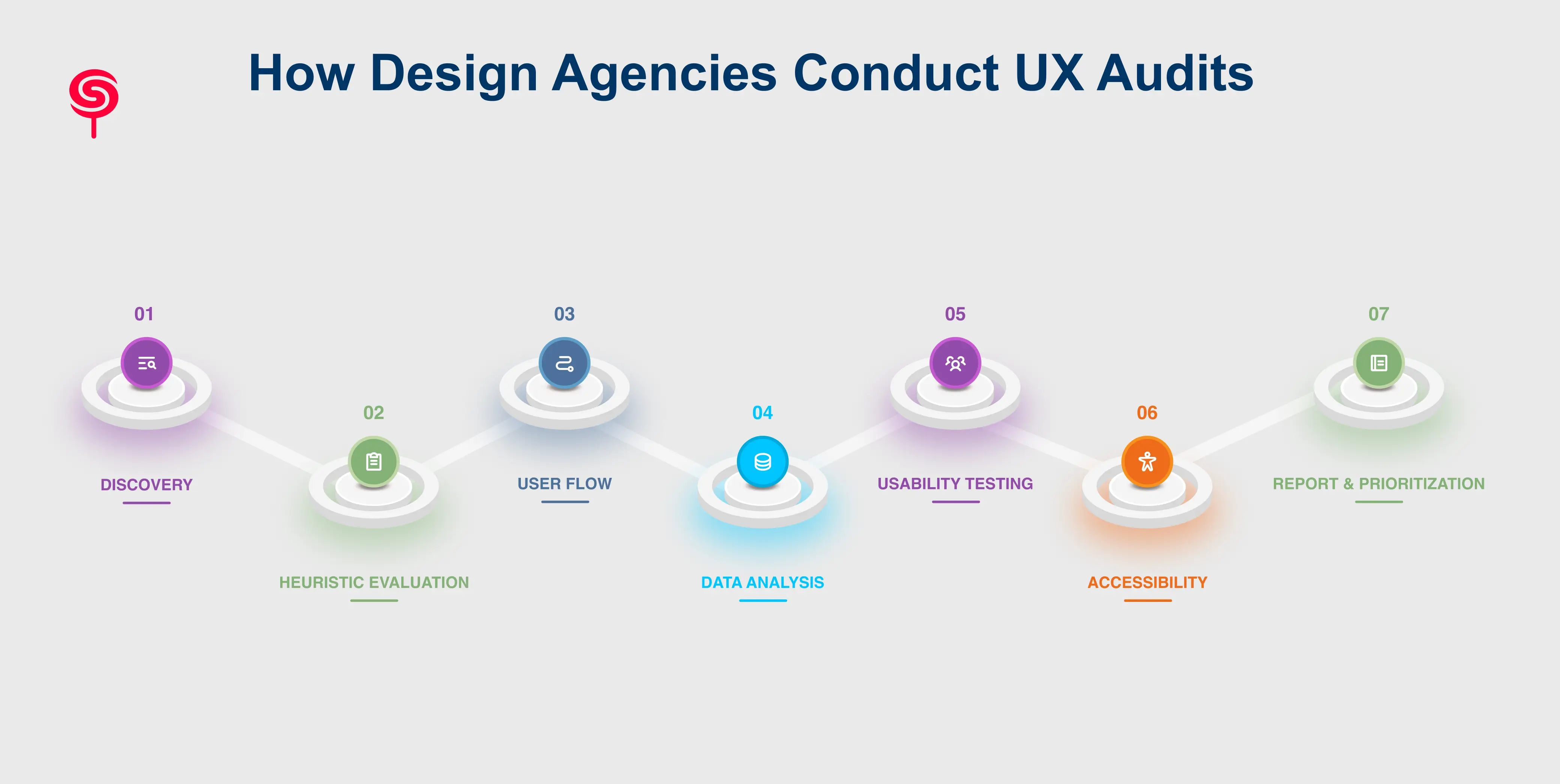
A professional UX audit isn't a checklist walkthrough. It's a structured investigation that blends qualitative insight with quantitative evidence.
Here's how experienced agencies approach it:
Step 1: Discovery and Context Setting
Before touching the product, the agency needs to understand the business. What are the primary conversion goals? Which user segments matter most? What does the product analytics data already show? This context shapes every subsequent decision in the audit.
Step 2: Heuristic Evaluation
Trained UX specialists evaluate the product against established usability heuristics frameworks like Nielsen's 10 Usability Heuristics. This surfaces interface-level problems: unclear error states, inconsistent navigation patterns, missing feedback loops, and confusing information architecture.
Step 3: User Flow Mapping
The agency traces every critical user journey from first touch to conversion signup to activation, free to paid, onboarding to first value delivery. Each step is documented and analyzed for friction, confusion points, and drop-off risk.
Step 4: Behavioral Data Analysis
Heatmaps, session recordings, funnel analytics, and click-tracking data are reviewed to validate qualitative observations. Where are users actually clicking? Where do they hesitate? What do they scroll past? Data turns hypotheses into evidence.
Step 5: Usability Testing
Real users attempt to complete defined tasks while thinking aloud. These sessions expose assumptions the team didn't know it was making interactions that feel obvious to insiders but confuse first-time users within seconds.
Step 6: Accessibility and Technical Review
The audit also evaluates accessibility compliance, mobile responsiveness, load performance, and error handling all of which affect the user experience and, in regulated industries, legal compliance.
Step 7: Findings Report and Prioritization Matrix
The audit culminates in a detailed report: a severity-ranked list of UX issues, their business impact, and recommended solutions. Issues are categorized by effort vs. impact so product teams can act immediately on quick wins while planning longer redesign work.
The UX Audit Framework Used by Agencies: A Step-by-Step Breakdown
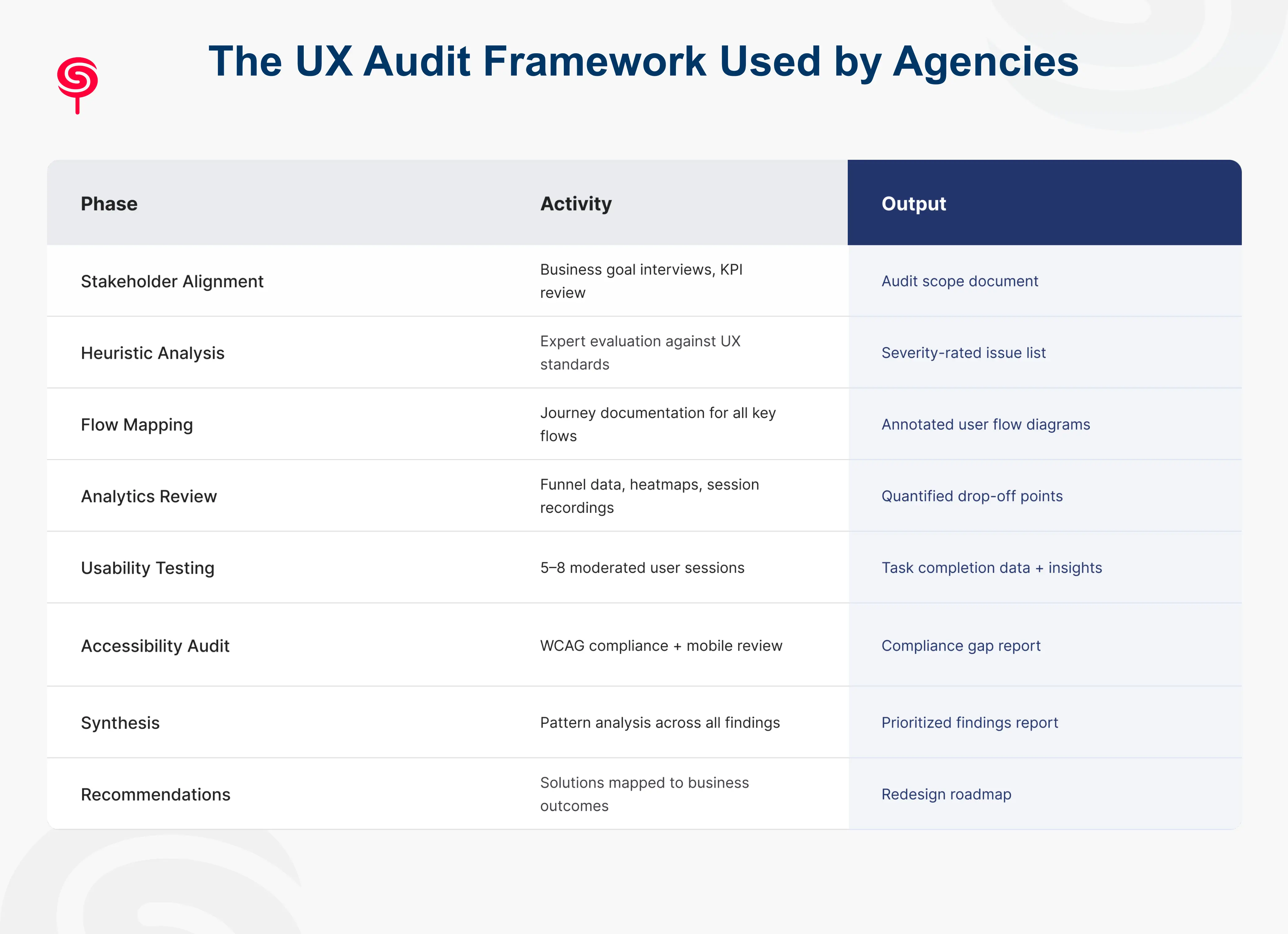
This framework ensures no finding is isolated every issue is understood in the context of the full user journey and connected to a business metric.
How UX Audits Improve Your Core Growth Metrics
The value of a UX audit isn't theoretical. It maps directly to the metrics product and growth teams care about most.
Activation Rate
By identifying exactly where users fail to reach their first meaningful value moment, agencies can redesign onboarding to guide users to activation faster. Improved activation is typically the single highest-ROI outcome of a UX audit.
User Retention
Users who successfully complete key workflows in their first session retain at dramatically higher rates. A UX audit identifies the friction preventing those early wins and creates a clear path to habitual product use.
Customer Satisfaction (CSAT/NPS)
Reducing confusion, improving error feedback, and creating intuitive flows directly improves satisfaction scores. Users who feel competent using your product become advocates.
Feature Adoption
Agencies regularly discover that underused features aren't undervalued they're undiscoverable. Audit findings often lead to navigation restructuring, contextual onboarding tooltips, and in-app education that dramatically increases feature engagement.
Conversion Rate
Whether the goal is trial-to-paid, free-to-upgrade, or visitor-to-signup, conversion optimization is a direct output of UX audit work. Removing friction from conversion moments consistently moves the needle.
Revenue Growth
All of the above compound. Higher activation × better retention × improved conversion = measurable, attributable revenue growth. Companies that invest in UX audits don't just improve their product they improve their business fundamentals.
When Your Startup Needs a UX Audit Right Now
Not every company needs a full redesign. But most growing SaaS products need an audit. Here are the signals that yours does:
High Bounce Rate: Users arrive and leave without interacting. This indicates a disconnect between what they expected and what they found a messaging or UX entry-point failure.
Low Free-Trial Conversion: If less than 25% of trial users convert to paid, your product isn't delivering its value promise within the trial window. An audit reveals where the experience is failing to build conviction.
Poor Onboarding Completion: If fewer than 50% of new users complete your onboarding flow, something is causing drop-off. An audit pinpoints exactly where and why.
Recurring User Complaints: When support tickets and NPS verbatims cluster around the same themes, that's a signal of systemic UX failure, not isolated incidents.
Feature Abandonment: High-investment features with low usage rates indicate discoverability or comprehension failures both directly addressable through UX audit findings.
Post-Funding Pressure: When you've closed a round and need to demonstrate growth metrics to your next investors, there's no faster path to improving core KPIs than a focused UX audit and targeted redesign.
Conclusion
Marketing teams optimize ads. Growth teams run A/B tests. Engineering teams ship features. But the experience connecting all of those investments the moment a user lands in your product and decides whether to stay is often left to chance.
A UX audit changes that. It brings rigorous, evidence-based analysis to the question every SaaS founder should be asking: Why aren't more users finding value in what we've built?
Design agencies that specialize in UX audits don't just find problems they build the strategic roadmap for fixing them in the order that moves your business forward fastest.
If your product has traction but your metrics don't reflect it, the answer probably isn't more features. It's a clearer, more intentional experience one that your users can actually navigate to success.
Frequently Asked Questions
1. Is a UX audit useful for early-stage startups?
Yes. Early UX improvements often produce significant gains in activation, retention, and product-market fit validation.
2. Can a UX audit help improve my SaaS conversion rate?
Yes, conversion rate improvement is one of the most consistent outcomes of a UX audit. By identifying friction in your trial-to-paid flow, onboarding experience, and key conversion moments, agencies can recommend targeted changes that directly improve conversion without requiring a full product redesign.
3. What's the difference between a UX audit and a UX redesign?
A UX audit is the diagnostic phase it identifies what's broken and why. A redesign is the solution phase it fixes what the audit found. Agencies perform audits before redesigns to ensure the redesign solves the right problems and changes are measurable against baseline data.
4.What tools are used during a UX audit?
Common tools include Google Analytics, Mixpanel, Hotjar, FullStory, customer surveys, and usability testing platforms.
Share this blog!
Latest Blogs
Explore our latest insights on design, AI, and digital innovation.