Human-Centered Design for AI Education Products
Author
Vignesh
Published On
AI education products have never had more funding, more data, or more computing power behind them and yet, most of them still lose users within the first few weeks. Founders build sophisticated recommendation engines, adaptive quizzes, and AI tutors, only to watch activation rates stall and churn quietly climb. The technology works. The experience doesn't.
This is the uncomfortable truth many AI Startup Founders, EdTech Founders, and CTOs eventually run into: a smart model does not automatically create a smart product. What separates AI education platforms that scale from the ones that plateau isn't the algorithm it's whether the product was designed around real human learning behavior. That's where Human-Centered Design for AI Education Products becomes the deciding factor, not a "nice to have."
In this article, we'll walk through why AI education products struggle despite strong technology, what Human-Centered AI Design actually looks like in practice, a step-by-step framework you can apply today, and how this thinking translates directly into retention, revenue, and investor confidence.
What Is Human-Centered Design in AI Education?
Human-centered design in AI education products is a product strategy that starts with people, not technology. It asks what students, educators, parents, and institutions need, then shapes the AI experience around those needs with empathy, validation, and iteration.
In practice, this means the product should support learning, not interrupt it. It should be understandable, accessible, and trustworthy, while making the AI’s role visible enough that users feel confident using it.
Why AI Education Products Still Struggle Despite Advanced Technology
Most AI education platforms don't fail because the AI is inaccurate, they fail because the product experience around the AI breaks trust or adds friction. A few patterns show up again and again:
Opaque personalization. When an AI tutor changes a learner's path without explanation, users feel controlled rather than supported. This is one of the most common UX mistakes in AI education apps.
Overwhelming interfaces. Founders pack in every AI feature at once chatbots, dashboards, analytics without sequencing the experience around a learner's actual cognitive load.
Generic personalization that feels wrong. If the AI's recommendations don't match a learner's real skill level or goals, the tool feels careless, not intelligent.
No feedback loop for improvement. Many teams ship an MVP, then never systematically observe how real students behave inside the product, so friction points go unresolved for months.
These issues explain why AI learning platforms lose users even when the underlying AI is genuinely well-built. This is the core reason we ask: why do students stop using AI learning apps? Almost always, it's a design and trust problem, not a technology problem.
Why Human-Centered Design Matters for AI Education Products
Education is uniquely sensitive to trust and emotional experience. Learners are often vulnerable struggling with a concept, unsure of their own ability, occasionally anxious about being "judged" by a system. An AI Learning Experience Design approach that ignores this emotional context will always underperform, no matter how accurate its models are.
Human-Centered EdTech Design matters because it directly affects:
Course completion rates learners persist when they understand and trust the system guiding them.
Retention and reduced churn friction removed early prevents silent drop-off later.
Investor and institutional confidence accessibility, ethics, and usability are increasingly part of due diligence for education technology.
Differentiation in a crowded AI EdTech market, experience quality is often the only defensible advantage.
Human-Centered Design Principles Every AI Education Startup Should Follow
Design for explainability. Every AI-driven decision a recommended lesson, a difficulty adjustment, a progress score should be understandable to the learner in plain language.
Respect learner autonomy. Let users see, question, and adjust AI recommendations rather than forcing a single "optimal" path.
Build in accessibility and inclusive design from day one. Diverse learners, abilities, and contexts must shape the product, not be retrofitted later.
Reduce cognitive load. Introduce AI features progressively rather than all at once.
Treat trust as a feature. Ethical AI Design and data transparency should be visible in the product, not buried in a privacy policy.
Validate with real users, continuously. Product Discovery and UX Research should never stop after launch.
A Human-Centered Design Framework for AI Education Products
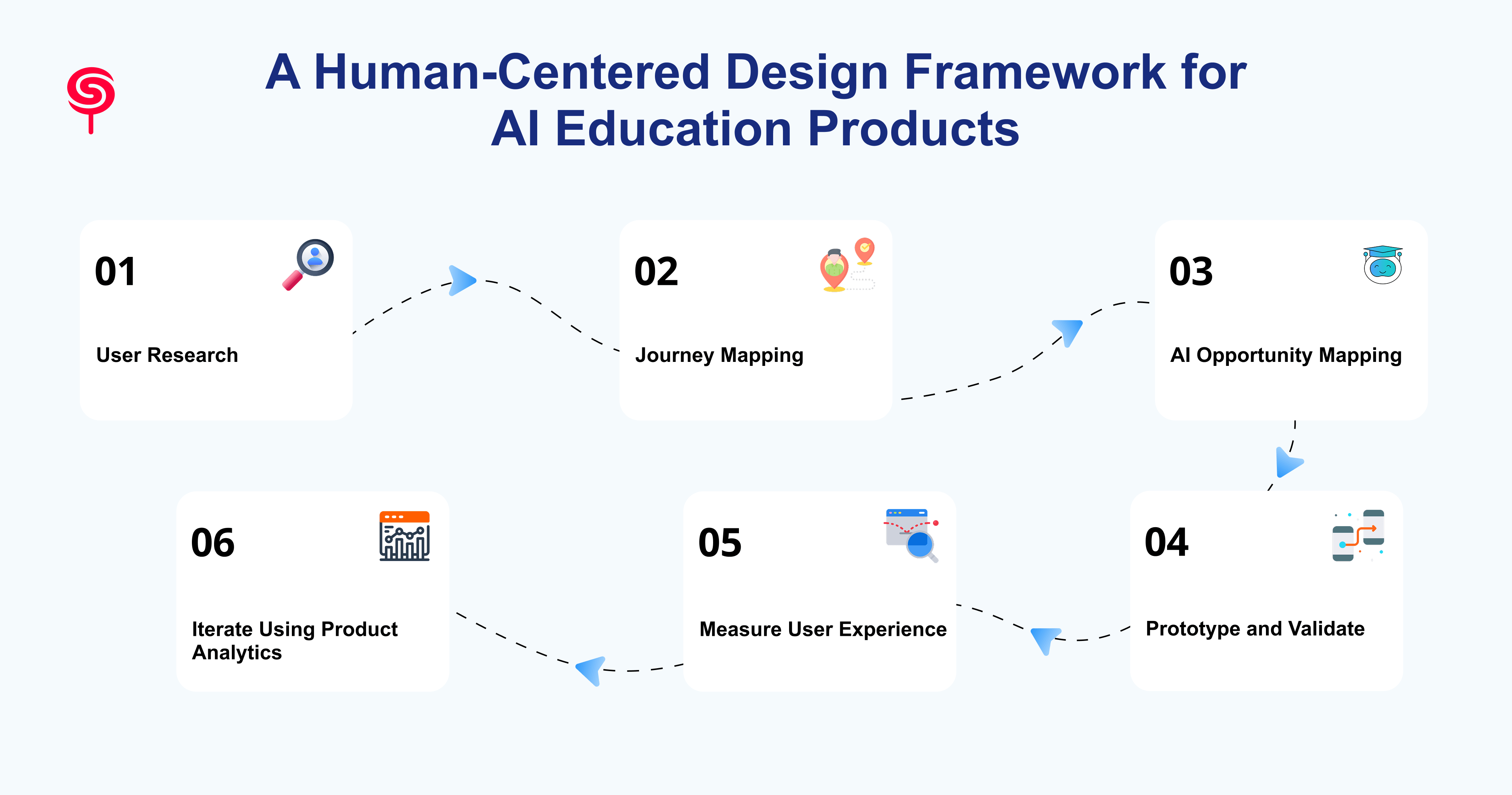
This is the practical framework CandyStudio uses when guiding AI Startup Founders and EdTech teams through a redesign or new build.
Step 1 – User Research
Start with real learners and educators, not assumptions. Interviews, contextual inquiry, and behavioral data reveal where confusion, drop-off, and mistrust actually occur the foundation of any credible UX Research effort.
Step 2 – Journey Mapping
Map the full User Journey across onboarding, daily use, and moments where AI intervenes. This surfaces exactly where Human-Centered AI Design decisions need to happen.
Step 3 – AI Opportunity Mapping
Identify where AI genuinely improves the learning experience versus where it adds complexity without value. Not every interaction needs an algorithm behind it.
Step 4 – Prototype and Validate
Build low-fidelity prototypes of AI interactions (explanations, recommendations, feedback) and test them with real users before committing engineering resources.
Step 5 – Measure User Experience
Track qualitative and quantitative signals together: task completion, trust ratings, engagement depth, and support tickets not just model accuracy metrics.
Step 6 – Iterate Using Product Analytics
Treat launch as the start of design, not the end. Use ongoing product analytics to refine AI behavior and interface decisions over time.
How Human-Centered Design Improves Business Outcomes
This isn't just a design philosophy it's a growth strategy. Teams that apply Human-Centered AI Design tend to see:
Higher activation rates, because onboarding is built around real user mental models instead of feature lists.
Lower churn, since trust and clarity reduce the silent frustration that drives cancellations.
Stronger word-of-mouth and referrals, because usable, respectful AI products are far more shareable than confusing ones.
Improved investor readiness, as responsible, well-designed AI is increasingly scrutinized in EdTech funding rounds.
The Future of AI in Personalized Learning
The future of AI in education is moving toward adaptive, personalized, and more context-aware experiences. But the winning products will not be the ones that automate everything. They will be the ones that blend AI capability with learning science, accessibility, and human judgment.
That means the next generation of AI education products will need stronger explainability, better user controls, more inclusive interfaces, and clearer outcomes. Product teams that invest in human-centered design now will be better positioned to build trust and scale in 2026 and beyond.
Real-World Examples of Human-Centered AI in Education
Real-world AI education products succeed when they solve a meaningful pain point with restraint. A good example is AI that helps teachers generate lesson support faster, but still lets them review and customize the output before sharing it with students.
Another strong pattern is inclusive AI that improves accessibility by assisting with captions, transcripts, alternative text, and interface adaptation. These features create broader reach and make the product more usable in diverse learning environments. The best products combine personalization with control, so the user feels assisted rather than replaced.
How CandyStudio Helps Startups Build Human-Centered AI Education Products
CandyStudio works as an embedded Human-Centered AI Consultant for AI Startup Founders, EdTech teams, and Product Managers who need their AI education product to actually retain and convert users not just demo well.
Our process combines UX Research, AI Opportunity Mapping, and Product Strategy into a single engagement: we audit where your AI experience is losing trust or engagement, prototype and validate fixes with real learners, and hand your team a clear, prioritized roadmap. Whether you need a full UX Audit, a product redesign, or hands-on design partnership through your next funding round, CandyStudio builds the human-centered layer that makes your AI genuinely usable and genuinely valuable.
Conclusion
Human-centered design is the difference between an AI education product that gets attention and one that gets adopted. When product teams design for real learning needs, accessibility, transparency, and trust, they build experiences that users return to and institutions are willing to buy.
For AI startups and EdTech companies, the opportunity is clear: design the learning experience around people first, and the product becomes easier to understand, easier to sell, and easier to scale.
Frequently Asked Questions
1. What is Human-Centered Design in AI Education?
Human-Centered Design (HCD) is a design approach that places learners, educators, and stakeholders at the center of every product decision. Instead of building around AI capabilities, it focuses on understanding user needs, learning behaviors, motivations, and challenges to create AI-powered education products that are intuitive, trustworthy, and effective.
2. What is Human-Centered AI?
Human-Centered AI is the practice of designing Artificial Intelligence systems that enhance human decision-making rather than replace it. It emphasizes transparency, explainability, accessibility, fairness, privacy, and user control to ensure AI supports meaningful experiences and builds user trust.
3. How does AI improve learning experiences?
AI enhances education by personalizing learning paths, recommending relevant content, adapting assessments, identifying knowledge gaps, providing intelligent tutoring, automating feedback, and helping educators monitor student progress. When combined with excellent UX, AI creates more engaging and effective learning experiences.
4. How can startups build better AI education products?
Startups can build better products by combining user research, journey mapping, prototype testing, accessibility review, and analytics-driven iteration. This ensures the product solves a real problem and fits into real workflows.
5. Why do AI learning platforms lose users?
Many platforms focus on AI technology instead of learner experience. Users often leave because they feel overwhelmed, don't understand AI-generated recommendations, struggle to navigate the platform, or fail to see meaningful learning progress. Human-Centered Design helps eliminate these friction points.
Share this blog!
Latest Blogs
Explore our latest insights on design, AI, and digital innovation.