The Strategic Role of UX Audits in Product-Led Growth
Author
Vignesh
Published On
Product-led growth (PLG) promises scalable, efficient SaaS expansion by letting the product sell itself. But many startups stall: signups grow while activation, retention, and revenue remain stubbornly low. The missing lever is often a strategically executed UX audit not a surface-level design polish, but a rigorous, outcome-focused review that ties user experience to business metrics. In this post I’ll explain why UX audits are a core growth strategy for PLG companies, common mistakes founders make, a step-by-step audit framework tailored to SaaS, real-world outcomes, and why CandyStudio is the right partner to convert UX clarity into measurable growth.
What Is Product-Led Growth?
Product-led growth is a go-to-market model where the product itself not sales calls or marketing campaigns drives acquisition, conversion, and expansion. Users try the product, experience value quickly, and convert to paying customers because the product proves its worth directly.
PLG depends on a few core mechanics working in harmony:
Fast time to value: users need to reach an "aha moment" almost immediately
Self-serve onboarding: no salesperson walks them through it
In-product upgrade paths: the product itself nudges users toward paid plans
Low-friction adoption: every extra click or confusing screen is a chance to lose someone
When these mechanics work, PLG is extraordinarily efficient. When they don't, the entire growth model collapses not because the product lacks value, but because users never experience that value long enough to notice it.
Why Startups Struggle to Achieve Product-Led Growth
Most founders assume PLG failure is a feature problem: "we need more functionality," or "our pricing is off." In reality, the more common culprit is experiential.
Common struggles include:
Onboarding that overwhelms instead of orients. New users are dropped into a dashboard with no clear next step.
Unclear activation paths. Nobody has defined what a user needs to do to reach their first value moment.
Feature bloat without hierarchy. Everything is visible, so nothing feels important.
Confusing information architecture. Users can't find what they need, so they assume it doesn't exist.
No feedback loops. Teams ship changes without ever measuring how users actually behave.
These aren't edge cases they are the default state of most growing SaaS products, because speed of shipping usually outpaces the discipline of UX validation. The result is a product that works, technically, but doesn't convert, strategically.
What Is a UX Audit? Beyond a Simple Design Review
A UX audit is often misunderstood as a cosmetic pass cleaning up buttons, aligning spacing, picking better colors. A real UX audit is closer to a business diagnostic than a design exercise.
A strategic UX audit combines:
Heuristic evaluation: assessing the interface against established usability principles
User journey audit: mapping how real users move (or get stuck) through core flows
Product analytics review: using behavioral data, not opinions, to find drop-off points
Customer journey mapping: connecting UX friction to business-stage outcomes like activation, retention, and expansion
The output isn't a redesign mockup. It's a prioritized, evidence-backed roadmap that connects specific UX issues to specific business metrics trial-to-paid conversion, feature adoption rate, churn, and customer lifetime value.
Why UX Audits Are Critical to Product-Led Growth
In a sales-led model, a skilled rep can compensate for a confusing product by explaining it. In a product-led model, there is no rep. The product has to explain itself, in real time, to a stranger who may abandon the session in seconds.
This is why UX audits matter more not less in PLG companies:
They reveal exactly where users disengage, using real behavioral evidence rather than internal assumptions
They align product design with revenue metrics like MRR growth and customer acquisition cost
They surface quick, high-leverage fixes that improve activation without a full rebuild
They protect the compounding value of PLG since every improvement to core flows benefits every future user, not just one segment
A UX audit essentially gives leadership a map of where the product experience is silently taxing growth, so investment can go toward fixing causes instead of guessing at symptoms.
Common UX Issues That Quietly Reduce SaaS Growth
Some of the most damaging UX problems are the least visible in internal demos, because teams already know how to use their own product. Frequent findings in SaaS UX audits include:
Onboarding flows that ask too much before delivering value
Ambiguous CTAs that don't tell users what happens next
Empty states with no guidance, leaving new users stranded on their first login
Inconsistent navigation patterns across the app
Mobile experiences treated as an afterthought
No clear signal of progress, so users can't tell how close they are to value
Upgrade prompts that appear at the wrong moment, creating friction instead of motivation
Individually, each issue seems minor. Together, they compound into meaningfully lower activation rates and higher churn the two metrics that quietly determine whether a PLG motion scales or stalls.
A Strategic UX Audit Framework for Product-Led Growth
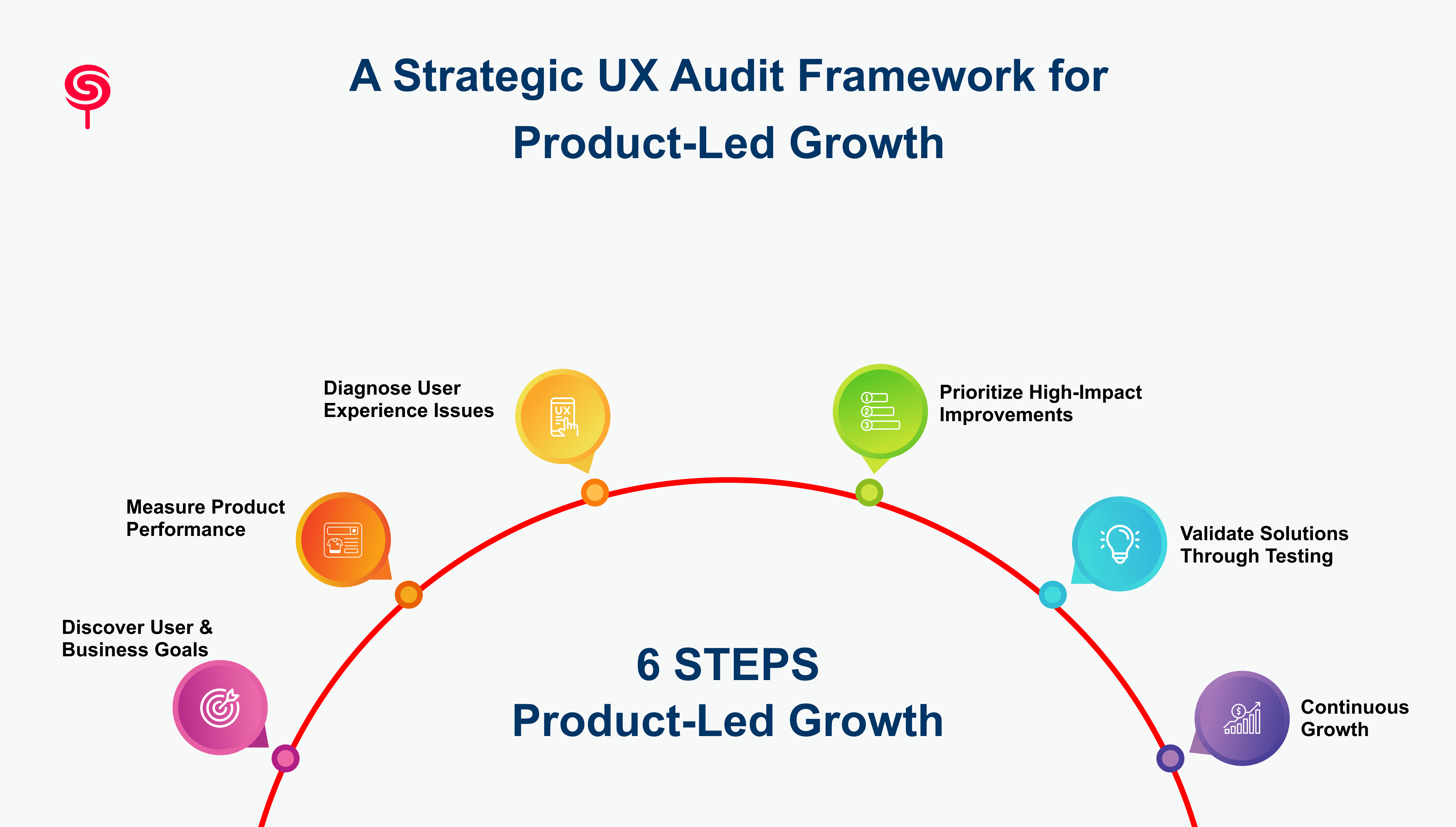
A UX audit only creates value when it follows a structured, repeatable process. Here is the six-step framework strategic teams use.
Step 1 – Discover User and Business Goals
Every audit starts by aligning on what "success" means both for users (what job are they hiring the product to do?) and for the business (what metric matters most right now: activation, retention, expansion?). Without this alignment, an audit risks optimizing for the wrong outcome.
Step 2 – Measure Product Performance
Before any subjective evaluation, the audit pulls quantitative signals: funnel drop-off points, feature adoption rates, session recordings, and product analytics. This step grounds every later recommendation in real user behavior rather than opinion.
Step 3 – Diagnose User Experience Issues
With data in hand, auditors conduct a heuristic evaluation and journey walkthrough to identify why the drop-offs are happening confusing copy, hidden features, broken flows, or misaligned expectations.
Step 4 – Prioritize High-Impact Improvements
Not every UX issue deserves equal attention. This step scores findings by potential business impact versus effort to fix, so teams tackle the highest-leverage changes first instead of getting lost in a long backlog.
Step 5 – Validate Solutions Through Testing
Recommendations are tested through usability sessions, A/B tests, or prototype validation before a full build commitment. This protects engineering time and de-risks the redesign.
Step 6 – Optimize for Continuous Growth
A UX audit isn't a one-time event. The final step establishes ongoing measurement so the team can track whether changes actually moved activation, retention, and revenue metrics, and repeat the cycle as the product evolves.
How UX Audits Directly Improve Business Metrics
Strategic UX work shows up directly on the metrics that matter to leadership and investors:
Trial-to-paid conversion improves when onboarding friction is removed
Feature adoption rate rises when key functionality is easier to discover
Customer retention improves when users consistently reach their "time to value" faster
Customer acquisition cost effectively decreases, since a better-converting product needs less paid traffic to hit the same revenue goal
Customer lifetime value and Net Promoter Score both benefit from a smoother, more intuitive ongoing experience
In short: UX audits don't just make a product feel better. They move the specific levers that determine whether a PLG business is efficient or expensive.
Real-World UX Audit Example: Turning Product Friction into Growth
Consider a common pattern seen across early-stage SaaS products: a strong free-trial signup rate, but a weak trial-to-paid conversion rate. On the surface, this looks like a pricing or sales problem.
A UX audit typically uncovers the real cause users complete signup but never reach the feature that demonstrates core value, because it's buried three steps deep in a flow built around the product's internal architecture rather than the user's mental model.
After restructuring onboarding to surface that value-generating feature within the first session, teams commonly see meaningful lifts in activation and downstream trial-to-paid conversion without changing pricing, sales process, or the product's core functionality at all. The fix wasn't more product. It was a clearer path to the product that already existed.
Why Startups Choose CandyStudio for UX Audits
CandyStudio approaches UX audits as a growth discipline, not a design deliverable. Our audits combine UX heuristic evaluation, product analytics, and customer journey mapping with a strategic lens on the metrics founders actually report to their boards activation, retention, and revenue.
What sets this apart:
A senior team that has worked across SaaS, AI products, and enterprise software, not a junior design pass
Recommendations tied explicitly to business outcomes, not aesthetic preference
A prioritized roadmap your engineering team can act on immediately, not a 40-page report that sits unread
A partnership model built around your product-led growth strategy, not a one-off engagement
For founders trying to make product-led growth actually work, CandyStudio's UX audit is designed to be the fastest path from "something feels off" to a clear, validated plan to fix it.
Conclusion
Product-Led Growth is not achieved simply by adding more features or increasing marketing investment. Sustainable growth comes from delivering experiences that help users realize value quickly, confidently, and consistently.
A strategic UX audit enables organizations to identify hidden usability issues, remove friction, improve customer journeys, and align product experiences with business goals. By combining research, analytics, usability principles, and growth strategy, companies can transform their products into powerful growth engines that increase activation, retention, and long-term revenue.
For startups, SaaS companies, and digital product teams seeking scalable growth, investing in a UX audit is not an optional design exercise it is a strategic business decision that creates measurable competitive advantage.
The strongest Product-Led Growth companies continuously improve the user experience because they understand that every interaction shapes customer perception, loyalty, and business success.
Frequently Asked Questions
1. How does a UX audit improve Product-Led Growth?
A UX audit identifies usability issues, onboarding friction, and conversion barriers that prevent users from experiencing product value quickly. Addressing these issues improves activation, adoption, retention, and recurring revenue.
2. Can a UX audit improve customer retention?
Yes. By simplifying workflows, improving onboarding, reducing friction, and enhancing usability, UX audits increase customer satisfaction and encourage long-term engagement.
3. What are the signs that your product needs a UX audit?
Warning signs include low trial-to-paid conversion despite strong signups, high early churn, low feature adoption, or internal teams disagreeing about why growth has stalled.
4. How can UX audits reduce churn?
Audits often reveal that churn stems from users never reaching their "time to value," rather than a lack of features. Fixing that path directly reduces early and mid-lifecycle churn.
Share this blog!
Latest Blogs
Explore our latest insights on design, AI, and digital innovation.